



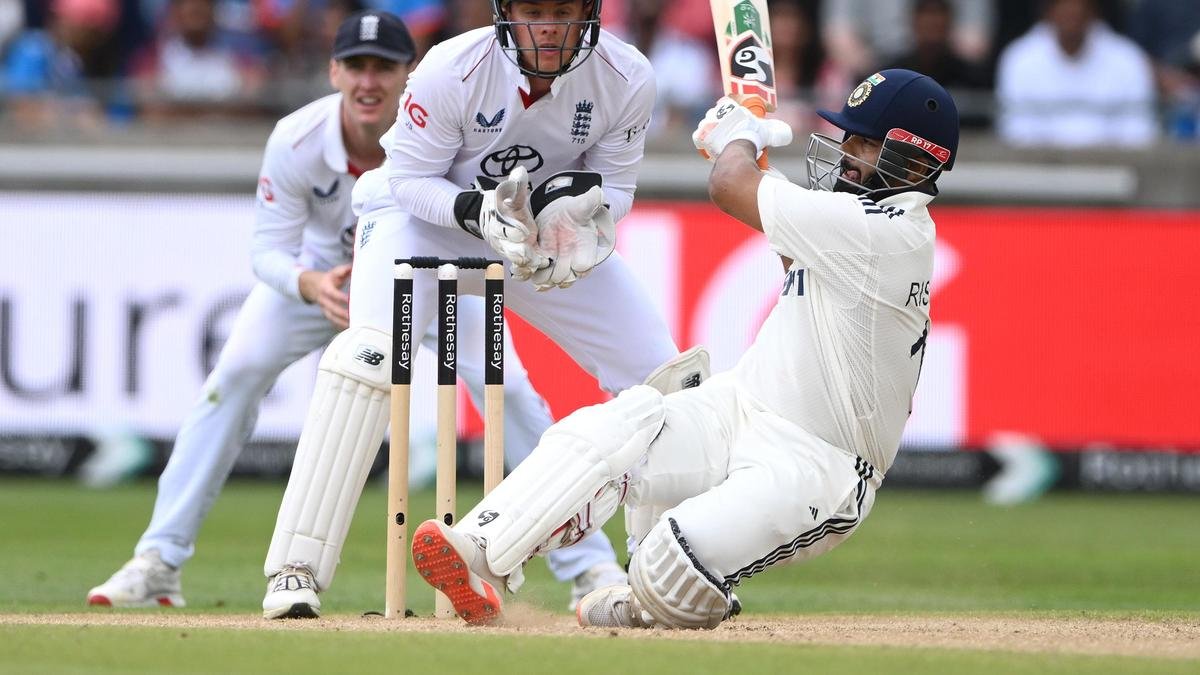
When we talk one-format India internationals in the current milieu, almost all the focus is on India’s two immediate all-format past skippers. Since May 2025, when they bid adieu to Test cricket within weeks of each other, Rohit Sharma and Virat Kohli play for the country only in One-Day Internationals, having already announced their retirement from T20Is at the conclusion of a triumphant World T20 campaign in Bridgetown in June 2024.
There has been so much talk about whether one, or both, or neither, will be present at next year’s 50-over World Cup in southern Africa that most other issues have been relegated to the background. Including the fact that there is another high-profile one-format-only international in recent times, a young man who has completed a decade in India colours but is now at a tenuous crossroads after an eminently forgettable last few months.
As India embarked on a journey of transition, replete with excitement and promise, last summer through a five-Test tour of England, it was expected that the future would be shaped by two of the most luminous gems in the Indian firmament. Shubman Gill’s elevation to the Test captaincy was no surprise, even though he didn’t have a great deal of leadership experience at the First Class level. Gill had time on his side, he was even then one of the top batters whose place wasn’t under threat, and he had shown himself to be a quick learner. Thrust into the role of his deputy was a once-fearless force of nature who had been forced by circumstances to temper his exuberance, both because of extraneous pressure and owing to the fact that, having established himself as one of the seniors within the setup, he had to strike a fine balance between carefree and careless batsmanship.
Rishabh Pant’s rise as the vice-captain of the Test side was welcomed with as much breathless anticipation as Gill’s to the captaincy. Or Pant’s arrival at the batting crease, if you like. With the chunky left-hander, you still don’t know what to expect. Or maybe you do, but even so, what he does simply blows your mind. Pant isn’t reckless; he isn’t someone who doesn’t not put a price on his wicket, though from time to time, ‘Stupid, stupid, stupid’ will surface because that’s just who he is. Successive coaches, from Ravi Shastri to Rahul Dravid to now Gautam Gambhir, have given him the licence to be himself with the rider that he should be a little more selective, a little more game-aware, a little more respectful of situations and conditions.
It might have been tough for Gambhir to reconcile, for instance, to Pant’s extravagant aerial drive to his fifth delivery, from off-spinner Ramesh Mendis, that nestled in long-off’s hands at the NCC ground on Saturday in India’s only practice game, against a Sri Lanka Cricket XI. Most other batters would have been happy to play themselves in, get some circulation going, get a feel of the conditions, prepare conservatively for the two-Test series beginning in Galle next Saturday. But Pant isn’t most people, and that’s precisely what makes him the compelling attraction in front of the stumps that he has been since his Test debut in August 2018.
Pant fell just two balls after attempting a similar stroke that fell just beyond the reach of the backtracking mid-off fielder, compelling Mendis and skipper Sonal Dinusha to push Nishan Madushka back. Perhaps in a show of bravado, or more likely because he backed himself to middle the ball turning away from him and comfortably clear the fielder, Pant went through with the stroke only to put the ball up in the air for Madushka to complete a smart grab. Two runs from five deliveries isn’t what Pant, or the leadership group of Gill and Gambhir would have hoped for, but as mentioned earlier, India have been willing to accept the trade-off because when Pant gets going, the destruction he can wreak is beyond parallel.
Pant’s dalliance with the vice-captaincy didn’t last too long, the decision-makers arriving at the conclusion that he and Indian cricket would be better off without additional responsibilities being thrust on his shoulders. In his first sojourn as Gill’s deputy, Pant was a runaway success. His batting in England, on admittedly excellent tracks for batting, was a sight for sore eyes. While Gill was wooing and wowing the connoisseurs with his correctness and his silken stroke-making on his way to 754 extraordinary runs, Pant was at his innovative, unpredictable best without compromising on consistency. In Leeds during the first Test, he became the first Indian stumper to notch up twin hundreds in England, backed it up with 25 and 65 in the series-levelling win in Birmingham, produced efforts of 74 and 9 in the Lord’s loss and won himself a few million more fans by coming out to bat with a broken foot in the first innings and making a stirring 54 in the fourth Test in Manchester.
On-field heroism
The manner in which he contracted that injury, and the events that followed as he took on-field heroism to a different level, are archetypal Pant. The 28-year-old attempted a reverse against seamer Chris Woakes and only managed to play the ball on to his foot, carried off the field as that part of his body swelled up dramatically within seconds of the impact. When he came out to bat, hobbling and unable to put any weight on his right foot, he still found enough timing and power to smack fours – and a six – as he brought up his fifty to raucous applause and walked off to warm appreciation and genuine respect from England’s fielders.
That broken foot not only ended his England tour but also kept him out of the home series against West Indies in October. By this time, Pant was clearly only in the running for Test matches. His last ODI was in August 2024, his last T20I a week before that, both in Sri Lanka in Gambhir’s first assignment as Dravid’s successor. Sanju Samson and Ishan Kishan in the shorter white-ball format, and K.L. Rahul and Kishan in the 50-over version, have surged well clear in the wicketkeeper-batter stakes, which means the only canvas available to Pant, apart from the IPL which hasn’t been his happiest hunting ground, is the five-day spectacle.
Pant’s return to Test cricket, against South Africa in Kolkata in November, was anything but auspicious as India failed to hunt down 124 on an Eden minefield. Gill’s batting efforts in that Test were restricted to just three deliveries in the first innings as he retired hurt with a neck injury, an affliction that kept him out of the second Test in Guwahati and thrust Pant into the Test skipper’s role for the first time.
Hard times
It was a disastrous initiation; Pant himself played one of the most horrendous strokes of his career, a little after lunch on day three, then oversaw a 408-run hammering – India’s heaviest by runs in Test history. A few months later came a campaign of gigantic failure in the IPL when, under Pant, Lucknow Supergiants hurtled from one misadventure to another. Even before the tournament had ended, Pant had stepped down as captain, and a few weeks later, it was confirmed that the IPL’s most expensive player would return to his original franchise, Delhi Capitals, after taking a heavy pay cut.
Pant had a reasonably fruitful outing in the one-off Test against Afghanistan in New Chandigarh in June, with a somewhat restrained 81 in his, and India’s, only innings of the game that they bossed all the way through. By then, though, he had been replaced as vice-captain by K.L. Rahul, one of the few individuals to have captained the country in all three formats, all in a stand-in capacity. It was the clearest indication that Agarkar’s panel, if no one else, believed that Pant himself and the team as a whole would be better off if he was divested of official leadership responsibilities, though given his standing in the international circuit, Pant can’t not be a leader in his own right.
Now, Pant can focus on his primary disciplines without having to attend lengthy team discussions or the distraction of being pulled in different directions, an inevitable fallout of additional role thrusts. Behind the stumps, he is unconventional and unorthodox, more Mahendra Singh Dhoni than Syed Kirmani or Nayan Mongia. In front of it, he is evidently in a league of his own. Like he showed on Sunday in Colombo, he can stonewall if so required – though even he will admit that he took it too far – and switch gears around his stonewalling without warning. It is exactly this unpredictability that makes him such an irascible force, a revolving door that can exasperate as much as it can exhilarate.
Impressive numbers
Despite the presence in the squad, and possibly in the playing XI, of Dhruv Jurel, there is not even an artificial threat to Pant’s presence in the Test scheme of things. After all, we are talking about someone who averages 43.37 from an even 50 Tests, at a jaw-dropping strike-rate of 74.05 embellished by eight centuries and 19 fifties in 87 innings. These are numbers that would do several specialist batters proud – remember that Mike Atherton and the recently retired Ajinkya Rahane both averaged less than 40 – and yet, there is more to Pant. Such as 162 catches and 16 stumpings, and the very rare ability to change the course of even Test matches with two hours of unadulterated mayhem.
Six of Pant’s eight centuries have come away from home – four in England, and one each in Australia and South Africa – though like most of the rest of his colleagues, he hasn’t played a Test match in Sri Lanka yet. In some ways, the conditions there will be strikingly similar to India, but in others, they won’t be, especially when it comes to pace off the surface. Galle from Saturday, and the SSC ground the week thereafter, will ask questions of Pant that he hasn’t been asked too often in the past, but knowing him, he will find the answers. How he uses those answers, however, will make for fun viewing, as much as how much and how freely he is allowed to use them. There is no point asking Pant to bat like Ravindra Jadeja because, well, he wouldn’t be Pant then, would he? India need the most potent version of Pant to come to the fore. Only a really brave or stupid individual will bet against that eventuating.


