






On a good day, when traffic does not clog Jammu and Kashmir’s streets and highways; or if travelling is not impaired by the movement of security forces, Pahalgam takes exactly two and a half hours from Srinagar, says Aishaq Hassan, a driver. “Stare out the window. I will play you my list of old Hindi songs even if you do not understand it,” he says, already a tad overfamiliar.
As we leave the summer capital city’s polluted streets behind, the roads begin resembling poet Agha Shahid Ali’s Postcard from Kashmir. The lines from my Class 6 text book: “This is home. And this the closest I’ll ever be to home. When I return, the colours won’t be so brilliant, the Jhelum’s waters so clean, so ultramarine. My love so overexposed,” echo out of the blue. My lungs adjust to the crisp air from the sturdy grey mountains speckled with snow. There are acres of apple trees, and chinars with trunks thick as walls.
“I’m a poet too, you know,” Aishaq says, prattling off lines in Urdu that sound like dense couplets. I nod the ‘super’ sign to him. “Leave it, you won’t understand,” he says, and then stops where the river Lidder appears. “We are getting close,” he adds.
At the Lidder Valley Golf Course
| Photo Credit:
Special Arrangement
Following the mule
To get to Pahalgam by road, tourists must pass through Pampore, where purple saffron blooms between October and November; and through Sangam, where stacks of willow mimic chic hutments. If you are lucky, someone like Aishaq will insist that you drink kahwa laden with powdered almonds from Pampore because the saffron is best there — fresh red stigma that turns a rich orange-yellow with water. Your luck is not likely to run dry in Kashmir as a tourist though. Every turn is a journey, every bend, a stream of thought and otherwise.
“There is grave misconception about Kashmir,” says Nazir Ahmed, resident manager, Pine and Peak, a property of Welcomhotel By ITC Hotels in Pahalgam. One year ago, Nazir was one of several hundred locals from Pahalgam sheltering stranded tourists with no way out of the town after a terror attack. On April 21, 2025, militants unleashed brutal violence in the region’s picturesque Baisaran valley, full of rolling green meadows, killing 26 tourists. Videos from the incident, particularly of a man on a zip line capturing the carnage, were played over and over by Indian news channels with a barrage of exaggerated animations.
A tourist on a zipline
| Photo Credit:
Special Arrangement
“We heard shots sometime in the afternoon coming from somewhere uphill. Baisaran is only a six kilometre trek from the property. We instantly knew it was firing. We are familiar with the sound of bullets. My boss called up the police station. That is when we knew that it was something major. Us drivers went rushing to Baisaran but also to Pahalgam’s top A-B-C tourist spots — Aru, Betaab, and Chandanwadi valleys — to gather everyone. It was a horrific day that I hope we never relive,” says Jahangeer Ahmad Shah, a driver.
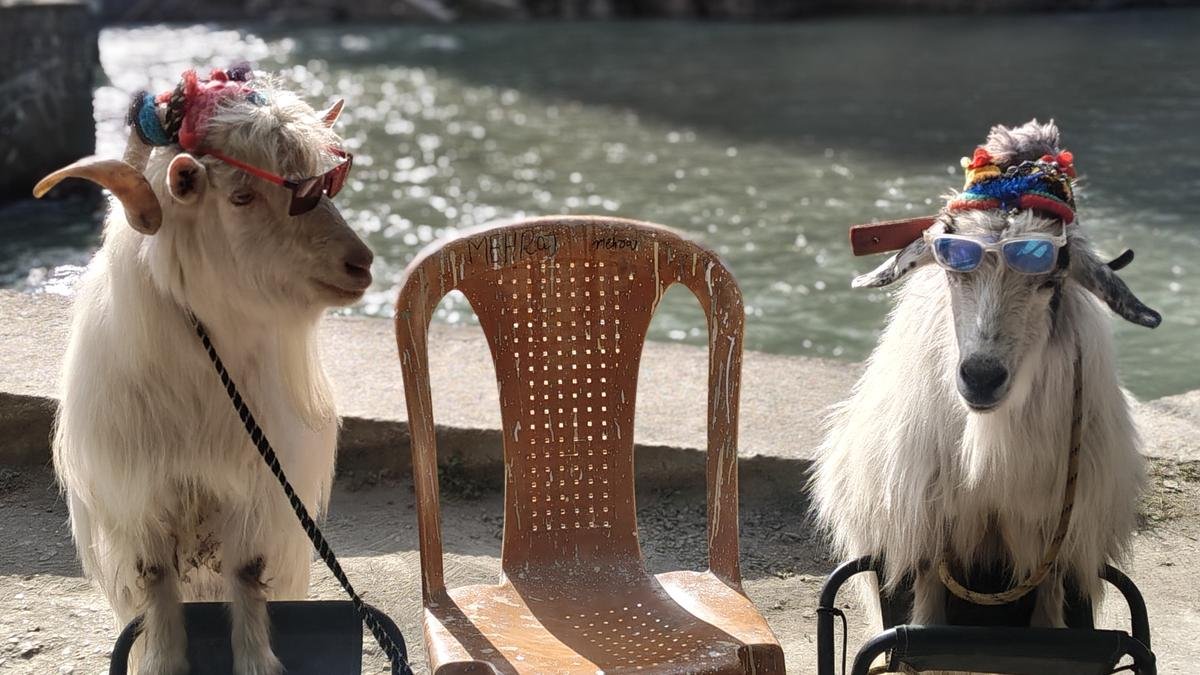
Except when the entire valley was shut down during the height of militancy in the 1990s and early 2000s, Pahalgam has always been considered safe. For years now, the destination has been viewed as an essential part of the Kashmir itinerary. A definite day-trip to the tourist spots where able-bodied people are transported on comical looking coloured sleds, and goats are made to wear sunglasses and pompoms, is guaranteed.
My job as a journalist is to use words to describe people, places, and things. But I find myself scrambling for words to describe Pahalgam. I wish I could play you a sound recording of a whistling thrush singing as water flows through rocks and crevices in the Lidder’s path. The hill station, full of trees, takes on a most beautiful serenity. Life here is meant to be lived in a slow, sensible manner. Words can take time. Sometimes even years, to get right.
Kahwa with freshly baked bread
| Photo Credit:
Special Arrangement
In the last year though, Pahalgam’s main markets, once overrun by tourists especially during peak season all the way from April to December, were used for playing cricket, says Muzaffer Raina, a caddy at Lidder valley golf course. While sitting on perfectly manicured grass amidst dandelion flowers that look frail, Muzaffer says that it is a heartening sign to see A-B-C fill up again this summer. While Baisaran valley and a number of treks from the region have been disallowed due to security reasons, tourists from across the country seem to be flocking the region, getting their share of ‘Pahadi Maggi’, even though it was never really a thing in Kashmir until after the pandemic. “Things are looking up for us but not entirely yet. Pahalgam survives on tourism. The hope is for things to settle quickly,” he says.
Over an elaborate wazwan, a thali of many different mutton dishes including the rogan josh, and delicious fresh saag, Nazir Ahmad at Pine and Peak, says that occupancy is currently hitting about 60% in hotels across the valley. This is a good sign, especially because it means that more people are staying at the destination rather than considering it a day trip. Javed Burza, president, Pahalgam Hotels and Owners Association (PHOA), agrees, adding that the price of rooms in hotels at Pahalgam range from ₹1,000 to ₹30,000 a night, based on the requirement of various customers. “Things may be looking up but prejudice is yet to change,” he says.
Tourists on sleds
| Photo Credit:
Special Arrangement
Shabir Malik, a pony rider and tour guide, says that although the pony riders were the first to aid with rescue before the Army arrived, the discrimination against them has been indiscriminate. For six months after the incident, they had to present themselves at Pahalgam’s police station twice a day. “One customer told me three times ‘You’re going to take me somewhere and shoot me’. What can you do when this is someone’s sense of humour. All I am here to do is my job,” Shabir says.
Dishes prepared for a wedding feast wazwan are laid out before being served in Srinagar.
| Photo Credit:
NISSAR AHMAD
It is why places like Pine and Peak are packaging experiences where one meets locals, samples cuisine from the region, and picnics in spots only known to those who share secrets with trees. “All we can hope for after this, is the best,” Nazir says.
At Betab Valley, I meet a young veterinary student from Mumbai who is pouting for photos with her two friends. Behind her, are the mountains, still holding onto resplendent white snow. She speaks for 15 minutes and then asks me to not quote her by name. “My friends were joking around that I was going to be shot. Just to be prepared, I asked my Muslim friends to teach me some verses of the Quran. Upon coming here though, I must admit that every Kashmiri person has been nothing but friendly. It has made me resist the idea of an ‘us’ and ‘them’,” she says.
A fancy looking goat at Betaab valley
| Photo Credit:
Special Arrangement
In a valley mired by multiplicities — self-determination, Internet shutdowns, magical mountains, cashmere, and tandoors full of freshly baked bread — Kashmir succeeds evidently in its kindness. A reductionist take but advice for you nevertheless: Leave prejudice at the door and sip on some kahwa instead.
The heavens afterall beckon the kind.
The writer was in Pahalgam on invitation of Welcomhotel By ITC Hotels Pine N Peak, Pahalgam.
How to head to Welcomhotel By ITC Hotels Pine N Peak, Pahalgam
Pine N Peak hotel that was started in the late 1980s, and taken over by the ITC group in 2017. They offer treks, fishing expeditions, picnic, and village walks to understand Pahalgam and the geography better. Best way to reach Pahalgam is by road. It takes about three hours from Srinagar.


