






Rod Laver in tennis is like Don Bradman in cricket. The famed left-hander is the only player to have achieved the Grand Slam — the herculean feat of winning all four Majors in a single year — twice. It’s like Bradman’s astronomical average of 99.94, a measure of greatness unlikely to be emulated or surpassed in a million years.
In 2017, when the inaugural Laver Cup was held in Prague, it seemed like the perfect honour for the legendary Aussie. Modelled on golf’s Ryder Cup, the biennial competition with a 100-year history that pits Europe against the United States of America, the Laver Cup broadened the scope — in line with tennis’ global footprint — to bring Europe face to face with the World.
Federer’s brainchild
That the tournament was the brainchild of Roger Federer, the winner of 20 Slam titles, gave it enormous legitimacy. The elegant Swiss has often been spoken of as the ‘GOAT’ (Greatest of All Time), and for him to celebrate and immortalise Laver was the ultimate acknowledgement of who stood at the sport’s zenith.
Nine years since that festive September weekend, where does the Laver Cup stand and what does it bring to tennis? Has the association with two of tennis’ greatest champions helped it acquire an exalted status?
Split identity: For all the grandeur, there is an unmistakable feeling that the Laver Cup straddles the division between exhibition and hard-nosed competition.
| Photo Credit:
Getty Images
At the outset, it has all the ingredients that make any modern-day sporting extravaganza tick — participation from the elite (the three highest-ranked players from each region are automatic picks); eye-popping prize money (appearance fee and a $250,000 bonanza for each of the six players in the winning team); a weekend window without competing big-ticket competitions in a calendar that is bursting at the seams.
For the first seven editions, Europe and World were captained by icons Bjorn Borg and John McEnroe, and saw wholesome participation from Federer, Rafael Nadal, Novak Djokovic and Andy Murray, who collectively won an astonishing 69 Majors from 2003 to 2023. Since then, the captaincy has moved on to Yannick Noah and Andre Agassi, and the cream of the present era, led by the irresistible Carlos Alcaraz, has embraced it too.
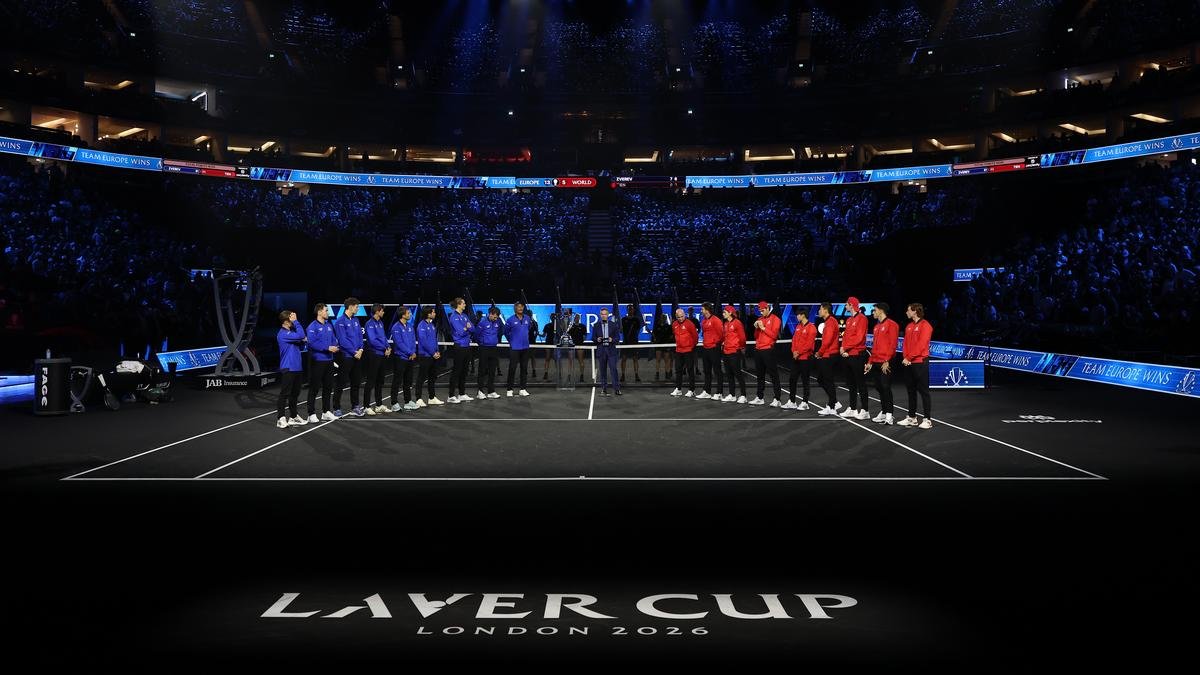
If the signature black tennis court makes the Laver Cup a tournament apart, the concert-like setting with dark-arena lighting imparts a posh, cinematic look. It showcases both singles and doubles, and has adopted a format that ensures that the tie is alive on all three days.
It helps that tennis, one of the foremost individual sports, has incrementally warmed to team events, ensuring that the idea of the collective isn’t limited to just the more-than-a-century-old Davis Cup.
The sense of camaraderie championships like the United Cup — the season-opening joint-venture between ATP, WTA and Tennis Australia — and the Laver Cup evoke, and the tactical back and forth between a star-studded bench and players on court, have made for great viewing.
“I never cared more than winning this one,” proclaimed World No. 22 Alexander Bublik, who played the 2026 Laver Cup in London two weeks ago. “I never cared as much in a quarterfinal of a Slam than the doubles that I played [here].”
That Federer brought the curtains down on his storied career at a Laver Cup doubles fixture in 2022 alongside Nadal says it all. Federer and Nadal faced each other 40 times in one of tennis’ greatest rivalries. But little would anyone have imagined that their final act would be one of brotherhood, sitting side by side, holding each other’s hands, and sobbing uncontrollably.
Part organic, part pretentious
Yet, for all the grandeur and the theatre, there is an unmistakable feeling that the Laver Cup is straddling the division between a tennis exhibition and a hard-nosed competition. Part of the bonhomie appears organic, but it is also pretentious.
Davis Cup, tennis’ premier team championship, is replete with tales of polar opposites featuring in the team for a common cause. The most high-profile example is of the United States team that reached the final in 1984 under the captaincy of Arthur Ashe wherein McEnroe and Jimmy Connors went the whole campaign without speaking to each other.
In contrast, the Laver Cup looks like a pageant. “Players talk in a more friendly way,” Casper Ruud told The Athletic in 2024. “You can actually get to know your competitors. Daniil [Medvedev] is a father and we can talk about his family and how it is to be a father. Sometimes I forget that we are normal people as well.”
There are contradictions galore. The Laver Cup and men’s professional tennis’ governing body ATP have been partners since 2019, even allowing matches at the event to be counted in players’ head-to-head records. But without any ranking points, the Laver Cup is also uncoupled from the pulls and pressures of the rest of the Tour.
The grant of official status is in itself debatable, for matches in the Laver Cup aren’t full-fledged contests, with the third set just a 10-point tie-breaker. The scoring system — one point for a win on Friday, two on Saturday, and three on Sunday, with 13 required to lift the trophy — is a masterclass in manufacturing stakes.
When Federer was still an active member of the Tour, there persisted an awkward situation where a player expected to be treated on par with the others by the ATP had a business relationship with that very body. Tennis Australia, which conducts the Australian Open, was one of the original investors in the Laver Cup, another potential conflict of interest involving Federer.
Superstar on board: The tournament is of the stars, by the stars and for the stars — and Carlos Alcaraz, the cream of the present era, has embraced it.
| Photo Credit:
Getty Images
There is no question that the Laver Cup is of the stars, by the stars and for the stars. Will this continue as the tennis world transitions from the era of Federer, Nadal and Djokovic to that of Alcaraz, Jannik Sinner and Alexander Zverev?
Alcaraz is no doubt a big draw, as seen in the way he has electrified the setting in the past three editions. But Sinner hasn’t befriended the tournament yet, and but for Zverev’s ascent this year, the tennis universe outside of Alcaraz and Sinner has seemed hollow.
Too many hats? The Laver Cup faced a potential conflict of interest situation when co-founder Roger Federer was an active player.
| Photo Credit:
Getty Images
It is also a question of sporting purity. The Ryder Cup famously doesn’t award prize money, and still Rory McIlroy, the six-time Major winner, once proudly said that he would “personally pay for the privilege to play”.
“We’ll never get rid of that gap [with the Ryder Cup],” Tony Godsick, Federer’s long-standing agent who co-founded the Laver Cup, told The Athletic in 2024. “We invest in the brand for the players, for the sponsors, for the fans, for the media.”
Survival of the fittest
The Laver Cup’s aspirational zeal has taken root at a time when tennis governance is splintered. With all four Grand Slams, and governing bodies in ATP, WTA and World Tennis (erstwhile International Tennis Federation), each having a product to shoehorn into a finite calendar, it is about the survival of the fittest.
“There could be too many other tennis events, but this one is working,” insisted Godsick. “We have sold-out crowds, the biggest captains, the best sponsors. Every player loves to play. So the question is: Is there too much Laver Cup? No. I think there is not enough Laver Cup.”
Laver was — and is — a man of quiet confidence. The Laver Cup is evidently not. Success has been carefully engineered. But for how long?


