



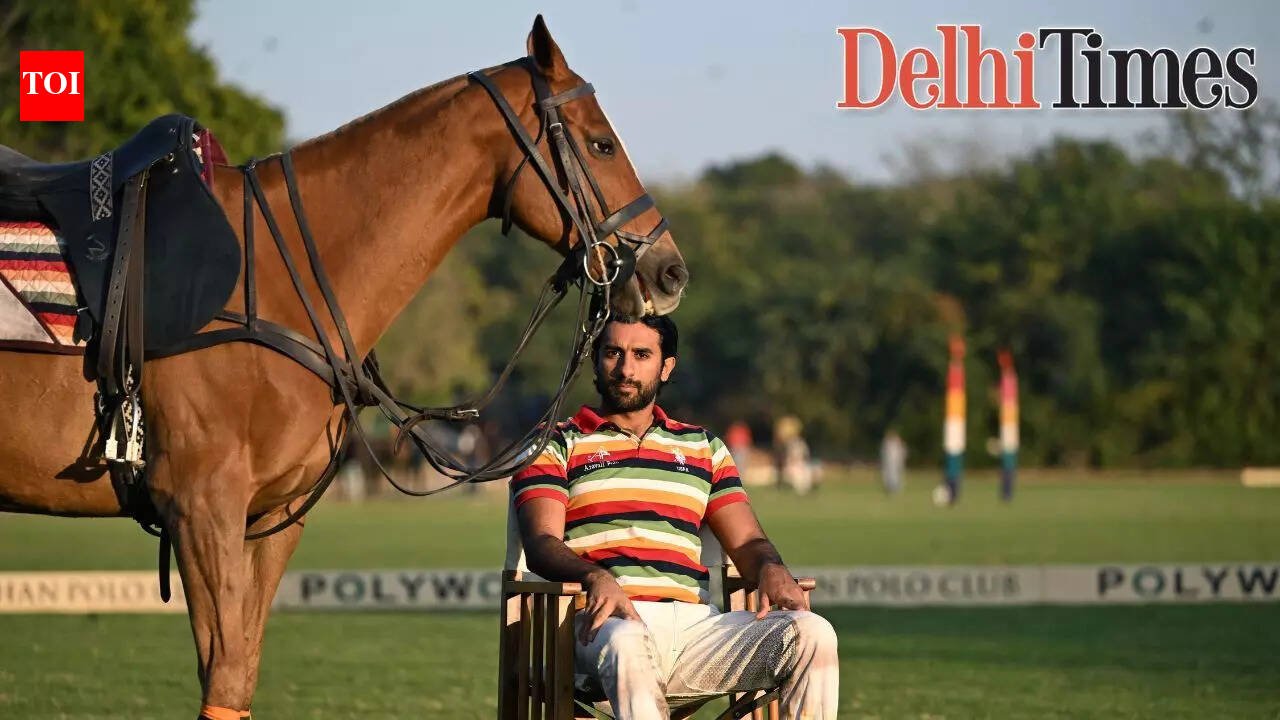
After an intense match at the Rajasthan Polo Club – a ground he grew up on – Padmanabh Singh poses for selfies as people gather outside his tent. The sun dips into shades of pink; horses are being bathed while others rest in nearby stables. Still in his team’s colours, unexpectedly paired with traditional Rajasthani juttis , he finally sits down to talk about the two things that matter most to him: polo and Jaipur. For Padmanabh Singh, the great-grandson of Maharaja Man Singh II and heir to Jaipur’s storied City Palace, the game is more than inherited legacy – it is memory, identity, and victories and defeats that are entirely his own. The Jaipur royal reflects on memorable days at the Rajasthan Polo Club, the city’s relationship with polo and fashion, and the legacy he hopes to leave.
The first time I won the Sirmour Cup (my grandmother’s family presented it to the polo club in Jaipur to mark her marriage to my grandfather), there was a crowd of a few thousand people and they lifted me up on their shoulders and carried me around for the prize ceremony.
Padmanabh Singh
“It’s a special place for me. I’ve grown up here. I’ve spent hours riding, playing with my horses, watching polo. I’ve spent some memorable moments of my life here,” Padmanabh tells us. He recalls some of his most cherished memories here, “Primarily, some of my most memorable polo wins. I remember when I started playing maybe 15 years ago, if not more, winning some high goal tournaments. The first time I won the Sirmour Cup (my grandmother’s family presented it to the polo club in Jaipur to mark her marriage to my grandfather), there was a crowd of a few thousand people and they lifted me up on their shoulders and carried me around for the prize ceremony. It shows the passion that people have for the sport in our city, the history we’ve had with the sport, the incredible players that the city has given to polo, the great Sawai Man Singh being obviously at the forefront of that.”
For Padmanabh Singh, the great-grandson of Maharaja Man Singh II and heir to Jaipur’s storied City Palace, the game is more than inherited legacy – it is memory
I associate Jaipur with my family. And when I’m on a horse, looking back on my relatively short career of about 15 years, all my achievements are mine. They’re things I’ve had to work hard for. On the polo field, you’re just yourself with the horse and seven other players; nobody cares who you are, where you come from, or what weight you carry.
Padmanabh Singh
‘I associate Jaipur with my family’And what does the sport mean to him now? “Well, I work a lot and I have other interests,” quips the royal, adding, “I’m involved with various verticals of our family’s interests. But of all the things I’m involved with, the two that give me the most happiness are Jaipur – everything I do that somehow helps Jaipur – and the sport of polo. These are the two things that make my heart beat. I associate Jaipur with my family. And when I’m on a horse, looking back on my relatively short career of about 15 years, all my achievements are mine. They’re things I’ve had to work hard for. On the polo field, you’re just yourself with the horse and seven other players; nobody cares who you are, where you come from, or what weight you carry. In that sense, all my achievements in polo – however small they may be – feel very personal, and I’m proud of them. The fulfilment, satisfaction and joy I get from being on a horse playing polo… few things in my life come close to that.”
Pacho, as Padmanabh is known to friends and his large following on Instagram, says polo is often seen as more than a sport – an occasion for people to dress up and turn the match into an event.
There’s a misconception that polo isn’t accessible, and that’s absolutely untrue. In cities with a history of polo – especially Jaipur, Delhi, and Bombay – there are riding and polo schools. You can learn to ride and play polo at subsidised rates, and even play alongside some of us professionals.
Padmanabh Singh
‘There’s a misconception that polo is not accessible’Pacho, as Padmanabh is known to friends and his large following on Instagram, says polo is often seen as more than a sport – an occasion for people to dress up and turn the match into an event. He’s quick to add, “We don’t mind that at all – it’s lovely to be the excuse that allows people to have a good time. But I’d really like them to understand some of the rules of our sport – it makes for better viewing. There’s a misconception that polo isn’t accessible, and that’s absolutely untrue. In cities with a history of polo – especially Jaipur, Delhi, and Bombay – there are riding and polo schools. You can learn to ride and play polo at subsidised rates, and even play alongside some of us professionals. I think a lot of people haven’t moved past that supposed entry barrier, and I hope through your platform I’m able to communicate that it’s actually incorrect.”‘You don’t have to abandon your traditions to start new ones’On the legacy he wants to leave for the next generation, Padmanabh says, “I want Jaipur to be a city that respects its past and then carefully, steadily, but swiftly moves into the future – to be in the present, live in the present, anticipate the future, and be there before anybody else gets there. But that can be done with respect for your past. In simple, tangible terms, you don’t need to destroy a building to make a new AI center – repurpose it, adapt it, reuse it. Similarly, you don’t have to abandon your traditions to start new ones. The two can coexist.”The royal stresses, “Now that I’m 27, I’d like to inspire young people, or at least communicate to them, to look at these things.You matter. You matter the most. If companies, politicians, industries and institutions don’t care what you have to say, they’re going to be in a lot of trouble in five years’ time. We are the now, but we are also the future… and the onus is on us. It’s important sometimes for somebody else to tell you that.”
Padmanabh, who grew up in a house surrounded by polo memoribilia, says, “Polo is inescapable in my family and, in a certain sense, in Jaipur too.”
My father, Narendra Singh, played, as did my grandfather and my nana, Bhawani Singh. I’m maybe the fifth or sixth generation of players in my family
Padmanabh Singh
‘I’m the 5th or 6th generation of polo players in my family’Padmanabh, who grew up in a house surrounded by polo memoribilia, says, “Polo is inescapable in my family and, in a certain sense, in Jaipur too.” “The ground sits right in the middle of the city, we have a very long season, and thousands of people come and interact with the sport. It’s almost a household sport in our city, so I was always surrounded by it and it felt inevitable that one day I would take to it. My father, Narendra Singh, played, as did my grandfather and my nana, Bhawani Singh. I’m maybe the fifth or sixth generation of players in my family,” he says, adding, “But interestingly, it wasn’t until I went to Mayo College that I actually started playing. Jaipur obviously inspired me, but it was only after I went away to boarding school that I took it up myself.”‘I treat my horses with respect, but try not to get attached’Padmanabh says he tries not to grow too attached to the horses. “They don’t have long careers – maybe five or six years, if you’re lucky. Sometimes you play on 12 horses. When you lose a horse, or one breaks a leg or gets too old to play, you don’t want it to become an emotional situation. I treat them with respect, but try not to get personally attached. At the same time, I’m a lover of horses. I love them as animals – they are some of the most beautiful creatures in the world. The sacrifices they make on the field, the beats they take to get us to the ball, make space for us, or ride another player off – it’s like asking them to go into a wall, and they do it blindly for you. I’m extremely thankful to have them in my life.” Relying on another animal is a beautiful thing, he says, adding, “You have to try your best to understand how the horse is feeling. It teaches you care, patience, and the importance of teamwork. I deeply appreciate all the horses I’ve had, and I hope to continue working with them, because they are one of the most important contributors to success in our sport.”‘Polo has seen a resurgence in the past four to five years’The best era for polo in our country was the 1930s, ’40s, ’50s and even the ’60s, the royal believes. “Polo saw a bit of a dip after that in the ’70s, ’80s and ’90s, but it has been on the rise again. Over the last four or five years in particular, the sport has seen significant growth. There are more players, horses, teams, sponsors and overall visibility,” he says.“We play as the Jaipur team, in the colours of Jaipur,” Padmanabh tells us with pride, adding, “Many people have memories tied to this team and have watched iconic games being played here. Those stories still exist, and people recount them to their children and grandchildren. Historically, polo has also served purposes beyond sport. If you go back to the time of Sawai Man Singh II, when he was Rajpramukh, polo was used as an occasion for diplomacy. From that to today being a tool to promote tourism, it remains one of those unique sports whose byproducts have often had a positive impact on people.”


