






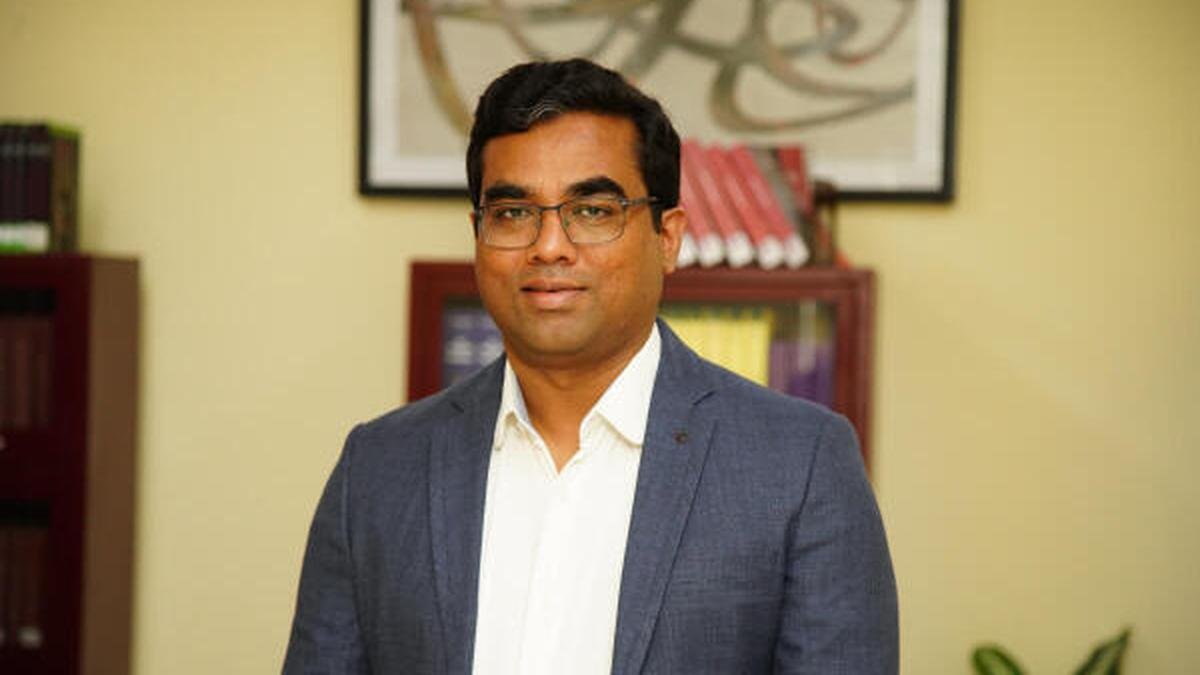
The 2026 Ramanujan Prize has been awarded to Mahesh Kakde, Professor, Department of Mathematics, Indian Institute of Science (IISc), for his contribution to algebraic number theory. It honours Prof. Kakde’s fundamental work on non-commutative Iwasawa theory and his outstanding research on the Gross-Stark and Brumer-Stark conjectures, with implications for Hilbert’s 12th problem — one of the 23 renowned and unsolved problems posed by David Hilbert in 1900. He is the fifth Indian to receive this award.
(Sign up for THEdge, The Hindu’s weekly education newsletter.)
Each year, the Ramanujan Prize is awarded to a young mathematician from a developing country jointly by the International Centre for Theoretical Physics (ICTP) and the International Mathematical Union (IMU) in honour of the Indian mathematical genius Srinivasa Ramanujan.
Born in 1983 in Akola, Maharashtra, Prof. Kakde knew from childhood that mathematics was his calling. He fondly recalls being motivated to solve problems, especially after an older cousin told him, “Maths is hard.” He would also solve problems from mathematics textbooks even before the corresponding topics were covered in school. “I realised that you don’t need to know a lot of things to start doing mathematics as long as you understand some definitions. That aspect of mathematics just attracted me—that you could start doing it without knowing a lot.” Prof. Kakde said.
In Class 10, he attended a mathematics workshop for high school teachers, led by a local professor. He remembers being fascinated by concepts that went beyond his math textbook. He later met the professor, who encouraged him to aim for the Math Olympiads and also gifted him relevant textbooks. The textbooks included the authors’ addresses, prompting Prof. Kakde to write to them and seek guidance in choosing maths as an academic option.
“One of the authors replied, suggesting I should pursue mathematics. He recommended I explore a place called Chennai Mathematical Institute,” recalled Prof. Kakde. Through networking, he also learned about the Indian Statistical Institute (ISI) in Bengaluru. He received a Bachelor’s in mathematics from ISI, becoming only the second in his family to complete university education.
With a profound interest in number theory, he went on to do a Certificate of Advanced Study in Mathematics (CASM Part III) and further pursued a Ph.D. at the University of Cambridge under the supervision of Professor John Coates. He previously taught mathematics at Princeton University and served as a reader at King’s College, London.
He joined the Indian Institute of Science (IISc) in 2019, where he has worked ever since, mainly on classical and non-commutative Iwasawa theory and Stark’s conjectures. He considers IISc a fantastic place that provides a conducive environment, particularly with a reasonable administrative and teaching load, supportive colleagues, and ample time for research and research visits to different places.
Prof. Kakde has received several prestigious awards and honours, including the 2022 Infosys Prize in Mathematics and the 2023 Whitehead Prize by the London Mathematical Society.
His work is directly influenced by Srinivasa Ramanujan’s work on modular forms, which has been quite influential in number theory. He further explains that modular forms act as a crucial bridge between analytic and algebraic mathematical objects in his field. “I think there’s hardly anything in algebraic number theory that hasn’t been influenced by modular forms. My work in non-commutative Iwasawa theory and Stark’s conjecture uses these congruences a lot,” Prof. Kakde said.
India has a rich history of mathematicians who have contributed to the field, spanning the period before and after Ramanujan. Prof. Kakde explains that after independence, mathematics education and research were mainly concentrated in fewer centres. However, the past 25 years have seen an expansion in mathematics with the inception of several institutes such as IITs and IISERs. Despite this, the number of institutes remains small for the size and population of India compared to Europe. He calls it a “chicken-and-egg problem”, further explaining, “In these places that you are building, until you train a lot of people, you won’t have enough people to hire, and without building those places, maybe you cannot train enough people.”
A strong mathematical ecosystem can only be built with students’ enthusiasm for learning and engagement with mathematics. The way students think can tremendously affect the ecosystem, he said.
Prof. Kakde is a staunch advocate for open-ended thinking and is worried that the overemphasis on multiple-choice questions in entrance examinations hinders exploration — an essential process for conceptual understanding, creativity, and problem-solving in mathematics. He acknowledges that the NCERT textbooks are well-written and provide ample scope in the form of open-ended questions, but “neither the school nor the student has incentive to solve any of those because eventually, the admissions to universities are based on multiple-choice question-based entrance exams,” Prof. Kakde says.
He is also deeply concerned about the under-representation of women in mathematics and describes it as a “universal problem”. He gives an example of policies in Europe, where maternity leave or not treating childcare-related career breaks as career gaps can work as possible ways to address the gender imbalance in India, and he is optimistic about the impact. “This will not solve the whole problem (of the gender gap), but at least it’s a step in the right direction,” Prof. Kakde said.
(Rohini Karandikar works with the TNQ Foundation and is a science communicator and educator.)
Published – October 12, 2026 08:30 am IST


