Experts warn shifting river flows, expanding glacial lakes
Long-term water security under threat despite March’s wet spell
Srinagar, Mar 23: A fresh blanket of snow has revived Kashmir’s mountains this March, offering a picture of abundance after weeks of wet weather. Yet, satellite observations and scientific studies reveal a stark reality beneath the surface—the Valley’s glaciers are steadily shrinking, and its water systems are undergoing a quiet but profound transformation.
Triggered by successive Western Disturbances, Kashmir witnessed nearly a week-long spell of rain and snowfall, with higher reaches of the Pir Panjal and Greater Himalayas receiving a good accumulation. Temperatures dipped below normal, delaying the onset of spring and temporarily slowing snowmelt. Satellite imagery shows improved snow cover across upper altitudes, even as lower belts have begun to experience early thaw—an emerging pattern linked to rising temperature variability.
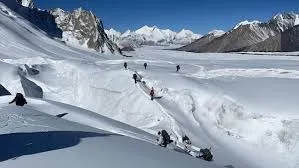
However, long-term data present a more troubling trend. A detailed satellite-based assessment of the Upper Jhelum Basin—Kashmir’s primary glacial zone—has mapped over 300 glaciers covering roughly 100–102 square kilometres, the majority of them small and highly sensitive to climate change. Studies indicate that these glaciers have already lost nearly 20 per cent of their total area over the past three decades, with many continuing to recede at measurable rates.
Research suggests that several glaciers in the region are retreating by 6 to 20 metres annually, with smaller glaciers fragmenting more rapidly and losing structural stability. Prominent ice bodies such as the Kolahoi Glacier, often referred to as Kashmir’s “water tower”, have shown consistent decline over the years.
Renowned glaciologist Prof Shakil Romshoo of the University of Kashmir has repeatedly cautioned that the region’s glaciers are extremely vulnerable to climatic shifts. “The glaciers in the Kashmir Himalaya are highly sensitive to even minor increases in temperature. Their sustained retreat is already altering hydrological processes and water availability patterns,” he has noted, stressing the need for continuous monitoring and policy intervention.
Experts from the University of Kashmir echo similar concerns.
A senior faculty member in the Department of Earth Sciences said, “What we are witnessing is a long-term structural change. Snowfall events may vary year to year, but the overall glacier mass balance remains negative.”
Scientists at Sher-e-Kashmir University of Agricultural Sciences and Technology of Kashmir (SKUAST-K) have also flagged the implications for agriculture. “Erratic snowfall and changing melt patterns directly affect soil moisture, cropping cycles and irrigation planning in the Valley,” an agro-meteorology expert at the university said. “The uncertainty in water availability during peak agricultural months is becoming a serious concern.”
While the recent snowfall has improved seasonal snow reserves, experts stress that it does little to reverse long-term glacier loss. “Seasonal snow is transient—it melts within months. Glaciers, on the other hand, are long-term water reservoirs. Their decline cannot be offset by a single good snowfall period,” said Faizan Arif, an independent weatherman.
The effects are increasingly visible in Kashmir’s river systems. The Jhelum River, which drains the Valley, is currently witnessing moderate flows due to delayed snowmelt. Typically, around 60 to 65 per cent of the basin remains snow-covered at the end of winter, regulating spring discharge.
However, satellite-based hydrological studies point to a gradual shift—winter flows are increasing while peak summer discharge is declining, largely due to shrinking glacier reserves. This trend poses risks to irrigation, drinking water supply and hydropower generation, particularly during the dry summer months when glacier melt is crucial.
Equally alarming is the rise in glacial lakes across the region. Scientific assessments have identified more than 150 such lakes in the Kashmir Himalaya, many of which are expanding due to accelerated melting. These lakes heighten the risk of Glacial Lake Outburst Floods (GLOFs), capable of causing sudden and widespread damage downstream.
“The rapid expansion of glacial lakes is a clear indicator of climate stress,” notes a recent study, warning that continued warming could increase both the frequency and intensity of such hazards.
Global research further reinforces these findings, indicating that Himalayan glaciers are retreating at unprecedented rates due to climate change, with far-reaching implications for millions dependent on river systems originating in these mountains.
For now, the snow-clad peaks offer a reassuring sight, and the recent weather has lifted spirits across the Valley, particularly among farmers preparing for the spring season. Streams have swelled, soil moisture has improved, and there is cautious optimism about the months ahead.
Yet, scientists urge a deeper understanding of the changing dynamics. “This is not recovery—it is variability,” an environmental expert observed. “We are seeing more extreme snowfall events, but also faster melting and an overall declining trend.”
As Kashmir transitions into spring, attention will turn to the pace of snowmelt and its impact on river flows. But the broader message from satellites and science remains clear: beneath the white cover lies a warming core, and Kashmir’s glaciers—its most vital natural reservoirs—are steadily losing ground.