



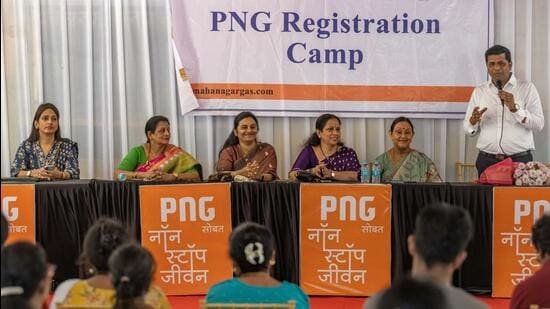
Mumbai: A mega piped natural gas (PNG) registration camp organised by Mahanagar Gas Limited (MGL) at Mumbai Public School in Sion on Sunday saw more than 100 residents apply for household PNG connections, amid a citywide push to shift consumers from LPG cylinders to PNG where infrastructure is available.


Officials at the camp said most applicants were from buildings that still do not have PNG infrastructure. Nearly 90% of registrations came from “non-gasified” buildings, while the rest were from societies where PNG pipelines already exist but individual households are yet to switch.
Muruganantham Yadav, 59, a driver from Pratiksha Nagar, said his 112-flat building is still waiting for a PNG connection. “This is good, especially in light of the recent LPG crisis. Having a PNG connection would ensure we are not affected; switching the entire city to PNG wherever possible would lessen our reliance on LPG. It is the need of the hour,” he said.
The camp comes after the Ministry of Petroleum and Natural Gas issued a directive on March 24 asking citizens to move to PNG wherever connectivity exists, warning that LPG connections could be discontinued within three months if households fail to shift. The move also ties in with the Maharashtra government’s push for PNG expansion and the BMC’s efforts to fast-track trenching permissions for pipeline work.
Residents were required to fill out detailed application forms, following which officials checked whether their buildings fell within MGL’s GIS-based serviceable network. Officials clarified that each household must apply separately even if the society has already been connected to PNG.
Applications are currently being accepted only in areas where infrastructure is already in place. “Wherever there is no pipeline infrastructure feasibility, applications are not being accepted,” an official said, adding that slum pockets are currently excluded, though some clusters are under consideration.
Resident Avinash Satpute, 43, said the shift was being driven by affordability and convenience. “We have heard that PNG is cheaper than LPG and wanted to try it. The post-paid meter system also seems better because unlike LPG cylinders, you do not have to pay in advance,” he said.
Another resident, Arvind Ghadi, 48, said the kitchen meter system makes it easier to monitor consumption and expenses. “It is also cleaner and more sustainable,” he said.
Nanda Patsupe, 46, said local corporator Ramdas Kamble organised the camp after several residents struggled to coordinate registrations individually.
Kamble told HT that residents had repeatedly approached him for help in securing PNG connections, which led him to bring officials from MGL and residents at one place so the issue gets resolved faster.
Many residents also enquired about revised PNG tariffs. Officials informed applicants that domestic PNG currently costs ₹51.50 per unit. Officials also clarified that registration and other related charges will be added to consumers’ first bills instead of being collected immediately.


