



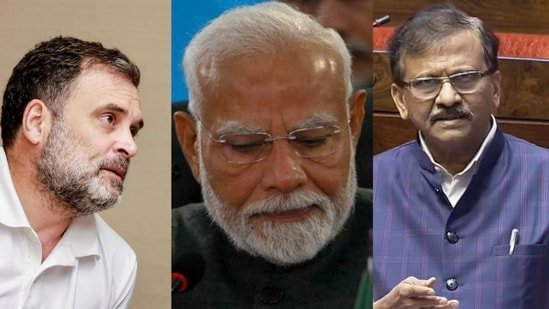
After leader of opposition in the Lok Sabha Rahul Gandhi’s remarks on Saturday on X that inflation is set to hit Indian households, Shiv Sena leader Sanjay Raut echoed similar concerns. Addressing a press conference in Delhi on Sunday, Raut said the Prime Minister Narendra Modi is busy trying to bring a BJP government to power in West Bengal while the rupee continues to depreciate in the market.


Raut reminded the Prime Minister of his days as a chief minister, when he had said that a falling rupee hurts the country’s image.
“There will be a century… Abki baar, 100 ke paar. Where is Modi ji? He is in West Bengal, preparing for President’s Rule to defeat Mamata Banerjee. Modi ji and Shah ji are attempting to do ‘khela’ in West Bengal, while the value of the rupee is declining… Modi ji had said that when the value of the rupee falls, the country’s prestige declines. What is it that is falling now?” Raut said, according to an ANI report.
The rupee opened at a record low of 92.89 per dollar on Friday and depreciated further to cross the 93 mark, indicating sustained pressure on the domestic currency.
While speaking to ANI, Raut demanded a resignation from Modi, saying that time has come for him to pick his jhola and leave. “….The Rupee began its downward spiral precisely when PM Modi became the Prime Minister. The PM is still busy in the election campaign and does not care about the rupee. I have only one thing to tell him: ‘Modi Ji, ab jhola uthao or chale jaiye,” he said.
Rahul Gandhi fears inflation is coming
Earlier, Gandhi had criticised the Modi government over the weakening rupee and rising fuel costs, calling them early warning signs of a looming inflation crisis. He said the Centre was downplaying the seriousness of the situation while ordinary citizens brace for higher prices of essential goods.
Gandhi warned that increasing production and transportation costs would hit MSMEs the hardest, trigger a spike in daily expenses, and put further pressure on the stock market due to foreign investor outflows. Accusing the government of lacking both direction and strategy, he said its response was limited to rhetoric, while the burden of economic mismanagement would ultimately fall on common households.
“The government may call it ‘normal,’ but the reality is: production and transportation will become costlier, MSMEs will be hit the hardest, prices of everyday goods will rise, and FII money will flow out faster, increasing pressure on the stock market. This means every household’s finances are bound to be directly and deeply affected. And it’s only a matter of time—after the elections, prices of petrol, diesel, and LPG will also increase,” Gandhi wrote on his X account.
Mamata Banerjee flags rising fuel prices as key issue in poll-bound West Bengal
Meanwhile, West Bengal chief minister Mamata Banerjee has made the rising cost of LPG and fuel a major issue in the poll-bound state. She earlier led a rally protesting the rising cost of LPG and the lack of supply. Banerjee said that she does not think the ongoing Iran war is the reason behind the LPG crisis and doubted centre’s intention.
“What happened to the stocks we had? Why didn’t he take action on time instead of suddenly enforcing ESMA? Was there no planning? And this is not just because of the war. The price of a domestic LPG cylinder was ₹400 in 2014. It has been hiked to ₹1,000 over the years,” Banerjee said, targeting the BJP-led NDA government, which first came to power in 2014.
“Is there really a shortage? Or have they (the Centre) held back stocks so that the fuel can be used during elections?” Banerjee added.
The ministry of petroleum and natural gas has maintained the stance that while there are concerns with he supply of LPG with major sea routes blocked courtesy the Iran war, no outlet has reported running out of stock across India. The ministry has also urged commercial LPG users to shift to piped natural gas, where available, to ease pressure on cylinder supplies. However, despite government assurances of adequate stock, reports of panic buying and long queues at LPG depots have surfaced in several parts of the country.
(With inputs from agencies)


