


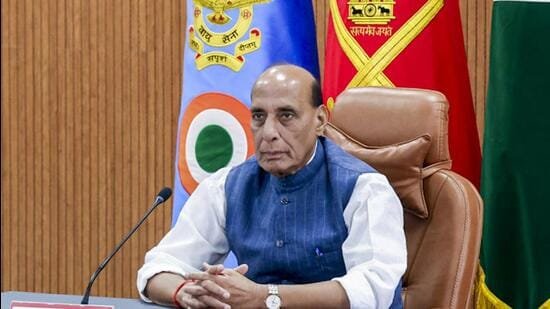
Defence minister Rajnath Singh on Friday said Operation Sindoor signalled India’s collective resolve and new military ethos, and the “short-duration, deep-penetration, high-intensity, and high-impact operation” compelled Pakistan to surrender.

“Operation Sindoor is a testament to the swift, precise, and joint response of the Indian defence forces to safeguard national interests,” Singh said while addressing the Joint Commanders’ Conference, a day after the country marked the first anniversary of the operation.
Launched in the early hours of May 7, 2025, it marked New Delhi’s muscular response to the Pakistan-backed Pahalgam terror attack that killed 26 people. It triggered four days of strikes and counterstrikes with fighter jets, missiles, drones, long-range weapons and heavy artillery before the two sides reached an understanding on stopping all military action on May 10.
Singh asked the country’s top military commanders to internalise lessons from the four-day military clash with Pakistan and other ongoing global conflicts to remain future-ready. He highlighted the need to strengthen capabilities in artificial intelligence, autonomous systems, data analytics and secure communication networks to ensure operational readiness in a rapidly evolving geopolitical security scenario.
Future conflicts, he said, will increasingly be shaped by hybrid threats, information dominance and operations conducted simultaneously across cyber, space, electromagnetic and cognitive domains.
Singh commended the progress in enhancing jointness, integration and technology adoption across the three services, noting that jointness is a pivotal element of the transformation sweeping the global defence sector. “Future wars will not be won solely through weaponry, but through innovative thinking and enhanced synergy.”
He asked the top commanders to cultivate the element of surprise to keep the country’s adversaries off balance and secure a strategic edge in any situation. Later, Singh released a joint doctrine for integrated communication architecture, aimed at strengthening “clarity, interoperability and integrated communications across the armed forces in future multi-domain operations.”
During the conference themed “Military Capability in New Domains,” he reiterated the government’s resolve to bolster the armed forces’ capabilities.
The armed forces have initiated several key procurements worth billions of dollars over the past year following Operation Sindoor, including additional S-400 air defence systems, Rafale fighter jets, loitering munitions, unmanned systems and missiles, and also inducted new platforms to enhance their capabilities and address emerging challenges with readiness and resolve.
“Comprehensive deliberations were held on future warfare, multi-domain operations, technological transformation and joint capability development. The conference witnessed extensive discussions on cognitive warfare, cyber resilience against evolving quantum and AI-enabled threats, military capability development in emerging domains, indigenous innovation and AI-enabled warfighting concepts,” the defence ministry said.
Those who attended the conference included chief of defence staff General Anil Chauhan, navy chief Admiral Dinesh Kumar Tripathi, army chief General Upendra Dwivedi, Chief of the Air Staff (CAS) air Chief Marshal AP Singh, and defence secretary Rajesh Kumar Singh.
Advanced systems and platforms developed for intelligence fusion, operational planning and information management were showcased during the conference, reflecting growing integration of cutting-edge technologies into joint operational structures, the ministry added.
On Thursday, a top army officer said there were no safe havens for terror in Pakistan anymore as India would hit them hard on its own terms, choosing the timing, conditions, and means of action.
“We will hit everything,” said deputy chief of army staff (strategy) Lieutenant General Rajiv Ghai, while addressing a joint press briefing by top officials from the three services to mark the first anniversary of Operation Sindoor.
In the early hours of May 7, the Indian Air Force (IAF) struck two terror sites at Markaz Subhanallah in Bahawalpur and Markaz Taiba near Muridke, both in Pakistan’s Punjab province, while the army hit targets at seven places, including Mehmoona Joya in Sialkot, Sawai Nala and Syed Na Bilal in Muzaffarabad, Gulpur and Abbas in Kotli, Barnala in Bhimber, and Sarjal.
In one of the counterstrikes on the night of May 7-8, Islamabad launched aerial attacks using drones and missiles at multiple towns and cities, including Awantipora, Srinagar, Jammu, Amritsar, Kapurthala, Jalandhar, Ludhiana, Adampur, Bathinda, Chandigarh, Pathankot, Phalodi, Suratgarh, Uttarlai, Nal and Bhuj. India’s air defence shield fended off the attacks.
On May 9-10, the IAF struck military targets in Rafiqui, Murid, Chaklala, Rahim Yar Khan, Sukkur, Chunian, Pasrur, Sialkot, Skardu, Sargodha, Jacobabad, Bholari and Malir Cantt in Karachi.
“When our desire for peace is mistaken for weakness, there is no choice but to act. And when we act, there are no half measures — it is decisive, it is lethal and it translates into Operation Sindoor,” IAF deputy chief Air Marshal AK Bharti said on Thursday.
