



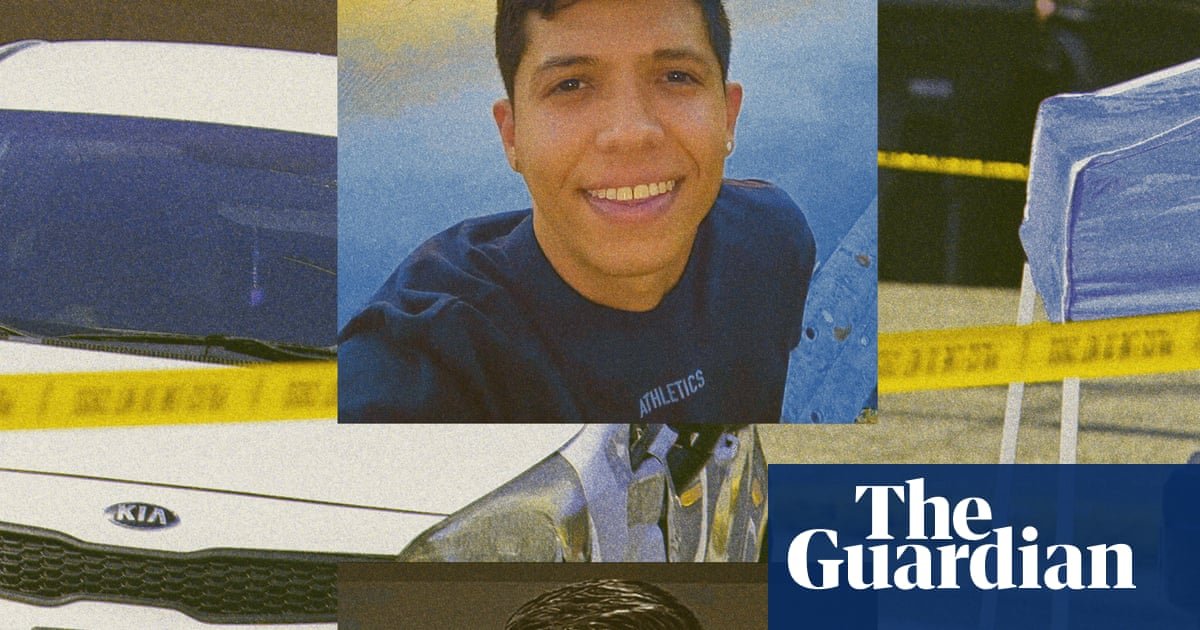
Lorenzo Salgado Araujo, 52, was driving to work with his brother and two other passengers in Houston, Texas, when immigration agents began tailing his car. They pulled him over and fired a fatal shot through the open passenger-side window.
Six days later in Biddeford, Maine, Joan Sebastián Durán Guerrero, 26, was driving around his neighborhood when agents stopped him at an intersection – right outside the laundromat where he’d often go with his three-year-old daughter – and shot him dead.
The two killings in less than a week have unleashed waves of grief and outrage across the US. Demonstrators gathered in both cities to – once again – demand that US Immigration and Customs Enforcement (ICE), the agency tasked with carrying out Donald Trump’s aggressive deportation scheme, remove its agents from their streets.
To deliver on Trump’s promise of mass arrests and deportations, immigration officers armed with military gear have been violently detaining immigrants in communities across the US – at traffic stops and outside department stores, at bus stops, warehouses, farms, schools and churches.
Salgado Araujo and Durán Guerrero were the 29th and 30th people that immigration officers have opened fire on since Trump took office last year, according to the Trace, an outlet that is tracking these shootings in its Gun Violence Data Hub. Officers killed eight of those people, among them Renee Good and Alex Pretti – the US citizens gunned down during a militarized enforcement operation in Minnesota.
This week, another man fleeing immigration agents in Florida died after being struck by a truck. Twenty-two people have died in ICE custody, including inside immigration detention centers, this year.
The two latest shootings echoed each other – and those that came before.
Neither victim, it turned out, was the true target of the immigration officers’ operation. Salgado Araujo, of Mexico, had lived and worked in the US for 35 years. He was a husband and the father of three US citizen children. Durán Guerrero, from Colombia, had been working multiple jobs to support his wife and daughter.
Salgado Araujo’s eldest son, Ronaldo, said he saw a Facebook video of his father’s shooting – and recognized him immediately from the sound of his voice crying for help. Neighbors told the Portland Press Herald that they saw Durán Guerrero’s partner and daughter rush outside in the aftermath of his killing – the three-year-old in her Bluey pyjamas – and heard their cries ringing through the street.
The US Department of Homeland Security (DHS) – which oversees ICE and the US border patrol – quickly followed up each shooting with statements, but no evidence, that the victims were to blame. Salgado Araujo “weaponized his vehicle” against officers, the DHS said – echoing the language used after officers killed Good, and other people that agents have shot. The DHS said the officers who fired at Durán Guerrero did so while “fearing for public safety”. Witness videos of each incident have already cast doubt on these official statements.
Calls for accountability: ‘This has to stop’
The shootings have galvanized thousands of protesters, and led to calls from local leaders and civil rights groups for independent investigations. In Houston, thousands of protesters have marched to demand that ICE leave the city entirely and for the Houston police department to end all cooperation with the agency. In addition to demanding a full, city-led investigation, they are also asking the DHS to reveal the names of the ICE agents involved and release from immigration custody the three witnesses who were in the vehicle with Salgado Araujo when he was shot.
One week after the shooting, hundreds of protesters gathered outside Houston’s city hall, chanting: “¡Justicia para Lorenzo!” – Justice for Lorenzo! More than a hundred Houstonians signed up to urge action from the mayor, John Whitmire, and the city council during lawmakers’ first meeting since Salgada Araujo was killed.
In Maine, hundreds of people poured into the streets of Biddeford and organized an evening vigil for Durán Guerrero. But many of his friends were afraid to speak publicly, according to Maine Public – because they feared that ICE would retaliate against them and others in the city’s Latino immigrant community. In an interview with Telemundo, Durán Guerrero’s father, Omar, said his son “had a strong vision of getting ahead, many dreams to fulfill”.
Even the scenes of mourning were familiar. At a memorial for Salgado Araujo, volunteers were sharing “know-your-rights” pamphlets with mourners and neighbors – just as volunteers had done near the site where Good and Pretti were killed.
“Nobody should have to learn their rights standing at a memorial for their neighbor,” said Neidi Dominguez, the executive director of the advocacy group Organized Power in Numbers. “But that’s where we are right now.”
Increasingly, advocates are grappling with a bigger question: what happens when ICE violates people’s rights with apparent impunity? Jasmine Khadem Gonzalez, an immigrant rights organizer with the Houston Democratic Socialists of America, said her training now includes instructions for documenting agents in the field – taking note of badge numbers, license plates and timestamps, and filming the agents – all in order to create a reliable record of violations.
On Houston’s Canal Street, where residents placed candles and flowers near the spot where Salgado Araujo was killed, people grappled with what it meant that ICE’s violence had reached them, and their community.
“We watched this happen in Los Angeles last year and taught our students about it, and then in Chicago, and Minneapolis, and now it is happening to us, here,” said JoAnna Rodriguez, who teaches the history of Mexican American communities, known as Chicano history, at the local arts center she founded. She lives two blocks from where Salgado Araujo was killed. “We’ve always been fearful, and it’s only getting worse. This has to stop.”
A supercharged deportation campaign
The Trump administration’s immigration enforcement apparatus is now the highest-funded law enforcement agency in the US. Last month, the president signed a bill securing $70bn in funding ICE and Customs and Border Protection (CBP), with $38bn for ICE to expand arrests, detention and deportation operations.
In recent months, the administration has recruited thousands of new immigration agents, many without proper vetting and questionable qualifications. At the same time, the government has been dismantling the offices tasked with investigating deaths and civil rights abuses within immigration agencies.
Following public outrage over Good’s and Pretti’s killings in Minneapolis, and massive nationwide protests against the Trump administration’s militarized immigration raids in cities across the US, Trump signaled a shift in tactics. He demoted Gregory Bovino – the bombastic border patrol official who led armed and masked bands of agents through cities with a film crew in tow – and fired his homeland security secretary, Kristi Noem. Tricia McLaughlin, the top DHS spokesperson who had become notorious for her blatantly false press statements, also left her role.
The DHS promised to equip all its agents with body cameras. But that has not been fully implemented, and the officers who apprehended Salgado Araujo and Durán Guerrero were not wearing cameras. After Durán Guerrero’s killing, the administration instructed federal immigration to pause pulling over vehicles – and almost immediately afterwards the president overturned that pause.
Many of the immigration arrests in recent months have been conducted by police, sheriffs and members of other state and local law enforcement agencies deputized by the federal government to conduct immigration sweeps. In many locales, it has become unclear to bystanders whether drivers are being pulled over due to a genuine traffic violation, or because an officer was interested in checking their immigration status.
While it has become less common to see roving caravans of immigration officers in masks, the administration has not slowed its mass-deportation campaign. Officers are still detaining immigrants at workplaces, at routine check-in appointments, outside their homes or during traffic stops.
The arrests are happening routinely – in most cases before neighbors and bystanders realize what is going on. “It’s just happening so quickly. So people can’t get there to observe, record and report what they saw,” said Gracie Willis, an attorney with the National Immigration Project. “And often all that’s left is an empty car sitting there.”
ICE agents are targeting immigrants not only in big cities, but also in smaller cities and towns all across the US. In Iowa, advocates noticed a surge in targeted arrests at people’s residences – among those detained were a delivery service driver from Turkey and a Fijian national who had come to the US on a student visa. This month in Wisconsin, advocates noticed a surge of arrests in suburban neighborhoods – agents trailed and stopped immigrants, including those with work permits and legal status, who were driving in Milwaukee and suburban Greenfield.
The New York Times reported earlier this month that immigration officials had detained more than 10,000 people in the last five days of June.
In the aftermath of the killings this week, ICE released statements emphasizing that the agency was arresting the “worst of the worst” including “murderers, pedophiles, violent assailants and drug traffickers”. However, data analyzed by the Guardian and others show that the vast majority of people that ICE has arrested had no criminal convictions.
Immigration attorneys and advocates are bracing for even more arrests to come. A recent supreme court ruling allowing the administration to revoke a designation known as temporary protected status from Haitian and Syrian immigrants will strip legal status from about 1.3 million people. Those who aren’t able to quickly find some other legal pathway to residency in the US could be immediately arrested and deported.
In Houston, residents said they would continue to push back against ICE – and protect their families and their neighbors, whose lives are on the line.
“We have to stop mincing words … ICE is a domestic terrorist organization,” said Jasmine Khadem Gonzalez, the immigrant rights organizer. “They are killing our fathers on the streets in cold blood all across this country.”


