






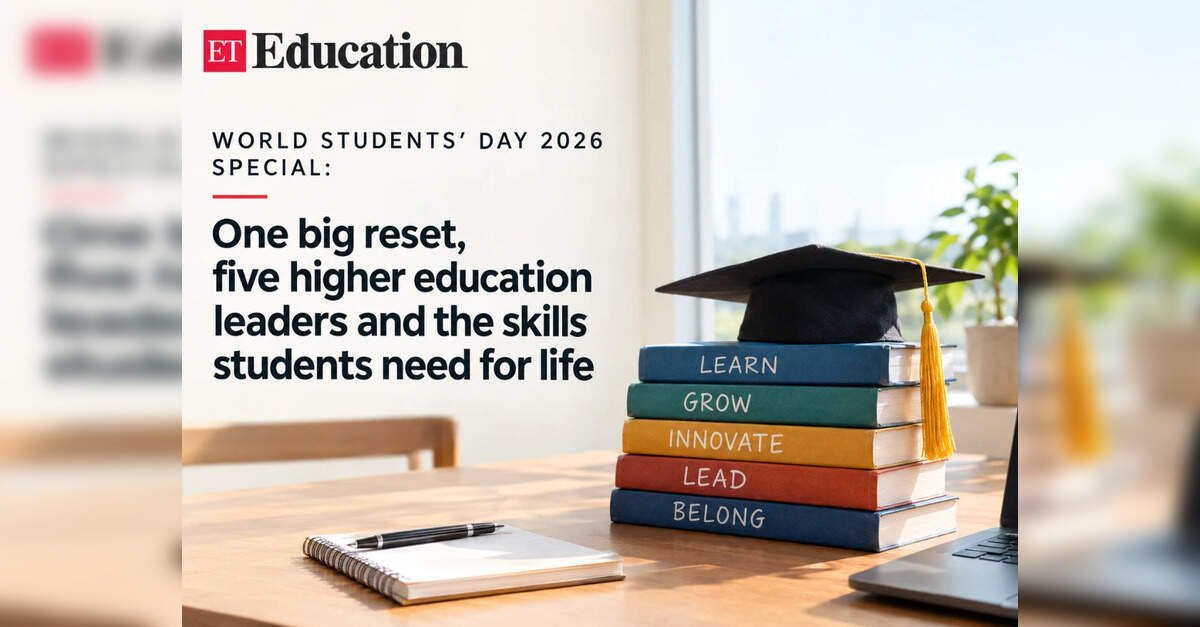
A degree can open doors, but what prepares students for life beyond them? As artificial intelligence reshapes industries and information becomes increasingly accessible, higher education must look beyond academic achievement to nurture judgement, adaptability, curiosity and character.
Observed on 15 October to commemorate Dr APJ Abdul Kalam’s birth anniversary, World Students’ Day offers an opportunity to reconsider what learning should accomplish. ETEducation invited five higher education leaders to reflect onThe Great Reset, The Unlearning Imperative and the books and life skills students need to thrive.
Their perspectives underline a crucial message: education must shape not only what students know, but also how they think, act and define success.
Q The Great Reset: What should education stop teaching, start teaching and never compromise on?
With information readily available and real-world challenges increasingly complex, universities must prepare students to apply knowledge rather than simply reproduce it. Here is what five leaders believe needs to change.
Prof Himanshu Rai, Director, IIM Indore, calls for moving beyond predetermined answers towards independent thinking and ethical decision-making.
“I would stop teaching the chase for the ‘right’ answer. The future will belong to people who can ask better questions, navigate ambiguity, challenge assumptions, and make sound decisions when there is no answer key.
“The one thing we must never compromise on is character. Intelligence without character can make someone more efficient, but not necessarily more responsible.”
For Narendra Nahata, Chancellor, Mandsaur University, education must redefine success beyond marks and placements.
“We must stop looking at success as an outcome with marks and placement packages. Rather see it as a constant effort to do better. What we need to teach is how to experiment and accept failure as a part of learning. What is non-negotiable is our values, because the purpose of education is to nurture responsible human beings.”
Extending the discussion from achievement to responsibility, Dr Satish Modh, Vice Chancellor, VIT Bhopal, advocates a deeper approach to knowledge.
“We should stop teaching knowledge as mere information. We should start teaching Jnana with inquiry, integrating knowledge, experience, reflection and wisdom. We must never compromise on Dharma: ethical conduct, responsibility, self-discipline and collective well-being.”
Dr Vikram Singh, Chancellor, Noida International University, similarly calls for replacing mechanical learning with inquiry.
“Mechanical and bookish learning has to give way to inquisitive and searching minds capable of managing the challenges of rapid growth in all fields of human endeavour. Knowledge is instant global advantage, this should be the top most priority.”
For Dr CA Achyut Dani, Director, JG University, Gujarat, the priority is conceptual understanding, human skills and integrity.
“We should stop score/grade-focused memorisation without knowing why. If WHY is clear WHAT is easy. We should start teaching Human Skills & Psychology. Creativity and challenging the status quo would be the most important skill set.
“One thing we should never compromise on is integrity. Values, morals, ethics and kindness must never be compromised, come what may.”
Q The Unlearning Imperative: What are we teaching today that could hold students back tomorrow?
If the Great Reset asks what universities should change, the Unlearning Imperative challenges the assumptions that may be holding students back. For these leaders, the shift begins with rethinking success, lifelong learning and the purpose of education.
Prof Himanshu Rai challenges the idea that achievement automatically leads to a meaningful life.
“Education has to unlearn the idea that achievement and a meaningful life are the same thing. As technology and AI make productivity increasingly abundant, qualities such as attention, judgement, purpose, empathy and genuine human connection are becoming increasingly scarce.
“Education needs the courage to stop producing young people who are exceptionally good at answering ‘How do I win?’ without ever asking, ‘What is worth winning?’”
Narendra Nahata believes learning must extend beyond degrees and predefined career paths.
“Students today need less instruction on what to think and more opportunities to question, experiment, solve and apply. We must move beyond teaching for answers and start preparing students for complexity and change.”
For Dr Satish Modh, education must move away from excessive competition towards collaboration and responsibility.
“We are teaching students to compete rather than collaborate and pursue success rather than Dharma. The education system has to unlearn outdated knowledge and the notion that the classroom is the best place of learning.”
Dr Vikram Singh questions the equation of academic excellence with memorisation.
“Any learning without a strong conceptual foundation is an unproductive appendage that is of no consequence. Education has to be man-making, as Swami Vivekananda said. Character building and patriotism must remain core values.”
Bringing the conversation back to students’ futures, Dr CA Achyut Dani argues that education must prepare them for life, not just employment.
“We are still preparing them for jobs and not for life. We need to teach students how to learn, adapt, be resilient and overcome or cope with failures.”
Together, these perspectives call for education that makes room for independent thought, meaningful experiences and lifelong growth. But what can students themselves carry beyond the university gates?
Rapid Fire: Little questions, big insights for student survival
Beyond qualifications, which books can broaden students’ perspectives, and which skills will help them navigate life? We put the five leaders on the spot.
Q1. One book every student should read before graduating?
Books can challenge assumptions, introduce new perspectives and prompt students to reflect on their own choices. Here are the leaders’ recommendations.
- Prof Himanshu Rai: Siddhartha by Hermann Hesse. Wisdom cannot be borrowed; it must be experienced.
- Narendra Nahata: Ratan Tata: A Life by Thomas Mathews.
- Dr Vikram Singh: Complete Works of Swami Vivekananda.
- Dr CA Achyut Dani: The Professional by Subroto Bagchi and Do Not Sweat the Small Stuff by Richard Carlson.
Q2. One skill every student should master that no classroom can teach?
Knowledge helps students understand the world, but navigating it calls for self-awareness, adaptability and the ability to learn from experience.
- Prof Himanshu Rai: Self-awareness, including an understanding of one’s motivations, strengths, values and blind spots.
- Narendra Nahata: Adaptability, developed through real-world experiences and problem-solving.
- Dr Satish Modh: Mindful awareness, the ability to remain fully present in the moment.
- Dr Vikram Singh: Integrity.
- Dr CA Achyut Dani: Being coachable: observe, learn, understand, adapt and execute.
The real measure of education: What students become
The leaders’ reflections point to a broader purpose for higher education. Degrees and academic knowledge matter, but students also need the judgement to question, the resilience to adapt and the integrity to act responsibly.
As Dr APJ Abdul Kalam said, “Learning gives creativity, creativity leads to thinking, thinking provides knowledge, knowledge makes you great.”
This World Students’ Day, the challenge for universities is to prepare students not merely for their first job, but for a lifetime of learning, thoughtful choices and meaningful contributions to the world.


