









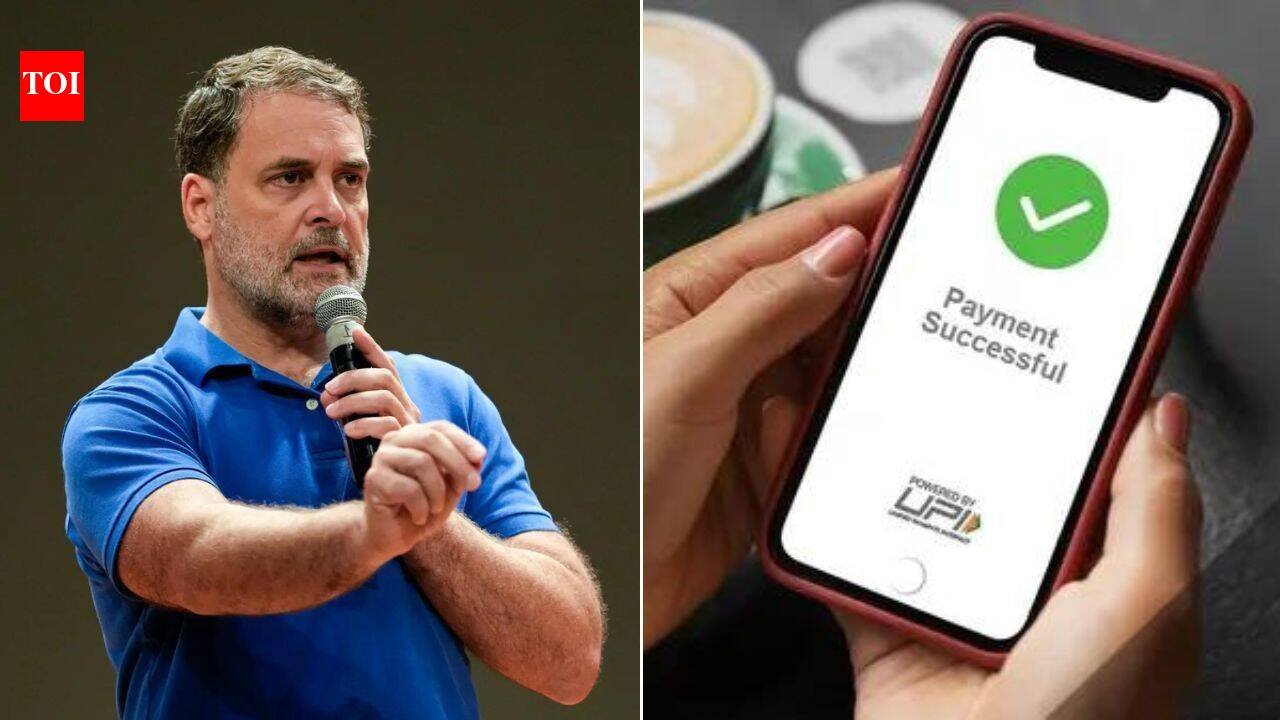
NEW DELHI: Congress leader Rahul on Tuesday accused the Prime Minister Narendra Modi-led government of “surrendering to pressure from American corporations” by reportedly paving the way for charges on certain Unified Payments Interface (UPI) transactions.Rahul argued that although the government has said consumers will not be charged directly, allowing a Merchant Discount Rate (MDR) on merchant transactions above Rs 2,000 could eventually lead to higher retail prices.Sharing a post on X, the leader of opposition said, “The Modi government has quietly opened the door to imposing fees on UPI. Now, MDR can be levied on merchant UPI transactions above Rs 2,000. Even if these transactions account for just 5% of the volume, they make up nearly 65% of UPI’s total transaction value.”“The government says no fees will be charged to customers. But where will the fees imposed on shopkeepers ultimately come from? Added to prices, straight out of the customer’s pocket. American payment companies have long opposed India’s zero-MDR policy. Now, the Modi government has opened the path to changing the policy in exactly that direction. Just like with the US Trade Deal, Compromised PM Modi is once again surrendering to American pressure,” he added.Rahul’s remarks came after the government directed banks and payment system providersnot to impose direct or indirect charges on UPI transactions of up to Rs 2,000or on payments made through RuPay debit cards.However, the notification does not clarify whether charges could be imposed on transactions above Rs 2,000, particularly those made by merchants. UPI transactions have so far remained free of charges, irrespective of the amount.Congress president Mallikarjun Kharge also accused the PM Modi government of laying the groundwork for a “Digital Payments Tax” by allowing the possibility of charges on UPI transactions above Rs 2,000.“The Modi government’s loot has now reached UPI. “No fees on UPI” has been changed to “no fees on UPI transactions up to Rs 2,000.” Sky-high inflation has already emptied the common man’s pocket. Wholesale inflation is near 10%, and the BJP government has planned to impose a “Digital Payments Tax” on the public, aiming to destroy whatever little savings they have left,” Kharge said in an X post.“Ten years ago, demonetization delivered a shock to the country’s economy. When questions were raised about the disastrous outcomes of demonetization, the government argued that it was imposed to promote Digital Payments and a Cashless Economy. The Finance Minister had recently stated in Parliament that no Tax or Charges would be levied on UPI, but according to several reports: A potential collection of Rs 25 on a Rs 5,000 transaction and up to Rs 50 on Rs 10,000. Is this true?” he added.He also warned that any Merchant Discount Rate (MDR) imposed on merchants could eventually be passed on to consumers through higher prices.Congress general secretary in-charge of communications Jairam Ramesh also questioned whether the transaction limit could be changed through a future notification to cover person-to-person transfers.“It is evident that the groundwork is being laid to collect fees on UPI transactions from all of us. Tomorrow, through another similar notification, this limit could also be altered—there is now no guarantee of this in the law. As far as we know, the government could impose charges even on everyday person-to-person UPI transactions,” he wrote on X. “Is all this being done with the intent of opening up digital payments for American companies to please President Trump?” he asked.
What does the notification say?
According to a gazette notification dated September 14, no bank or system provider can impose a direct or indirect charge on a person making or receiving a payment through a RuPay debit card or a UPI transaction of up to Rs 2,000.The notification follows an amendment to Section 10A of the Payment and Settlement Systems Act, 2007. The amendment provides an enabling framework for imposing MDR on UPI and other notified electronic payment modes.The amendment Bill was passed by Parliament during the Monsoon Session, which concluded on August 13, 2026. The government had said that the UPI and Services Steering Committee, headed by the National Payments Corporation of India (NPCI), would decide the MDR rates.The government has argued that rising transaction volumes require continuous investment in cybersecurity, fraud prevention and payment infrastructure. It has also said that charges would support market expansion, encourage competition and help create a self-sustaining revenue model for the payments ecosystem.UPI is operated by NPCI, an initiative of the Reserve Bank of India and the Indian Banks’ Association. It enables real-time payments between individuals and allows customers to pay merchants directly.Launched on August 25, 2016, UPI has transformed India’s digital payments landscape. Its transaction value rose from Rs 0.07 lakh crore in FY17 to around Rs 314 lakh crore in FY26, an increase of more than 4,000 times in a decade.
Share your thoughts in the comments
Be respectful · TOI community guidelines
UPI is now accepted in 11 countries, including Singapore, the United Arab Emirates, France, Mauritius, Nepal, Bhutan, Qatar, Sri Lanka, Cambodia, Greece and Uzbekistan.According to Reuters, the introduction of UPI charges could benefit Paytm and Pine Labs, create an additional revenue stream for banks and improve prospects for IPO-bound PhonePe and Razorpay. Analysts at Jefferies estimate that the fees could generate Rs 5,000 crore to Rs 10,000 crore annually for the payments industry.


