






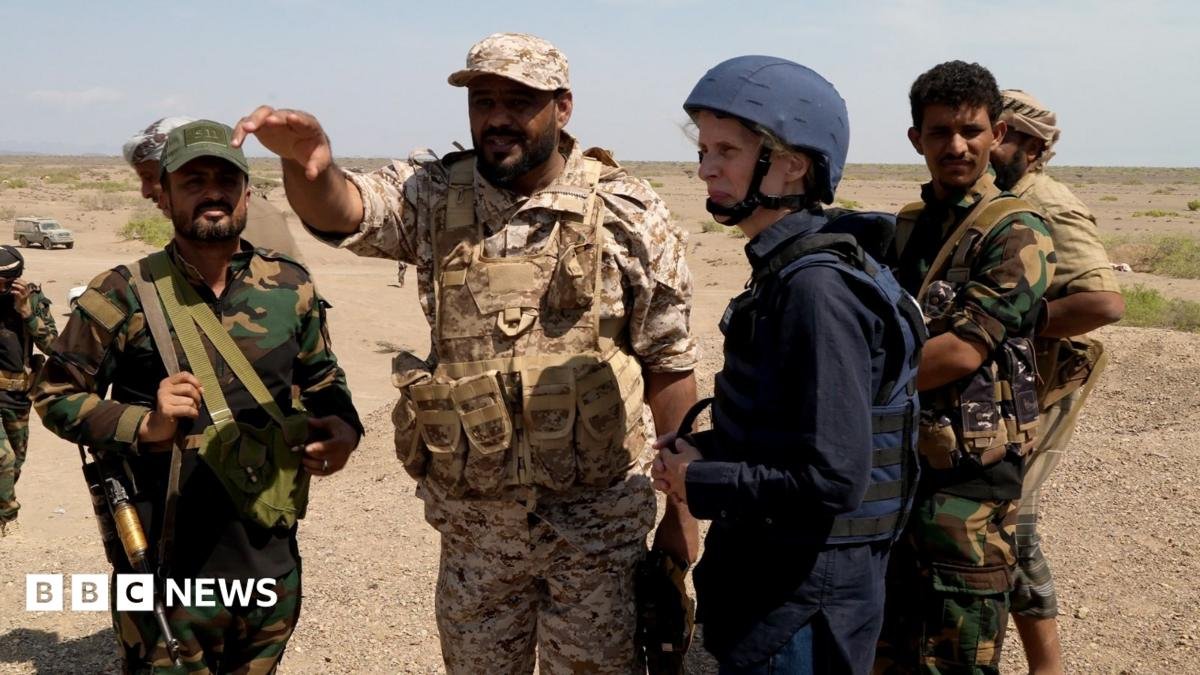
It was a journey at high speed through the desert – in a pick-up truck with armed fighters in the back. We were travelling with Yemen’s pro-government forces, catching glimpses of the Arabian Sea, and forbidding mountain peaks in the distance. Houthi rebels were dislodged from here just days ago, we were told.
When you are battling over expanses of empty desert, progress can be hard to see. But these soldiers, in Shaab-al-Jinn in Lahj governorate, showed us new sandbagged defences – new lines in the sand.
“There was heavy fighting,” said Tawfiq Al Haboun, a bearded commander in camouflage uniform. “They have snipers, artillery and ballistic missile launchers.”
Here in the far corners of the Middle East, a war is being waged with global implications.
Yemen’s entrenched civil war is now impossible to ignore. It’s part of wider conflict, stretching from Tehran to Riyadh, where missiles slammed into the international airport this weekend. Yemen’s Houthi fighters – already a threat to global shipping – are an increasing threat to Saudi Arabia. And they provide leverage for their backers in Iran, Saudi’s regional rival.
Tawfiq Al Haboun pointed to shards of fibre glass and bits of metal at his feet – part of a downed Houthi drone that he said was carrying C4 explosives.
Commander Al Haboun is from the Southern Forces, part of the loose – very loose – alliance of groups fighting for Yemen’s government, which is internationally recognised, and backed by Saudi Arabia and its air strikes.
The Houthis swept into the capital, Sanaa, in 2014, ousting the government. A year later a Saudi led coalition of Arab states intervened, trying to dislodge the Houthis. Despite years of devastating air strikes, that hasn’t worked.


