



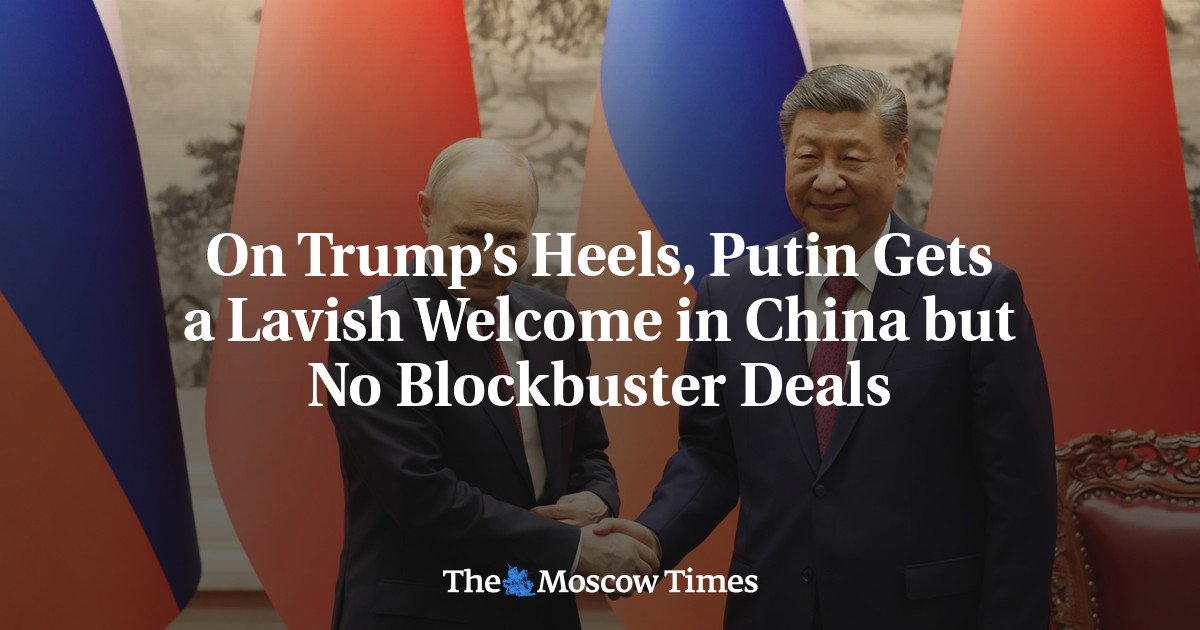
President Vladimir Putin has never been a stranger to the red carpet in Beijing, and his arrival in the Chinese capital this week was no different.
The Russian leader attended a grand welcome ceremony at the Great Hall of the People and hugged an adulatory Chinese engineer named Peng Pai 26 years after the pair first met in 2000.
But though the Russian delegation signed more than 20 agreements strengthening cooperation in areas ranging from trade to tech, it notably left without securing a blockbuster deal on the long-delayed Power of Siberia 2 gas pipeline.
Experts told The Moscow Times on Wednesday that for what Putin’s visit lacked in deliverables, it made up for in underscoring the relevance of one of Russia’s most important partnerships.
“In a way, it’s much more of a symbolic visit, but in foreign policy and big politics symbols mean a lot,” said Temur Umarov, a fellow at the Carnegie Russia Eurasia Center.
In spite of the flurry of agreements, this meeting was not supposed to be about attaining “consequential outcomes,” Umarov said.
Putin has met with Chinese counterpart Xi Jinping annually to shore up ties since the start of the full-scale invasion of Ukraine and his subsequent break with the West.
Unlike his past visits to meet with his “old friend,” looming over this trip was U.S. President Donald Trump, who held a summit with Xi in Beijing last week.
The fact that the visits took place in such quick succession, and that Putin was treated to the same level of pageantry as Trump, “puts him on the same level as those great powers, which of course is a very important reputational gift that Xi Jinping grants to Vladimir Putin,” Umarov said.
Some analysts interpreted the Trump meeting as a sign of stabilizing relations between the U.S and China.
If Putin’s goal was to prove that closer U.S.-China relations are not mutually exclusive with Russia’s close ties to China, he succeeded, said Joseph Torigian, an associate professor at American University in Washington.
“The ability to go to China and have this conversation and show that he’s not isolated, that one of the most powerful countries in the world continues to have his back, is meaningful,” Torigian told The Moscow Times.
At a press conference, Putin repeated lines about Russia and China’s shared foreign policy philosophies that rebuke Western hegemony, concepts he often invokes to emphasize their strong relations.
He said the countries “are committed to independent and autonomous foreign policies, operate in close strategic partnership and play an important stabilizing role on the global stage.”
Meanwhile, Xi appeared to take aim at the U.S. when he cautioned against “the damage caused by unilateral actions and hegemony.” Earlier, Russia and China had signed a joint declaration on working toward a “multipolar world.”
Statements like these matter because some factions in Beijing view the Russians with skepticism and believe they are trying to push China into a more “confrontational ideological relationship” with the U.S., Torigian said.
“This is language that the Chinese and the Russians used to criticize the Americans,” Torigian said. “And so for Vladimir Putin to be able to get Xi Jinping on the record making these kinds of comments, literally days after the Trump-Xi meeting, shows that the Russia and China relationship remains strong.”
He added that the optics of the meeting affirms Russia’s and China’s belief that Washington “is losing its ability to enforce its will on the international system.”
In the lead-up to Putin’s trip, it was unclear if the timing was opportunistic or simply coincidental. Trump told reporters at the White House in March that his visit to Beijing, originally scheduled to take place in early April, would be delayed to give officials time to manage the Iran war.
As Trump was departing Beijing last Friday, the South China Morning Post reported that a rumored visit by Putin would take place this week.
Russia and China have enjoyed close ties under Putin. He and Xi have met more than 40 times over the years, and these regular summits are often seen as a venue to show off their close diplomatic and cultural ties.
Security assistance has become an increasingly important part of this dynamic since the full-scale invasion of Ukraine in 2022.
Chinese soldiers have been accused of fighting alongside Russian forces in Ukraine’s Donetsk region and manufacturers have supplied Moscow’s defense industry with sanctioned technology, even as Beijing says that it wants to help find a diplomatic solution to the conflict.
On Tuesday, Reuters reported that last year China’s army covertly trained about 200 Russian soldiers, some of whom went on to fight in Ukraine. If confirmed, it would represent a major escalation of Beijing’s involvement in the war.
Torigian pushed back against the notion that Putin’s goals were purely symbolic, saying there was one tangible outcome that Moscow had hoped to secure: a commitment to building Power of Siberia 2.
The project to construct a new gas pipeline between China and Russia has been stuck in limbo since its development began in 2020. If completed, it would nearly double Russian gas exports to China and help Moscow offset lost sales to Europe.
The timing for progress on Power Siberia 2 was right. China’s energy supplies have been severely strained with the outbreak of the U.S.-Israeli war against Iran. The Strait of Hormuz remains blocked, cutting off maritime imports from the Middle East, which accounted for about 30% of China’s LNG imports in 2025.
Putin likely entered Wednesday’s talks hoping these geopolitical pressures would push Beijing toward an agreement, Torigian said.
But by the end of the day, all that both sides had agreed on was a “general understanding” to continue talks. Markets in Russia reacted poorly to the news, with Gazprom shares falling 3.5%.
“The fact that they can say once again that it’s still sort of on the radar might be useful,” Torigian said of the pipeline. “But the fact they still couldn’t get it clinched is probably going to feed it into a narrative of this meeting as not something that the Russians would have ideally liked, especially after the Strait of Hormuz situation.”
A Message from The Moscow Times:
Dear readers,
We are facing unprecedented challenges. Russia’s Prosecutor General’s Office has designated The Moscow Times as an “undesirable” organization, criminalizing our work and putting our staff at risk of prosecution. This follows our earlier unjust labeling as a “foreign agent.”
These actions are direct attempts to silence independent journalism in Russia. The authorities claim our work “discredits the decisions of the Russian leadership.” We see things differently: we strive to provide accurate, unbiased reporting on Russia.
We, the journalists of The Moscow Times, refuse to be silenced. But to continue our work, we need your help.
Your support, no matter how small, makes a world of difference. If you can, please support us monthly starting from just $2. It’s quick to set up, and every contribution makes a significant impact.
By supporting The Moscow Times, you’re defending open, independent journalism in the face of repression. Thank you for standing with us.
Continue
Not ready to support today?
Remind me later.
×
Remind me next month
Thank you! Your reminder is set.


