



The report is an evisceration of the way of things among these two clubs and the way in which their Ultras groups behave.
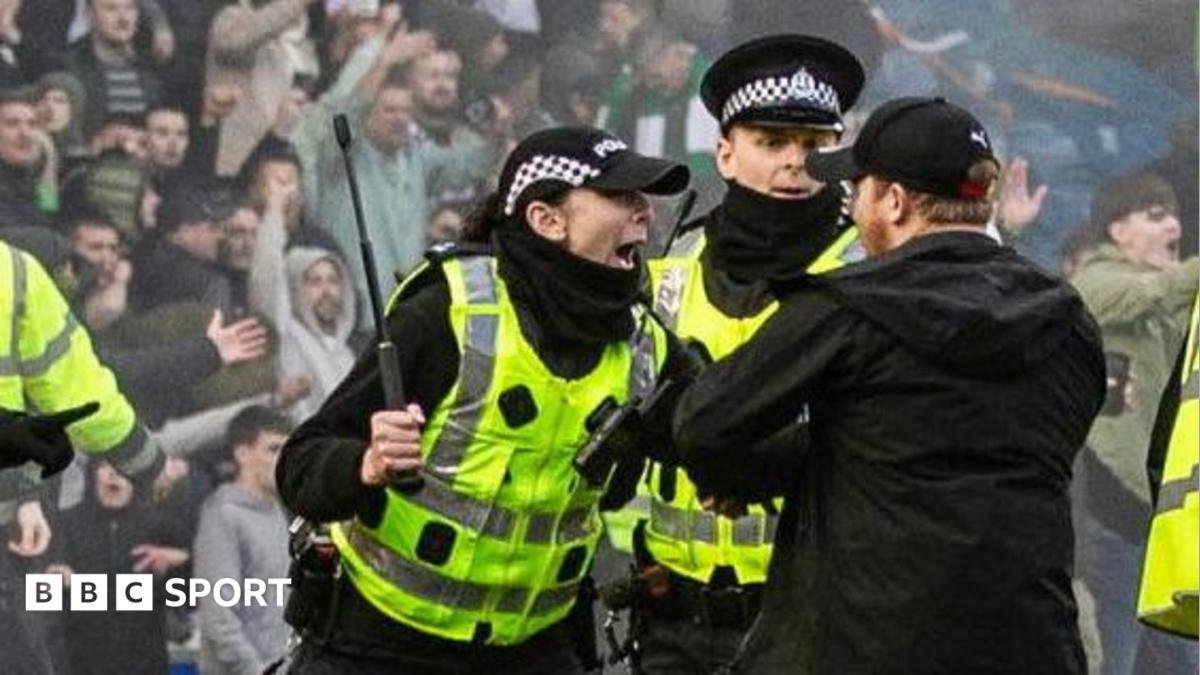
Blackbourne catalogues that day in detail, a cup tie won on penalties by Celtic, a victory that sparked a “wholly inexcusable” pitch invasion by hundreds among the more than 8,000 visiting fans.
Then there was an “immediate hostile” counter invasion by Rangers supporters, many wearing face-coverings and carrying “poles and reinforced gloves”. It is said in the report that it’s “a minor miracle that no-one suffered serious injury”.
It took police four minutes and 28 seconds to establish control – “a period in which life-threatening violence was possible”.
He cites the risk of crushing in the Broomloan Road when Celtic fans without tickets crashed through security, how police had no plan for fans outside the stadium, how some police officers say they are now “petrified” of working at this game.
There’s a gamut of observations and flak.
-
A steward at one of the gates at Ibrox accepted payment to allow fans into the stadium during the game. He has subsequently been arrested.
-
A Celtic employee was hit in the face by a masked Rangers fan.
-
There’s mention of a Rangers player reporting an episode of racial abuse.
-
A 10-year-old boy in the Celtic end was struck in the face by a coin.
-
A Celtic supporters’ bus was attacked and a fan left unconscious on the street.
-
The Rangers mascot, Broxi Bear, was criticised for provoking Celtic fans.
The risk assessment before the game concluded that a pitch incursion was “unlikely”, one of a number of operational failures that the report jumps all over. “A number of interviewees used the word ‘complacency’,” it says.
There’s a call for the Scottish FA to take responsibility and reinforce a zero-tolerance policy across the game. “Section closure, not ticket reduction, should be the standard first-response for confirmed unacceptable conduct.”
Ultras groups came in for serious examination in the report. And there was just as much criticism about the Old Firm’s inability to control their Ultras, who are described as having the feel of organised crime gangs.
“Clubs have demonstrated a reluctance to confront this dynamic, in part because of the atmospheric value Ultra groups provide, and in part through fear of the consequences,” the report added.
“These groups exhibit internal hierarchy, coordinated planning, operational security awareness, and the use of intimidation in securing ‘best position’.
“The implication for football authorities and Police Scotland is significant: these are not spontaneous groups of disorderly fans but organised entities that require an intelligence-led, multi-agency response.”
There is a nod to the dilemma in all of this.
Is there a stomach within the game for the kind of changes demanded by the investigation? Do the authorities have the backbone to push the kind of reform, or elements of the reform, that some powerful clubs might steadfastly resist?
“Across interviewees, there was a consistent and strongly expressed view that the Scottish FA and SPFL have the disciplinary powers to act more severely than they have done but have chosen not to use them,” the report states.
“The existing rulebook – which every club signs up to – provides for financial penalties, points deductions, and expulsion… The question is not whether the tools exist. It is whether there is the will to use them.”
If this report doesn’t bring sweeping change, then the scenes of Ibrox in March and Celtic Park on the final day of the season (and many more in seasons past) are bound to continue.
When the report mentions how close everything came to life-threatening violence, you wonder if people in power are actually listening. What the football authorities do next will be interesting. All eyes are upon them.


