






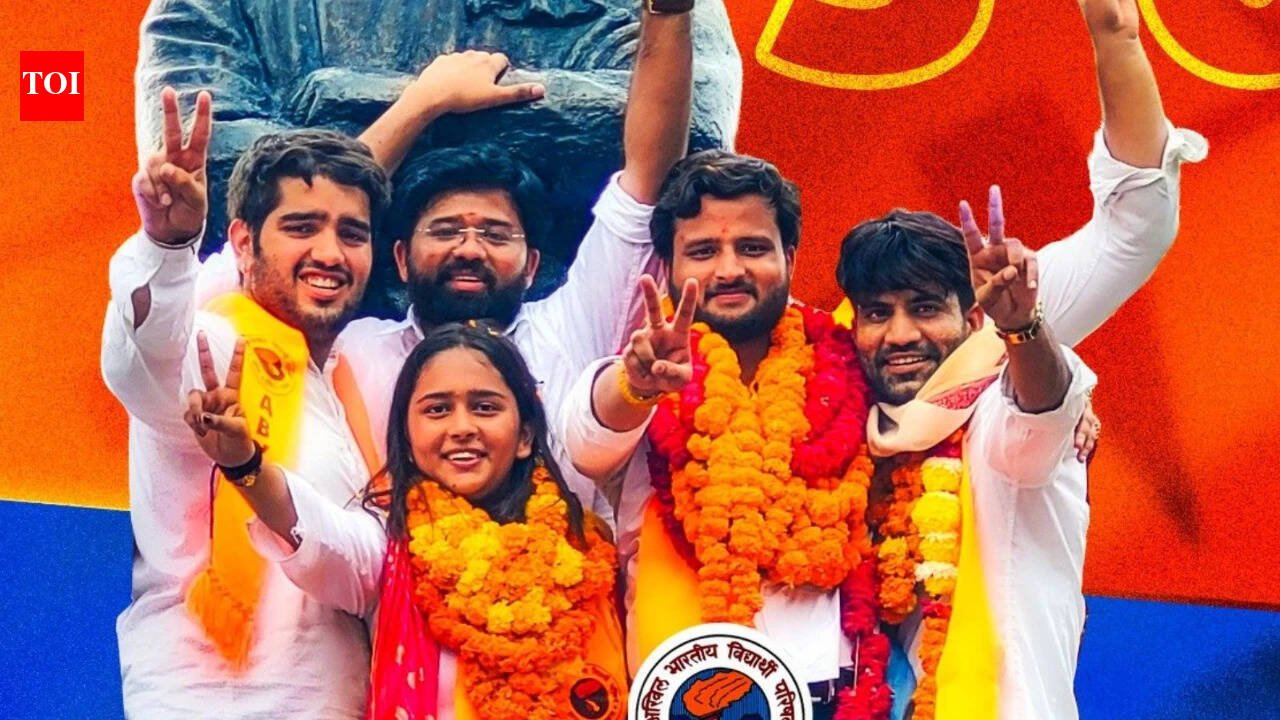
NEW DELHI: Deepanshu Shokeen’s victory as an Independent has emerged as the most striking story of this year’s Delhi University Students’ Union (DUSU) election not just because he won the vice president’s post by a huge margin, but because he did so after breaking away from Congress affiliated NSUI, the organisation with which he had been associated for long.The 21 year old postgraduate student of Buddhist studies is the son of a DTC bus conductor and an anganwadi worker.A former member of National Students’ Union of India, Shokeen, a resident of Peeragarhi, fought the election as an Independent following a dispute over ticket distribution.
Behind the result
At 30,615, Shokeen secured the highest number of votes among all central panel candidates and won by 13,705 votes.Analysts said his strong support base among Jat students, and beyond the community, helped him build a distinct identity outside the established ABVP NSUI contest.His high visibility campaign, including his decision to remain barefoot while seeking justice for students killed in the Satya Niketan building collapse, further strengthened that independent identity.Sidestepping questions on the split, Shokeen said, “Irrespective of who I represent, I am going to focus on students’ issues. The major focus should be on who can address students’ issues and whom students believe in, not which party or community they come from.”NSUI’s vice presidential candidate, Vir Chatrath, claimed Shokeen was not denied a ticket and was offered the presidential post.In the presidential contest, at the end of 10 rounds, NSUI’s Vijay Shankar Meena led ABVP’s Yash Dabas by 524 votes, 11,966 to 11,442. But Dabas eventually won by 2,053 votes.Independent candidate Samarth Beniwal, who was also associated with NSUI, polled 819 votes. In the joint secretary race, the contest went beyond the traditional two party fight.At the end of 10 rounds, Samajwadi Chhatra Sabha candidate Vishesh Yadav was leading with 8,501 votes, ahead of NSUI’s Gopal Choudhary at 8,135 and ABVP’s Lakshay Raj Singh at 8,125.The race subsequently shifted, with Lakshay winning with 16,615 votes, just 837 ahead of Yadav’s tally of 15,778. The NSUI candidate polled 15,206 votes.The results point to a DUSU contest that remained dominated by ABVP in terms of seats, but was not a sweep and was considerably less straightforward in terms of votes.The outcome shows a growing space for candidates and outfits operating outside that ABVP NSUI binary.An NSUI rebel’s lead remained substantial throughout the race for the VP’s post, an SCS candidate came within 837 votes of taking the joint secretary’s post, while the presidential race stayed within a few hundred votes through the middle of counting before ABVP finally pulled away.The results also raise questions about the Left alliance’s ability to convert its political mobilisation into votes.Compared with 2025, the AISA SFI alliance’s performance was virtually unchanged in the presidential race, with Ananya Raturi polling 5,377 votes against 5,385 last year, but its tally fell in the other three contests, from 4,163 to 2,383 for vice president, 9,535 to 8,734 for secretary, and 8,425 to 5,837 for joint secretary.This came despite the alliance’s prominent participation in the CJP mobilisation and its campaign around issues such as student housing, examinations and accountability.
CJP momentum doesn’t show up in left’s vote tally
The SFI AISA alliance had a strong 2025 showing, polling 5,385 for president, 4,163 for VP, 9,535 for secretary and 8,425 for joint secretary.This year, its candidates polled 5,377, 2,383, 8,734 and 5,837, respectively.
ASAP: New name, first electoral test
AAP’s relaunched student outfit ASAP made its first formal DUSU electoral appearance this year, replacing the earlier CYSS.It polled 1,388 votes for president and 7,639 for secretary, with its secretary candidate, Pankaj Kumar, DUSU’s first ever visually impaired candidate to contest, finishing last in the race.CYSS had contested DUSU in 2015 and 2018 but never won a central panel post.


