



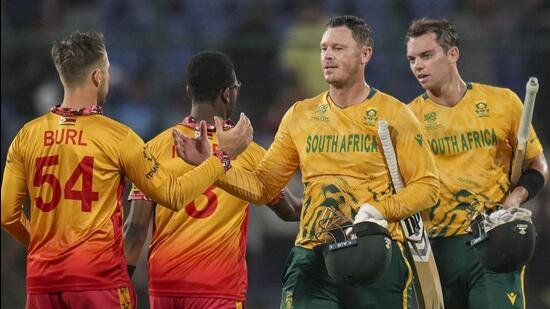
New Delhi: “We had non-believers along the way, and I have one thing to say to those non-believers: Don’t ever underestimate the heart of a champion.”
Those were some of sport’s famous lines spoken by NBA coach Rudy Tomjanovich. He had just guided the Houston Rockets to their second straight NBA title in June 1995. There was context. The Rockets were the lowest seed to ever win an NBA title. Tomjanovich revealed that he had adopted the “heart of a champion” phrase from a comment made by Phoenix Sun player Kevin Johnson during an earlier campaign.
Tomjanovich coached NBA teams for 13 seasons, winning the title twice, after being a five-time All-Star player for the Rockets.
While “winning is a habit” may be an oft-quoted cliché in elite sport, a champion mindset has revealed itself across sports. You do it once, and it gives you amazing mental strength, it binds the group in team sport. When the going gets tough, the steel reveals itself in many ways. This includes overcoming odds when entering a contest, or when everyone around them is convinced they are headed for defeat only for someone or the collective to dig deep. It’s not necessarily that defeat is not an option, but having won before, it’s about finding that inner strength and belief to keep doing it.
In the ongoing T20 World Cup, South Africa have appeared a serene outfit. As they head to Kolkata to take on New Zealand in the semi-finals, there are of course murmurs about how the Proteas, perennial underachievers in global competitions, will perform. A knockout in a format like T20 can throw up surprises on any given day, but as South Africa’s batting coach Ashwell Prince acknowledged, the mood has clearly shifted since last summer.
South Africa have been as good as any other team in the competition since their re-entry into international cricket 34 years ago. However, no other team has suffered the number of heartbreaks they have. A cruel rain-rule put them out of the 1991-92 ODI World Cup, while Herschelle Gibbs dropping the ball in premature celebration in the 1999 World Cup led to the beneficiary, Australia skipper Steve Waugh, taunting the fielder “You dropped the Cup, mate!”
When they met again in the semi-finals, it was Australia’s turn to show the champion’s heart by dragging the match back. As South Africa’s last man ran himself out in panic to tie the match, the group stage win took the 1987 champions into the final and eventual glory. Waugh’s “mental disintegration” meant rivals faced not just a formidable force, but also a battle of nerves they seldom won.
If Shane Warne put aside his misgivings about Waugh to pull his weight in 1999, his early departure from the next ODI World Cup in South Africa after testing positive for a diuretic angered skipper Ricky Ponting, but didn’t stop his side from retaining the title. The Aussies would complete a hat-trick in the Caribbean four years later. In the 2003 campaign, Australia faced a big test against England, but found its hero in Andy Bichel. A generation of England captains and players have wilted against their combative arch-rivals.
South Africa suffered heartbreak in the 2024 T20 World Cup, this time slipping up in the final against a determined India. But the World Test Championship final success, that too against Australia, and at Lord’s, was a massive release. Aiden Markram and Temba Bavuma battled to a brilliant partnership to take the Proteas to victory. It not only helped shed the tag of ‘chokers’ – although Graeme Smith, when asked before the 2007 ODI World Cup dismissively said, “we only choke on spare ribs”.
But South Africa have carried that champion spirit. In batting and bowling, players have stood up and delivered so far. It will take a very good New Zealand side to upstage this Proteas side, not like they did at home in the 2015 ODI World Cup semi-final at Auckland. “Big belief to deliver” as Prince put it.
Brazil are a classical example in world football. They didn’t win the World Cup until 1958, but added two more in the next three editions. The 1994 squad wasn’t the best in the field by any stretch of imagination, and the school of 2002 didn’t hold out hope until the late appointment of Luis Felipe Scolari and players moulding their lavish skills in his pragmatism. Brazil haven’t won since, but the five-time champions will definitely march into the tournament confident of doing it their way.
At the other end, interminable wait in sport can turn into repeated agony and hand-wringing. England’s inability to reprise their 1966 World Cup triumph adds so much weight on their shoulders they fluffed their lines in consecutive European championships, beaten in the final by Italy and Spain, in 2021 and 2024 respectively. Italy have often looked down and out, but when it came to penalty shootout at Wembley the former World Cup winners were the ones to stand up.
And Spain are a supremely confident side, believing in their playing philosophy as well as their winning mentality. That is what a sensational winning sequence of 2008 (Euro), 2010 (World Cup) and 2012 (Euro) has done to them. Be it club or country, players swear by the weight of the jersey they are wearing.
For interminable wait for success, nothing beats Boston Red Sox going 86 years without a World Series title – 1918 to 2004 is defined in American baseball as the “curse of the Bambino” or curse years. The superstition is linked to the unpopular sale of legend Babe Ruth in 1919 to New York Yankees.
But nothing succeeds like the champion mentality. Since 2004, Red Sox have won three more World Series – 2007, 2013 and 2018 – to become the first team to win four times this century.


