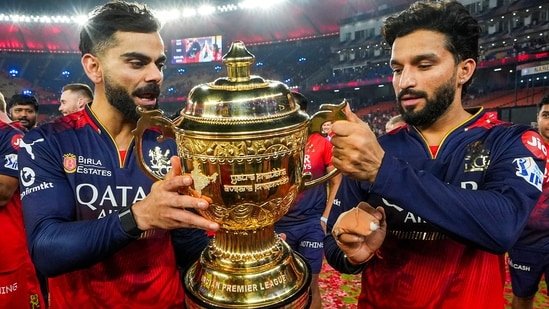
The easiest mistake to make before an IPL season is to flatten the league into one lazy benchmark. Make the playoffs, and you have done well. Win the title, and you have had a great year. Finish outside the top four, and you have failed. It sounds tidy, but it is also nonsense. The IPL is too uneven, too expensive, too emotionally overclocked for success to mean the same thing to Royal Challengers Bengaluru and Chennai Super Kings, or to Punjab Kings and Rajasthan Royals.
Virat Kohli and Rajat Patidar celebrate lifting the IPL 2025 trophy together. (PTI)
That is especially true in 2026. The season begins on March 28 and runs to May 31, with only the first phase scheduled released so far. RCB come in as defending champions after beating the Punjab Kings in the 2025 final. Last year’s top four were PBKS, RCB, GT and MI; DC finished fifth, SRH sixth, LSG seventh, KKR eighth, RR ninth and CSK tenth. So, the right question for this season is not who can win it. It is what a successful 2026 would actually look like for each franchise, based on where it finished, how it was built, and what it is under pressure to prove now.
The title-pressure teams
RCB no longer has the luxury of romance. For years, their season could be sold as a possibility. Virat Kohli, noise, and just enough self-inflicted peril to keep everybody emotionally unwell. That changed when they finally won the title in 2025. Rajat Patidar remains the captain, and Andy Flower carries on as the coach, while Kohli stays at the centre of a squad that is full of potential match-winners. For RCB, success in 2026 cannot be dressed up as another competitive season. The minimum is the top four. A deep playoff run is the true bar. Anything short of that and the defence will feel thinner than the celebration videos.
Punjab Kings now belong in the same bracket. Shreyas Iyer and Ricky Ponting are still in place after taking the team to the 2025 final and the top of the league table, which means the franchise can no longer hide behind its old chaos folklore. Teams spend years trying to escape the good story, weak finish trap; Punjab finally did, and that changes the standard. A successful 2026 for PBKS is not merely hanging around the top six. It is proving that 2025 was not a one-season alignment of stars, foarm and vibes. Playoffs are the minimum. Another top two push is what contender status looks like.
Mumbai Indians and Gujarat Titans sit slightly differently, but in the same pressure family. MI finished fourth last season and still have Hardik Pandya as captain, Mahela Jayawardene as coach, and a star-studded squad that makes mediocrity look almost offensive.
GT finished third and remain under Shubman Gill and Ashish Nehra, adding Matthew Hayden as batting coach. Both teams are too balanced, too experienced and too expensive to be graded on decent campaigns. For MI and GT, success means playing like finalists long before the knockout stage arrives. A top-four finish is not an achievement. It is the entry fee.
The playoff-or-failure teams
Delhi Capitals are the cleanest case in this category. They finished fifth in 2025, one step outside relevance, which is often the most irritating place a team can end up. Not bad enough to burn down the project, not good enough to claim progress. Axar Patel is now in charge of the team, with Hemang Badani appointed as coach, and the squad still has enough proven batting and bowling to make a top-four push realistic rather than theatrical. For DC, success is straightforward: qualify. Another season of almosts, even if decorated with a few excellent individual stories, would still amount to drift.
Sunrisers Hyderabad are the more volatile version of the same idea. Pat Cummins and Daniel Vettori remain in charge, and the squad still carries outrageous hitting power. But that is exactly why the bar for them is not to be dangerous. SRH are almost always dangerous. The problem is that danger can be random; success has to be repeatable. Their 2025 finish of sixth said as much. For them, a successful 2026 means turning explosive potential into a proper top-four campaign. Nobody should be fooled by one week of 250s if the season still ends in the middle of the table.
Lucknow Super Giants also belong here, though their case is more psychological. Rishabh Pant remains captain, Justin Langer remains coach, and the squad still looks like one that should scare opponents much more consistently than it actually does. LSG have enough name value to create noise; what they have lacked at key moments is a stable identity. Seventh place in 2025 was not a catastrophe, but it was a reminder that expensive batting talent alone does not create coherence. Success in 2026 is a return to the playoffs and, more importantly, a season where their cricket finally makes structural sense.
Kolkata Knight Riders are a fascinating inclusion in this band because they are coming from eighth, not fifth or sixth. But context matters. This is still a recent champion franchise, and 2026 begins with Anjinkya Rahane as captain and Abhishek Nayar as coach. That alone says this is not being sold as a patient rebuild. It is being sold as a reset with ambition. Harshit Rana’s injury is an early blow, and Blessing Muzarabani’s arrival underlines how quickly KKR have had to patch their pace resources. That makes the challenge harder, not smaller. For KKR, success is a return to playoff and the emergence of a shape that feels credible again.
The teams that need direction as much as results
This is where the story gets more interesting, because success does not always arrive looking like a trophy charge. Sometimes it arrives looking like a team finally knowing what it wants to be.
Chennai Super Kings finished last in 2025, and the fact that alone removes the old protection of the brand. Ruturaj Gaikwad remains captain, and Stephen Fleming remains coach, but the squad now carries a visibly different mix, with the old aura still present and fresh batting intent folded into it. For CSK, success in 2026 is not simply winning because you are CSK. Real success would be a season that restores clarity: a recognisable template, a credible batting identity, and genuine playoff relevance in the second half of the campaign. The top four would be a major success. Finishing fifth or sixth after looking like a side with a future would still count for something. Another year of confusion would not.
The Rajasthan Royals are the other team in this category, through for different reasons. They finished in ninth in 2025 and enter 2026 under Riyan Parag and Kumar Sangakkara with a squad that mixes serious upcoming Indian talent with enough experience to avoid being dismissed as a developmental side. That is what makes RR so difficult to judge: they have the ceiling of a fast-rising team and the fragility of one still figuring itself out. So their success bar should be set intelligently. It is not title-or-bust. It is not even strictly playoffs-or-failure. A successful 2026 for RR would mean moving toward something sturdier than occasional promise. A playoff spot would be a genuine statement.