



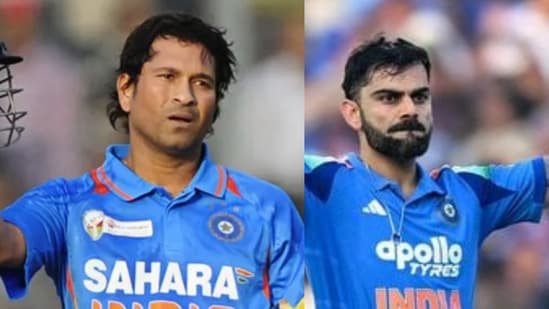
On March 16, 2012, Sachin Tendulkar reached a number that had long ceased to feel merely statistical. By the time he nudged his way to 114 against Bangladesh in the Asia Cup at Mirpur, his 100th international century had already become part national obsession, part sporting myth. That wait had stretched, the noise had built, and the milestone had swollen into something far larger than a score. When it finally came, it did not merely complete a record. It altered the definition of batting greatness.
Fourteen years later, the number remains untouched.
That, more than the romance of the day, is what gives the anniversary its enduring force. Cricket has moved on, formats have shifted, calendars have tightened, and batting conditions have evolved, and yet Tendulkar’s 100 100s still stand. More tellingly, the one man who has come closest – Virat Kohli, the defining run-machine of the post-Tendulkar age, is still 15 short. And that distance, far from diminishing Kohli, only enlarges the record he is chasing.
A record built on a lifetime of excellence
The temptation with Tendulkar’s 100 is to view it through the lens of roundness. But the number itself is only the surface. What makes it so formidable is the scale of excellence required beneath it.
Tendulkar’s final split – 51 Test Hundreds and 49 ODI Hundreds – tells the first part of the story. He did not build the record through domination of a single format. He built it across two of the hardest and most demanding arenas the game had to offer, over nearly a quarter of a century, against changing attacks, rules, demands, and expectations. He was not simply prolific. He was prolific for far longer than the sport usually allows.
That is why the record has aged so well. It demands two rare gifts in perfect combination: a peak high enough to separate a batter from his era, and a longevity deep enough to outlast it. Great players have often possessed one. Very few have sustained both at the level of Sachin Tendulkar. His 100 centuries were the accumulated weight of elite batting over generations of cricket.
The 100 centuries are more than the feat of a genius. It is closer to an endurance monument. To get there, a batter must remain world-class long after most careers have already surrendered to wear, decline, or the narrowing opportunities of age.
Virat Kohli is the closest challenger the game could have produced
If cricket were ever going to produce a serious threat to Tendulkar’s 100, it was always likely to be Kohli. No other modern batter has combined volume, conversion, technical range and appetite for accumulation quite like him. Kohli currently has 85 international hundreds: 30 in Tests, 54 in ODIs, and 1 in T20Is. That is enough to own a conversation. Nobody else has come close enough to turn Tendulkar’s record from a shrine to pursue. Kohli has.
Yet that is precisely what makes the record look even greater. Eighty-five hundreds is a towering number in any historical frame. In most eras, ot would have looked unreachable. In another context, it would have been the defining monument of batting itself. But in the chase, 85 does not bring the finish line into clear view. It merely reveals how far above ordinary greatness Tendulkar’s 100 truly sits.
The real obstacle for Kohli is not class
At this stage of the chase, the question is no longer whether Kohli is good enough. His numbers settled that long ago. The question is whether modern cricket will offer him enough innings, and whether time will allow him enough of himself.
That is where the pursuit has grown harder. Virat Kohli has already retired from T20Is after the 2024 T20 World Cup final and stepped away from Test cricket in May 2025. In practical terms, that leaves the road to 100 centuries as an ODI-only road.
The arithmetic captures the difficulty with brutal clarity. Kohli’s current ODI record stands at 54 hundreds in 299 innings, which translates to a century roughly every 5.5 innings. Hold that astonishing rate steady, and he should still need around 83 more ODI innings to score the remaining 15 centuries. That means the Indian maverick would require another major career surge.
Can Kohli still get there?
It would be foolish to dismiss Kohli outright. A batter of his calibre has earned the right to remain in any conversation until the conversation is closed. His ODI record remains staggering: 54 centuries, an average above 58, and a conversation standard that has redefined excellence in the format. If anyone can compress a late-career surge into something historic, it is Kohli.
But the realism of the chase must accompany the romance of it. Fifteen centuries is not a gentle closing act. Fifteen centuries is in another elite batter’s full legacy. It requires not merely form, but health, scheduling, selection continuity, and a prolonged stretch in which the great player remains greater than age. Kohli turns 37 in 2026. That does not shut the door. It simply narrows it.
Which brings us back to Tendulkar. Fourteen years after the hundredth hundred, the record still resists history’s usual erosion. It remains singular, not because the game has stopped producing giants, but because even its finest modern run-maker has discovered that there is still a long climb left. Tendulkar’s 100 centuries were never just a feat of accumulation. It was the ultimate fusion of brilliance, longevity, discipline and time.
And that may be why it still stands as cricket’s grandest batting monument: because the closer Kohli gets, the more impossible it begins to look.


