



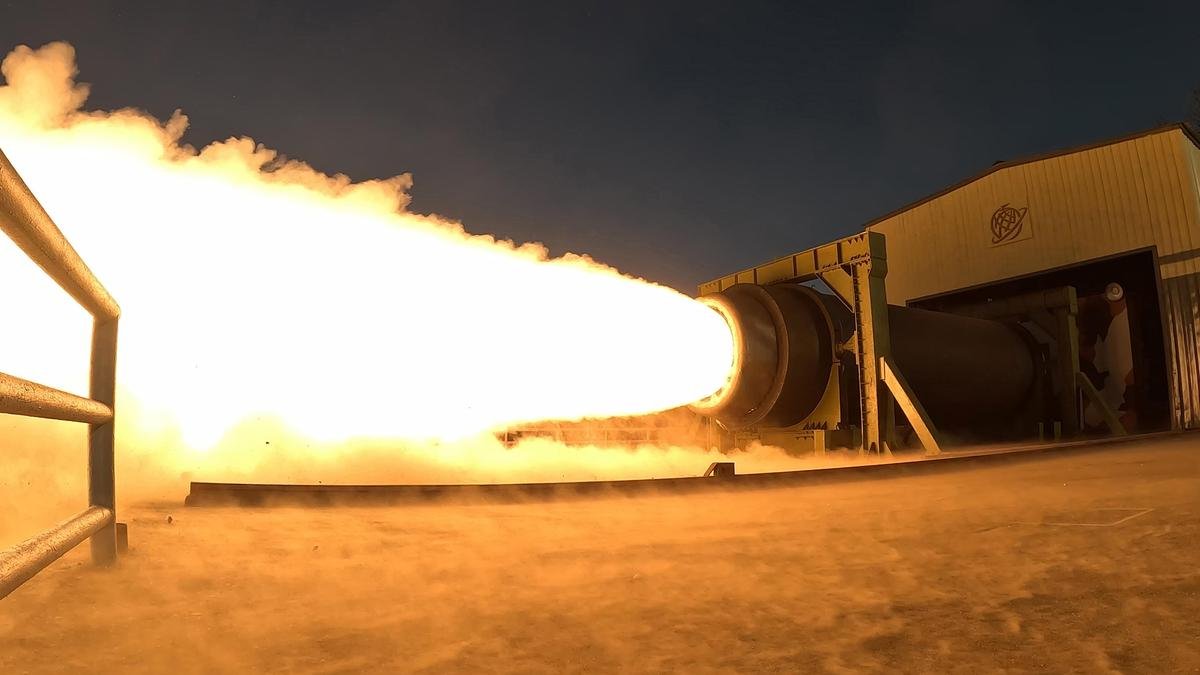
This undated photo provided on March 29, 2026, by the North Korean government, shows what it says is a solid-fuel engine test at an undisclosed place in North Korea.
| Photo Credit: AP
North Korean leader Kim Jong Un observed a test of a high-thrust, solid-fuel engine test and hailed it as a development to boost the country’s strategic military capability, state media reported on Sunday (March 29, 2026).
The test likely indicates Mr. Kim is intent on enlarging and modernising an arsenal of missiles capable of reaching the United States mainland.
The report on Sunday (March 29) from the Korean Central News Agency (KCNA) came days after Mr. Kim delivered a speech at North Korea’s Parliament pledging to irreversibly cement his country’s status as a nuclear power and accusing the U.S. of global “state terrorism and aggression,” in an apparent reference to the war in the West Asia.
Mr. Kim watched the ground jet test of the newly upgraded engine using a composite carbon fibre material, according to the KCNA, which reported the engine’s maximum thrust is 2,500 kilotons, up from about 1,971 kilotons reported in a similar solid fuel engine test in September.
A push to increase the engine power is likely associated with efforts to place multiple warheads on a single missile to increase chances of defeating US defences, observers say.
The KCNA did not report exactly when or where the test occurred.
The test was conducted as part of the country’s five-year military escalation program. The plan’s objectives include upgrading “strategic strike means,” the KCNA reported.
Also Read | Kim vows North Korea’s ‘unshakable’ support for Russia
The reference is understood to mean nuclear-capable, intercontinental ballistic missiles targeting the continental U.S..
Mr. Kim said the latest engine test had “great significance in putting the country’s strategic military muscle on the highest level,” the KCNA reported.
In recent years, North Korea has test-fired a variety of ICBMs demonstrating the potential range to reach the US mainland, including missiles with solid propellants that make detection prior to liftoff more difficult.
The country’s older liquid-fuel missiles must be fuelled before liftoffs and cannot last long.
Some foreign experts say North Korea still faces technological hurdles before it has a functioning ICBM, such as ensuring its warheads survive the harsh conditions of atmospheric reentry.
But others dispute that assessment given the number of years the country has spent on its nuclear and missile programs.
North Korea has pushed hard to expand its nuclear arsenal since Kim’s high-stakes diplomacy with U.S..
President Donald Trump collapsed in 2019. At a ruling Workers’ Party congress in February, Mr Kim left the door open for dialogue with Mr. Trump but urged Washington to drop demands for the North’s nuclear disarmament as a precondition for talks.
Published – March 29, 2026 10:38 am IST


