



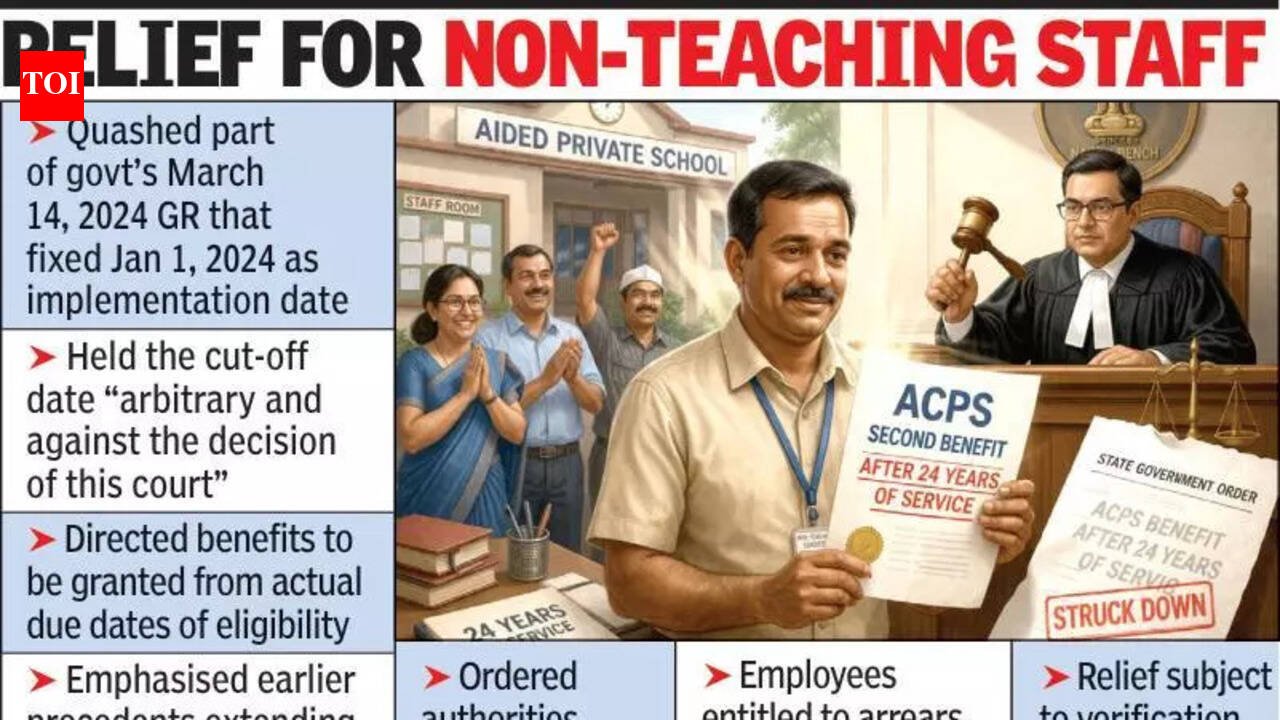
Nagpur: In an important ruling with wide implications for education sector employees, the Nagpur bench of the Bombay High Court recently held that non-teaching staff in aided private schools are entitled to the second benefit under the assured career progression scheme (ACPS) immediately upon completing 24 years of service, striking down part of a state govt order that delayed its implementation.A division bench comprising Justices Mukulika Jawalkar and Nandesh Deshpande quashed the Maharashtra govt’s March 14, 2024 resolution to the extent that it made the second ACPS benefit applicable only from Jan 1, 2024. The judges ruled that such a cut-off was “arbitrary and against the decision of this court”, emphasising that eligible employees must receive benefits from their actual due dates.“We direct the respondents to apply second ACPS to the petitioners as early as possible, preferably within six months. The petitioners are entitled to all the consequential benefits — revised pay fixation, arrears of salary, revised retirement benefits, monthly pension — which have been released, within six months,” the bench said.The petitions were filed by over 50 non-teaching employees — both serving and retired — from aided schools across Amravati and Gondia districts through counsel Bhanudas Kulkarni, challenging the denial of timely financial benefits despite completing the requisite 24 years of service. They sought revised pay fixation, arrears, pension revision, and other consequential benefits. However, the relief will be subject to verification of individual eligibility criteria by the competent authorities.The court relied on earlier precedents, noting that similarly placed employees have already been granted relief. Quoting a prior judgment, the bench observed, “We find no reason why the same benefit cannot be extended to the petitioners,” adding that such benefits should be extended to all similarly situated employees without forcing them to approach the judiciary repeatedly.Rejecting the state’s argument that ACPS is merely an incentive and not a statutory right, the court underscored that policy decisions cannot override binding judicial precedents. It also dismissed the distinction drawn between teaching and non-teaching staff as insufficient to deny parity in this context.As per the petitioners, the ruling is expected to impact a large number of non-teaching employees across Maharashtra, reinforcing principles of service parity and timely career progression benefits within the education system.


