



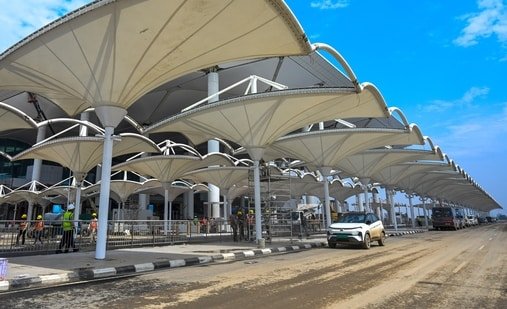
The first phase of the Noida International Airport at Jewar, inaugurated by Prime Minister Narendra Modi on March 28 is set to drive the next phase of real estate growth in NCR, particularly across Yamuna Expressway, Greater Noida, and Noida. Backed by enhanced connectivity and an evolving economic base, the airport is expected to accelerate development and transform these areas into high-growth corridors spanning residential, hospitality and retail segments.
The project is likely to spur end-user demand, especially for premium and luxury housing with modern amenities, while also attracting greater participation from Grade A developers. Key micro-markets such as the Yamuna Expressway, Greater Noida and the Noida Expressway belt are expected to see increased traction, particularly in the mid-income and high-end segments, say experts.
They note that the region is being developed along an aerotropolis model, similar to global hubs such as Schiphol, where aviation infrastructure is integrated with commercial, industrial, logistics and residential ecosystems. This model aims to create self-sustaining urban centres, with the airport acting as the nucleus of a broader economic network supported by manufacturing clusters, logistics hubs and business districts. Improved connectivity through expressways and multimodal transport networks is expected to reduce travel time and enhance overall investment appeal.
Estimates by SquareYards suggest that improved infrastructure could drive property prices along the Yamuna Expressway corridor up by as much as 28% by 2027. A recent report by Knight Frank India adds that the airport’s operationalisation is likely to boost developer confidence and increase residential supply in micro-markets such as Greater Noida, which has already witnessed steady momentum in launches and sales since the foundation stone was laid in November 2021.
As connectivity improves, previously peripheral areas are becoming increasingly viable for both homebuyers and investors. Going forward, demand is expected to be driven more by end-users seeking better planning, connectivity and liveability than by purely speculative interest. At the same time, investors are focusing on long-term, infrastructure-led growth, pointing to a more sustainable and balanced real estate cycle in the region, experts said.


Also Read: Noida International Airport to drive real estate prices: Plots may rise 28%, apartments 22%
“The Jewar Airport is a landmark infrastructure project, not just for the NCR but for India’s broader economic geography. Airport-led development has consistently been one of the most powerful catalysts for real estate growth in the country, driving demand across commercial, logistics, hospitality, healthcare, education and residential segments within a wide catchment,” said Anshuman Magazine, Chairman and CEO – India, Southeast Asia, Middle East & Africa, CBRE.
“The commencement of the Noida International Airport is expected to act as a strong catalyst for real estate development especially in the immediate catchment of Greater Noida and the Yamuna Expressway. With improving multi-modal connectivity and availability of large land parcels, we anticipate sustained growth in end-user demand, increased project launches, and continued upward momentum in capital values,” said Rajeev Vijay, Executive Director, Government Infrastructure Advisory, Knight Frank India.
“Noida International Airport (NIA) is likely to act as a structural catalyst for NCR’s next phase of real estate evolution, combining enhanced global connectivity with an already maturing economic and real estate base. As a second international gateway for the region, with an initial capacity of 12 million passengers and long-term scalability to 70 million, it is expected to strengthen the region’s integration with global business networks,” said Supriya Chatterjee, Managing Director, North, Cushman & Wakefield.
Who will drive demand near Noida International Airport: Investors or end-users?
Large infrastructure developments like the Noida International Airport are reshaping buyer dynamics in the region, attracting a mix of investors and end users.
“Large infrastructure projects tend to influence how residential markets evolve. As connectivity improves, areas that were earlier considered peripheral become more viable for both homebuyers and investors,” said Vijay Jain, Director, Star Estate.
“We are seeing a balanced mix of buyers entering the market. Investors are evaluating long-term potential linked to infrastructure, while end-users are also exploring options, especially in projects that offer better planning, connectivity and everyday liveability,” he said.
Jain also highlighted that simultaneous infrastructure development is accelerating market maturity. “Unlike earlier cycles where infrastructure and real estate growth happened in phases, multiple connectivity projects are now progressing together, significantly speeding up the region’s transition into a residential hub,” he said.
“Every new corridor sees initial excitement, where prices move faster than the ecosystem,” said Yukti Nagpal, Director, Gulshan Group. “What sustains a market is its evolution as a place to live, not just invest. Buyers are now looking beyond land appreciation to lifestyle, quality of living and future-ready infrastructure.”
She said that as the airport-led ecosystem matures, the region will attract a more premium buyer profile, driving a transition from plotted developments to curated, lifestyle-focused housing.
Echoing this, Salil Kumar, Director, Marketing and Business Management, CRC Group, said, “What we are witnessing is the evolution of a corridor from an investment destination to a planned urban ecosystem. As infrastructure and economic activity gain momentum, demand is clearly shifting towards organised, well-designed developments that offer a complete living experience, not just connectivity.”
Jewar Airport: Impact on residential property prices
The upcoming Noida International Airport at Jewar has triggered a sharp appreciation in property prices across the Noida housing market, particularly along the Yamuna Expressway corridor, according to a report by proptech platform Square Yards.
As per the report, “Runway to Realty: How Noida International Airport is Reshaping Realty,” apartment prices have nearly tripled between 2020 and 2025, while plot values have risen by an average of 1.5 times. In select micro-markets, prices have surged as much as fivefold, reflecting strong investor-driven momentum backed by infrastructure development.
Improvements in liveability, job creation and infrastructure upgrades are supporting this growth. The report projects that property values will continue to rise, with plot and apartment prices expected to increase by 28% and 22%, respectively, over the next two years.
“The Noida real estate market is currently at a pivotal moment, balancing its local roots with global ambitions, largely due to the upcoming Jewar International Airport,” said Tanuj Shori, Founder and CEO, Square Yards. “The airport is driving the development of a world-class aerotropolis, with significant long-term implications for housing demand, pricing and investment activity. It demonstrates how strategic infrastructure can reshape regional identity and unlock sustained economic growth.”
Sunita Mishra, Vice-President – Research & Insights at Square Yards, added that before the airport’s progress, Noida’s real estate market lagged other NCR regions due to project delays and developer challenges. “However, with visible progress in airport construction and supporting infrastructure, there has been a clear shift in sentiment. Developers are actively launching projects, especially in high-impact zones, to capitalise on emerging demand,” she said.
Gaurav Mavi, Co-founder of BOP.in, noted that Sector 22D along the Yamuna Expressway is emerging as a key investment hotspot, offering opportunities across plotted developments, group housing and commercial projects. He said the growing demand for residential developments due to their proximity to the airport, alongside increasing traction in commercial hubs driven by anticipated retail and business activity. Entry-level investments start at around ₹30 lakh, while premium offerings can go upwards of ₹1 crore, he added.
Vishal Raheja, founder and managing director, InvestoXpert Advisors, said the airport’s operationalisation marks a defining inflection point for the Yamuna Expressway corridor, enabling a multi-node urban growth model. “Over the past six years, Noida has delivered nearly 5x returns in select micro-markets, driven by infrastructure expansion, policy support and rising end-user demand,” he said.
He said the Yamuna Expressway has emerged as one of NCR’s strongest real estate corridors between 2020 and 2025, with apartment prices rising 158% (from ₹3,950 to ₹10,200 per sq ft) and plot prices surging 536% (from ₹1,650 to ₹10,500 per sq ft). Land prices have appreciated 5–6 times, while residential assets have grown 2–2.5 times, largely reflecting future infrastructure gains.
With aviation-linked industries, logistics parks, data centres and the proposed Film City taking shape, the region is steadily evolving into a major residential and commercial hub, signalling sustained long-term growth.
Noida International Airport: Impact on commercial real estate
As per a C &W analysis, in the office segment space, Noida currently hosts 43.4 MSF of office stock, including 26.6 MSF of Grade A+ supply, reflecting a significant rise in investment-grade assets over the past five years, with leasing activity at 4.7 MSF in 2025. The Noida International Airport is expected to further reinforce this strength by attracting higher-value occupiers, potentially deepening absorption and strengthening the city’s Grade A+ profile. GCC activity has also scaled up to ~2 MSF, supported by state incentives and a robust talent ecosystem. With this strong base, the airport is likely to sustain the GCC demand, as improved global access may encourage multinational firms to consolidate, expand or establish operations in Noida.
Beyond offices, NIA is also expected to unlock opportunities across hospitality and retail segments.
“On the commercial real estate front, the international airport is expected to attract global occupiers in the coming years, further enhancing the value proposition of Noida’s office market. We expect close to 2-3 million sq. ft. of annual Grade A office space demand in Noida over the course of the next few years, accounting for almost one-fourth of Delhi NCR’s leasing activity in 2026 and beyond,” said Vimal Nadar, National Director and Head, Research, Colliers India.
Yamuna Expressway vs Gurugram: A different growth story
Experts say the Yamuna Expressway’s evolution is not a repeat of Gurugram’s growth model, but a more integrated and multi-layered urban transformation.
Manoj Gaur, CMD, Gaurs Group, said the Noida International Airport will act as a major gateway, boosting global connectivity and attracting investments across sectors. “We expect a strong ripple effect on real estate, with property values witnessing steady appreciation. The airport will not only benefit Noida and Greater Noida but will also strengthen Uttar Pradesh’s position as an industrial and logistics hub, generating large-scale employment and driving demand for quality housing,” he said.
Sahil Agarwal, CEO, Nimbus Group, noted that the Yamuna Expressway is entering a new phase of growth. “The convergence of key drivers, including the airport, industrial and logistics hubs, the upcoming Film City and data centre clusters, is creating a more stable and diversified demand ecosystem. The market is no longer driven purely by early investors; end-users and long-term stakeholders are increasingly participating,” he said.
He said that formats such as low-rise developments and integrated townships are gaining traction, supported by improving affordability compared to established markets like Noida and Gurugram. “The region is steadily evolving into a self-sustaining city, with residential, commercial and industrial growth complementing each other,” Agarwal said.


