



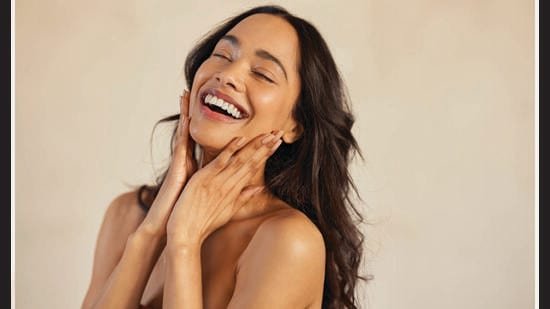
You don’t need to ask AI to write the script for a makeup ad. It’s the usual plot: Woman applies lipstick/eyeliner/whatever, then suddenly feels like a confident baddie with main-character energy. Every sanitary pad promo ever claims you can be a New Woman if you just put on the right pad (the cramps and discomfort were in your head, OK?). It’s advertising’s default formula: The only thing standing between you and a better you is the product they’re trying to sell.
Now, add science to the mix. No. Not your garden-variety of hyaluronic acid hydrators and collagen stimulators. The new superhero in a lab coat is Neurocosmetics. This is the branch of science that claims to have found a direct link between the brain and the skin, which means that what you slather on your face and body can make you feel happier or less stressed by targeting your body’s chemical messengers. Like aromatherapy, but with fewer sneezes and science that is just as dodgy.
Neurocosmetics experts don’t just believe in the link, they say the effects go one-way. Our skin influences our mood, not vice-versa. Because it’s more profitable to sell creams, serums and masks than have us all “think” our skincare troubles away. “The brands are positioning the category with products that balance hormones and deliver emotional well-being, to make people feel more confident while using a product,” says Sanika Sarna, the founder of skincare brand Ounce Organics.
At some level, we’re primed to believe this already. We’re calming down with ASMR videos that have rhythmic swishes and gently popping bubbles. There are scented gel pens that aim to reduce cortisol levels. Every home-fragrance brand plays up the idea that scent brings serenity. We universally prefer the feel of cotton bedsheets over shiny polyester. We respond better to crunchy snacks than soft ones. We’re getting emotional support from Stanley mugs, capybara memes, eucalyptus inhalers and fidget spinners. There are enough people who believe that there’s real neem in a tube of face wash. It’s not surprising that they’ll also believe that a cleanser containing adaptogenic mushrooms can calm them down.
Neurocosmetics are big on fancy-sounding buzzwords: Neuropeptides, bioactives, beta-endorphins. “These are frequently used as a marketing catch-all, and their effects are greatly exaggerated,” says Dr Sonia Tekchandani, the co-founder of skin and haircare clinic Tender Skin International. The branch is also a regulatory grey zone; if something is impacting your brain chemistry, it would need to be classified as a drug and not a cosmetic. And none of these brands really explain the scientific studies involved and what trials were conducted to prove their efficacy.
Another red flag: Neurocosmetics are targeted largely to women, says Dr Tanushree Biswas, dermatologist and head medical advisor at beauty clinic chain Kaya. “These perpetuate archaic beliefs about women and their emotions, and how hormonal changes need to be constantly controlled.” Meanwhile, men can have feelings and still use cheap seven-in-one cleansing gel.
Separate the noise from the actual science. Psychodermatology is a real field. “Your skin reflects your internal health – hormones, sleep, gut health, all of it. Lack of sleep shows up as dull skin and under-eye circles. Constipation can lead to acne due to hormonal imbalances like estrogen dominance,” says Dr Sonali Kohli, senior consultant in dermatology at Sir HN Reliance Foundation Hospital. “But applying a product topically can’t modulate your underlying biological systems. Most of these products work at the level of the skin barrier – helping with hydration and surface-level improvement.”
We convince ourselves that it’s working because we’re sold on the ritual. “It’s not the product, it’s the process,” says Sarna. “It’s the same effect as feeling relaxed when you take a warm bath after a stressful day.” There’s no globally accepted science that proves that skincare formulations can impact our emotions. So, approach neurocosmetics with “informed optimism”, dermatologists say. “They have the potential to be one of the most significant shifts in the beauty industry, because we are moving from surface-level beauty to emotional wellness,” says Radhika Ghai, the founder and CEO of skincare brand, Kindlife. “But it’s still very early, and we don’t have enough strong science-backed proof yet.”
From HT Brunch, May 09, 2026
Follow us on www.instagram.com/htbrunch


