



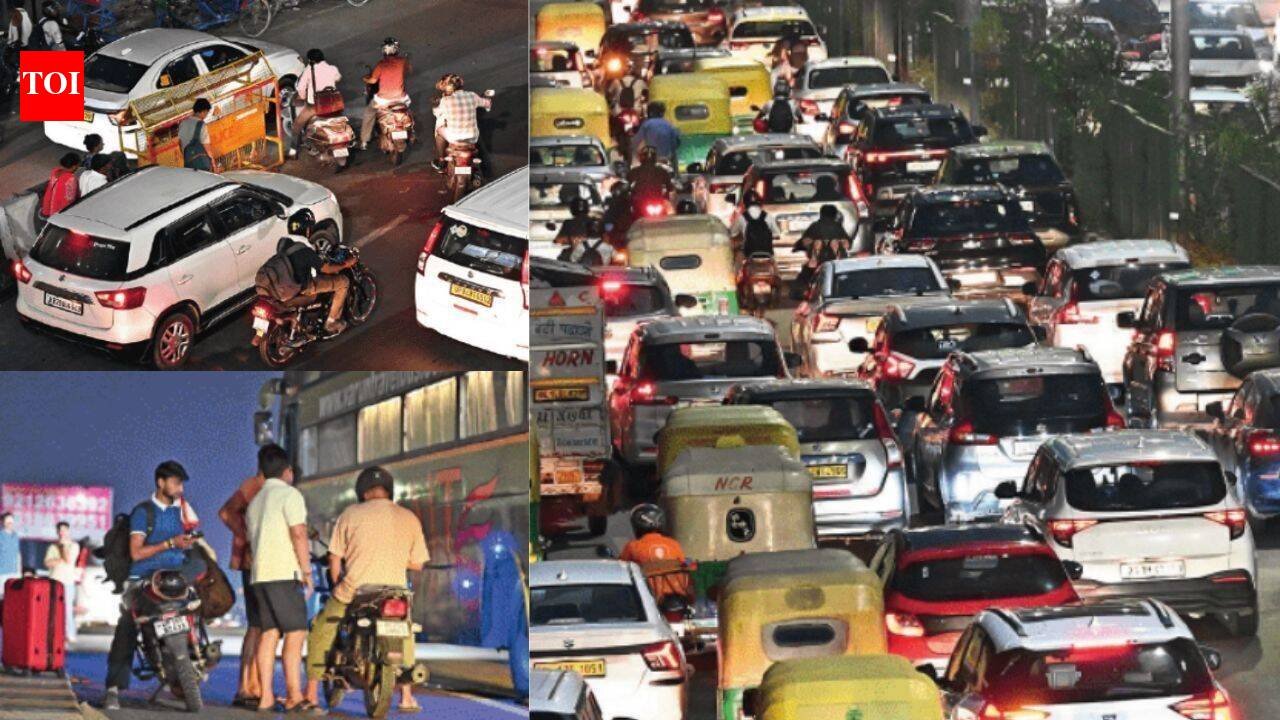
The strange thing about the Akshardham-Noida evening jam is not that traffic slows. It is that the road appears designed to prevent exactly that.The corridor is wide, largely signalfree and meant to move vehicles quickly out of central Delhi towards east Delhi and Noida. There is no red light waiting at the usual choke point, no roundabout, no market crossing that should bring traffic to a crawl. Yet, almost every evening, brake lights begin glowing on a stretch that should have kept moving.
TOI spent two evenings in early July on the corridor to track where the flow first breaks. What emerged was not one big bottleneck but a series of small interruptions. A vehicle waits where it should not. Another cuts lanes late. A cab stops for a booking. A private bus pulls over to pick up passengers. A family with luggage looks for the right coach along the edge of moving traffic. Each action lasts briefly, but each makes the vehicle behind it brake.That is how this road creates its own red lights. The problem is most visible after evening, when commuter traffic, metro-linked pickups, temple-area movement and private interstate buses begin competing for the same road edge. Long-distance buses add a different kind of friction. Unlike a quick citybus halt, boarding here often means passengers searching for the bus, loading bags, gathering children and stepping in from the carriageway. For through traffic, every such stop means one more lane partly lost.The cost is paid far beyond the flyover. A commute that should take minutes can stretch several times longer. Engines idle. Fuel burns. Tempers rise. Pollution increases with it. The delay cascades into offices, homes, dinner tables, school pickups and hospital appointments. It also makes the road more dangerous: when moving lanes double up as pickup points, both drivers and pedestrians are forced into avoidable conflict.
“When traffic demand from four lanes is suddenly reduced to one or two, drivers often lose the patience to follow the zipper merge principle, under which vehicles from each lane merge alternately. Instead, every driver competes to be first, creating conflict, long queues, aggressive driving, and often road rage. This is not merely a driver’s dilemma— it is fundamentally a traffic engineering failure,” explained Rohit Baluja, director of Institute of Road Traffic Education.He added that whenever a single car, bus, truck, or even an autorickshaw comes to a halt on a major arterial road, drivers instinctively shift into adjacent lanes to bypass the obstruction. The resulting lane-changing forces vehicles in neighbouring lanes to brake or alter speed, triggering a chain reaction that rapidly spreads across all lanes. What begins as a minor disruption in one lane can quickly develop into congestion extending several kilometres. Such situations are a result of a shockwave effect.The fixes are not mysterious. Private bus pickups need designated bays away from the moving carriageway. Cab waiting must be pushed into legal pickup zones, not tolerated under no-parking signs.
Kiosks and vending spillovers along fast corridors need relocation or stricter spacing. Lane splits need clearer marking and channelising so that lastsecond cuts reduce. Most of all, enforcement has to change behaviour, not merely record violations.Additional CP (traffic) Vijayanta Goyal Arya said regular prosecution is carried out and that traffic police, district police and civic bodies have held drives against encroachments, unauthorised parking and wrong-side driving. Another traffic official said 10-15 private buses and nearly 100 cabs are challaned daily on the stretch, and that more bus bays are being considered.But if the same violations return every evening, the road is not being regulated. It is being negotiated, halt by halt.


