



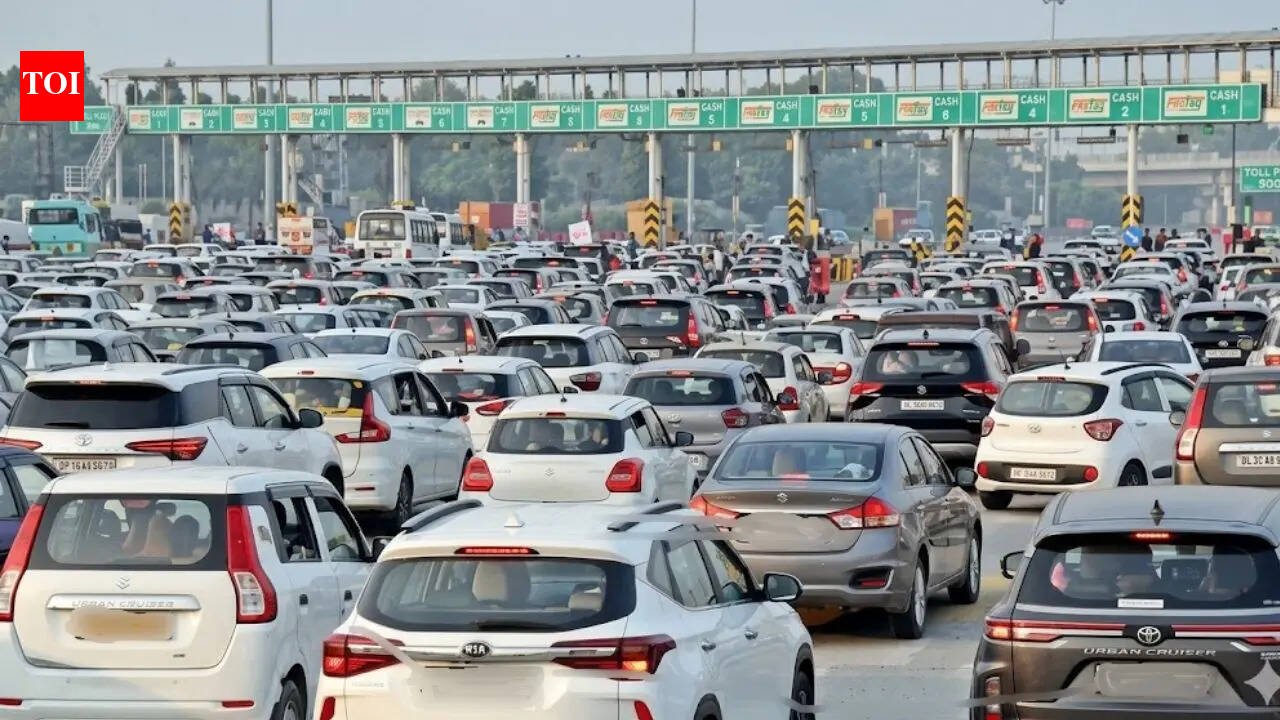
GURGAON: Commuting on Dwarka Expressway is set to become costlier from April 1 —more so, for those dependent on cabs —after National Highways Authority of India (NHAI) revised toll rates at the Bijwasan plaza.“The increase of 2-5% has been made across vehicle categories,” an NHAI official said, adding, the revision is part of the authority’s annual toll rationalisation exercise carried out in accordance with changes in the central govt’s wholesale price index (WPI), which typically results in incremental increases each year.
The revision comes just months after toll collection began at the plaza in Nov last year and is expected to further push up travel costs for daily commuters.The impact will be felt more by cab users, as the single-journey crossing toll has now been increased from Rs 355 to Rs 365, while the return-journey fare has gone up from Rs 535 to Rs 550. The monthly pass for 50 trips has also been revised upwards from Rs 11,890 to Rs 12,195.For private car users, the single-trip toll has been raised from Rs 220 to Rs 225, a 2.3% increase, while the return fare has gone up from Rs 330 to Rs 340. The monthly pass for 50 trips has been revised from Rs 7,360 to Rs 7,550. Meanwhile, the concessional monthly pass for residents living within a 20-km radius has also been increased from Rs 340 to Rs 350.While private vehicle owners have the option of monthly or annual passes to reduce per-trip costs, cab users do not enjoy similar relief. Cab aggregators typically pass on toll charges directly to passengers, making every trip more expensive.Many residents said fares have already surged since toll collection began last year and will rise further after the latest revision.Ranjan Jain, a resident of Chintels Serenity in Sector 109, said, “Hike in toll charges by NHAI will add more burden on commuters, especially those depending on taxis or cabs to travel between Gurgaon and Delhi through Dwarka Expressway, including senior citizens, women and students.”He added that cab fares have nearly doubled since the Bijwasan toll became operational. “Earlier, a ride from Sector 110 to Dwarka Sector 21 cost around Rs 250. Now it is Rs 550-600. It is often cheaper to take a longer route via Udyog Vihar just to avoid the toll. Since monthly passes are not applicable to taxis, the entire cost is borne by the end user. Authorities should consider allowing some relief at least until public transport becomes available,” Jain said.Residents also pointed out the absence of public transport in the area. Yash Varmani, a resident of Godrej Meridien in Sector 106, said, “Despite paying high taxes, residents living along Dwarka Expressway still do not have access to public transport. In its absence, cabs or private vehicles become unavoidable, even though they are extremely expensive due to toll charges. This also adds to traffic and pollution. The govt needs to address the issue and start bus services and metro connectivity, which we have been demanding for a long time.”Other vehicle categories have also seen a similar revision at Bijwasan toll plaza. For buses and trucks, the toll has been increased from Rs 745 to Rs 765 for a single journey, while return charges have gone up from Rs 1,120 to Rs 1,150. Three-axle vehicles will now pay Rs 835 per trip compared to Rs 815 earlier, while heavy construction machinery with four to six axles will be charged Rs 1,200, up from Rs 815. Oversized vehicles (seven or more axles) will now pay Rs 1,465, compared to Rs 1,425 earlier.The revision in toll charges has been made at other plazas in the city. At the Kherki Daula toll plaza on NH8, cars are charged Rs 100 for a single journey and Rs 150 for a return trip, with a monthly pass of Rs 3,320 and a local pass of Rs 350. Similarly, at the Ghamroj toll plaza on the Sohna Highway, car toll has been increased from Rs 125 to Rs 130, while the return fare has gone up from Rs 190 to Rs 195. The monthly pass has been revised from Rs 4,240 to Rs 4,345, and the local monthly pass from Rs 340 to Rs 350.


