



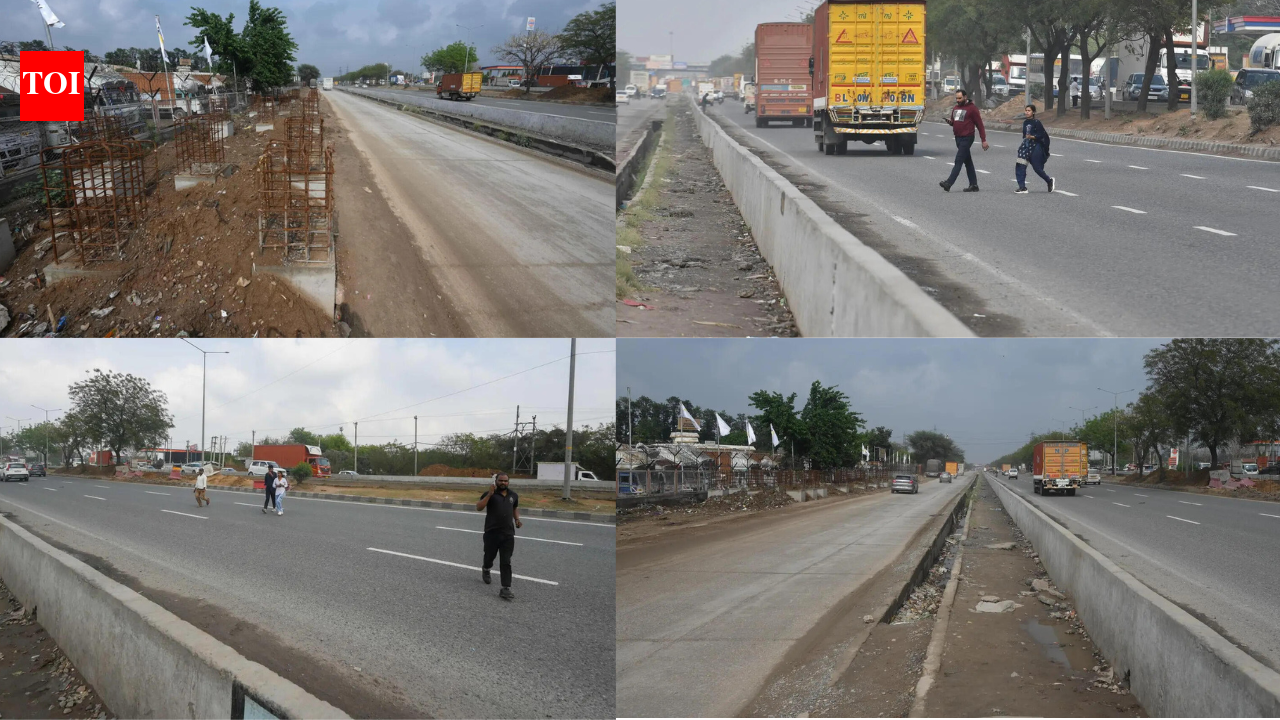
GURGAON: Along NH8, over 700 people every hour attempt what feels less like a commute and more like a race against death.At a stretch of Delhi-Gurgaon Expressway near Binola Industrial Area, every workday begins with a gamble for factory workers, delivery staffers and daily wagers; for some, it ended in tragedy. The daily wagers include those employed at the sprawling warehouse of an e-commerce firm across the highway.Their only way to reach work is to cross a relentless, high-speed corridor with no safe passage. In 2024 and 2025, 21 road users met with accidents at this very blackspot. Fourteen lost their lives. Among them were eight pedestrians — five in the past year alone —who died while simply trying to get to work or return home.
Satbir, a transporter, told TOI, “One of my drivers died last year while crossing here. A foot overbridge (FOB) started but then slowed due to objections. There is an urgent need for this FOB,” he said. National Highways Authority of India (NHAI) proposed the FOB considering the heavy pedestrian movement in the Binola industrial hub.The Binola FOB is part of a larger Rs 282-crore NHAI project to build nine-foot overbridges along a 59-km stretch between Kherki Daula and Jaisinghpur Khera, including locations such as Shikohpur, Manesar, Rathiwas, Malpura, Jaisinghpur Khera, Sidhrawali, Kharkhara and Khajuri.“Construction of the FOB at Binola is currently underway and is expected to be completed by the end of April,” an NHAI official said. Until then, as the sun rises and sets over NH8, the crossing continues. Workers will pause, judge the speeding traffic and run. And hope they make it across.“I hold my breath every day,” said a local dhaba owner. “We don’t know who will survive the crossing.” The FOB, meant to be their lifeline, stands unfinished, Its skeletal structure a daily reminder of delayed safety.According to the locals, construction began over a year ago but slowed after objections from a landowner adjacent to the proposed site, leaving thousands exposed. During construction, the landowner of the property adjacent to the FOB site objected, requesting the structure be shifted to nearby vacant land, citing concerns over access to their property. A detailed audit by the traffic engineering centre (TEC) of Gurgaon traffic police earlier this year found the original location to be both feasible and necessary. Engineers noted that a large number of pedestrians already cross at the same point where the FOB is planned.They also observed that the landowner retains access from two sides, including a 140-metre stretch sufficient for entry and exit. In contrast, shifting the FOB 35 metres away would cut off the only road access to the vacant land.The audit highlighted multiple hazards compounding the risk. Open drains between the service road and the main carriageway force pedestrians to climb over them before even reaching traffic. Boarding and alighting take place directly on the highway, with 32 buses and 22 auto-rickshaws stopping every hour, handling around 276 passengers — many of whom are then forced to navigate the dangerous crossing.Every morning and evening, the same scene unfolds. Workers climb over wide, open drains, gather at the edge of the roaring highway and wait. Minutes stretch endlessly as vehicles whiz past at unforgiving speeds. Then comes the moment of decision: a dash across four lanes, sometimes with children in tow, sometimes burdened with bags, always under pressure.For those who witness the danger daily, the urgency is deeply personal. “I am here for the past five years and have seen several people, mainly pedestrians, die while crossing the road,” said Babu, a biryani seller. “Last year, three women of the same family died in front of my eyes. Many more will die if the bridge is delayed further.”Parking and encroachment worsen the situation. Heavy vehicles occupy the minor road, shrinking usable space, while sidewalks are blocked by parked vehicles and street vendors.TEC recommended immediate measures: a dual-access FOB equipped with escalators, covering of open drains, shifting boarding and alighting to service roads, and strict enforcement against encroachment.A traffic police survey underscores the scale of the crisis: 702 pedestrians crossing every hour during peak times. That translates into hundreds of daily risks on a stretch that offers no safe alternative.


