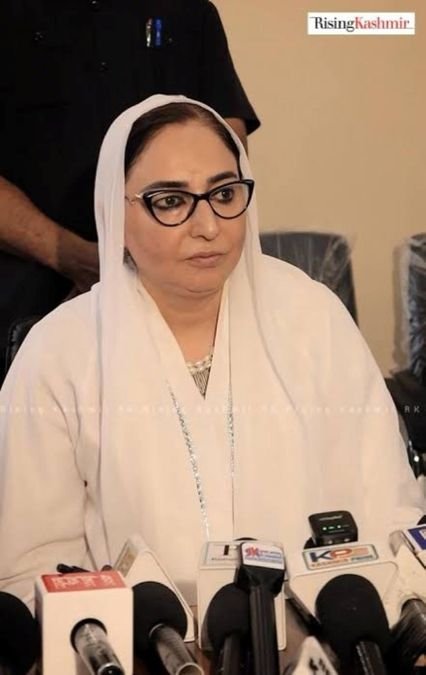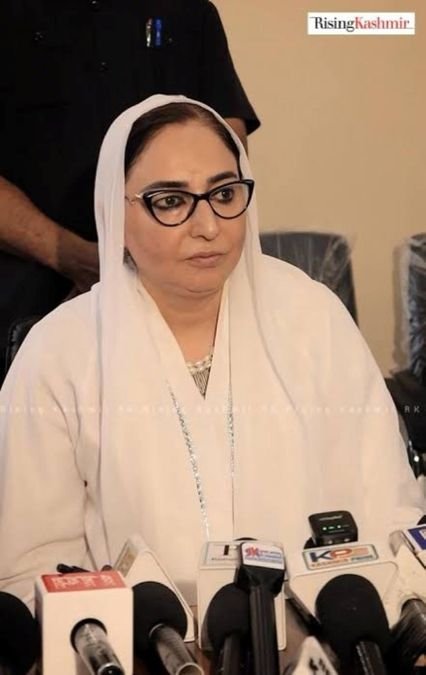
Srinagar, Oct 13: Jammu and Kashmir Waqf Board Chairperson Dr Syed Darakhshan Andrabi on Tuesday rejected allegations that the Board had directed mosques under its control to deliver uniform Friday sermons, asserting that no such order had been issued and that religious scholars would independently determine the subjects of their sermons.
Addressing a press conference in Srinagar amid growing criticism from political and religious leaders, Andrabi said neither the Waqf Board Chairperson nor its officials had the authority to dictate what Imams and Khateebs should preach.
She maintained that the proposed initiative was aimed at encouraging religious scholars to address social problems, particularly drug addiction, suicides, family-related concerns and psychological distress among young people.
“Even Darakhshan Andrabi cannot take any decision, nor can my officer take any decision. It is the decision of the independent scholars, our preachers, our sermonists, that we should try to remove the vices in society,” she said.
Andrabi said religious leaders were best placed to identify the issues confronting society and determine how they should be addressed through Friday sermons.
Referring to problems affecting young people and families, she said religious discourse could help raise awareness about drug abuse, difficulties surrounding marriage, suicides and mental health concerns.
“If we want to talk about drugs today, then we will talk about drugs. If we want to talk about daughters, if there is no marriage, then we will talk about it. If children are committing suicide, then why are they doing it? Why is there trauma in our society? Everyone has decided,” she said.
The Waqf Chairperson categorically denied that the Board had issued any binding instructions requiring religious preachers to follow common sermon topics.
“There is no order. There is no order anywhere,” she asserted.
Clarifying the proposed formation of a core committee, Andrabi said it would consist of religious scholars who would independently deliberate on subjects of public and religious importance.
She said she would not be a member of the committee and had no intention of interfering in its decisions.
“Who will form the core committee? Religious leaders,” she said.
Andrabi maintained that she was not a religious teacher and that decisions concerning religious guidance must remain with qualified scholars.
“Whatever our religious scholars want, they will do it in their own way. There is no interference in that,” she added.
She said religious scholars associated with Waqf institutions had an important role in addressing social problems, just as doctors, engineers and teachers contributed to society through their respective professions.
The Chairperson maintained that the objective behind encouraging discussions on common social concerns was to promote awareness and address problems affecting families and communities.
She urged political leaders to focus on challenges faced by people rather than criticise initiatives intended to address social evils.
Responding to Chief Minister Omar Abdullah’s allegation that the proposal amounted to BJP interference in Muslim religious affairs, Andrabi questioned the basis of the accusation.
“Where did BJP interfere? If I am the leader of BJP, I will be proud. I feel very proud today that I am from BJP,” she said.