



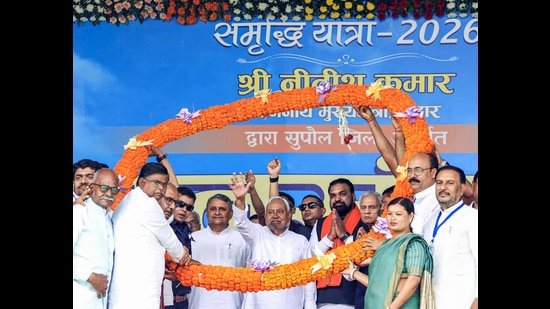
Bihar chief minister Nitish Kumar has undertaken many political Yatras in the past. The restart of his 16th, named “Samriddhi Yatra”, the second leg of which ended in Samastipur on January 29 ahead of the Budget session, form Tuesday is significant for more reasons than one.


First, it begins barely a week after his announcement that he would relinquish the chair of CM that he occupied unchallenged for two decades to make his debut in the Rajya Sabha, the only House that he has not represented in his over four-decade long political career.
Second, this may well be his last Yatra as CM before he steps down to create political room for his son, Nishant Kumar, who joined the JD(U) last Sunday after always remaining away from politics despite his father’s massive influence. In fact, taking a high moral stand on dynastic politics, Nitish never allowed any of his family members to get into politics taking his advantage.
A senior party leader, who did not want to be quoted, said that Nitish Kumar’s “Yatra” is to review development projects and solidify his political legacy as he prepares to step down, but he has lived up to his words by not allowing his son to accompany him on his official Yatra as CM.
“His son will take separate Yatra to get acquainted with the rigours of politics. As a father, he will give him his blessings. At present Nishant has joined the party only, not the government. Nitish Kumar remains very particular about clear demarcations. He has never mixed family and politics, and as long as he is the CM, he will stick to his principle,” he added.
Third, the Yatra begins amid questions over the fate of prohibition, which Nitish had implemented on the call of women ahead of the 2015 Assembly elections and that is set to complete 10 years despite challenges and criticism. Bihar had imposed total prohibition on alcohol on April 5, 2016, following an initial ban on country liquor from April 1, 2016.
“Prohibition was the unanimous decision of the Bihar Legislative Assembly. Nitish Kumar implemented it with good intent and he got support from all to continue with it. He himself tweaked the prohibition law after review quite a few times to plug the loopholes, but how things will unfold after he steps down is something that should be left to the future government,” said another senior JD(U) functionary.
Nitish guiding force
On Tuesday, Nitish embarked on the five-day third leg of his “Samriddhi Yatra”, during which he will cross-cross 10 districts of Kosi and Seemanchal. He will return on March 14 evening visiting Begusarai and Sheikhpura on the way, while the Rajya Sabha election is on March 16.
But as he brings curtains on his long stint as CM due to indifferent health, age and, perhaps, circumstances to pass on the baton to the BJP, which will have its first CM in a state where it has always struggled due to the political dynamics and coalition reality, the Yatra is being viewed with a lot of interest.
Aware of the challenges post-Nitish, Deputy CM Samrat Choudhary said to the people at Supaul that the CM would go to the Rajya Sabha, but continue to guide the Bihar government. “I assure that Bihar government will continue to work under Nitish Kumar’s leadership,” he added.
JD(U) is banking heavily on his hitherto uninitiated and untested son, Nishant, to keep the party together after Nitish, while the opposition views it as an end to the debate on “dynastic politics” and a well-orchestrated move to start an era under the BJP CM.
4 political heirs
“Four political heirs, four young faces and four different parties, including three in the NDA — Bihar’s political transition is complete now to end the discussion on ‘dynastic politics’ once and for all. It is increasingly like the medieval times when the political and social power originated from one’s social origin and ran through family generation after generation,” said social analyst Prof NK Choudhary.
He said though the BJP has had no such tradition of handing over the party reins to political heirs at the top, it has witnessed its third and oldest alliance partner charting the same course for whatever reasons, and so it can also not take high moral stand on it as its top leaders often did to browbeat the Opposition.
LJP and HAM-S already have the political heirs in Union minister Chirag Paswan and Bihar minister Santosh Suman holding the reins of their parties, and now Nishant is the third. In RJD, Tejashwi Prasad Yadav has already been established as the party’s future, with Lalu Prasad delegating all the responsibilities to his younger son.
In the Rashtriya Lok Morcha, another constituent of the NDA, the path for transition has already been set though it may not happen too soon, with the party chief Upendra Kushwaha’s son becoming a minister even before membership of any of the two Houses and his wife getting elected to the Bihar Assembly.
“The Congress started this politics in India and later it was copied by all those who rose to political power opposing the Congress politics. If caste or religion have dominance in politics, this will culminate into such kind of phenomenon and it is hard to stop,” he added.
Strategic move
Former director of AN Sinha Institute of Social Studies DM Diwakar said that Nitish Kumar moving to Rajya Sabha and son joining politics have a glimpse of his shrewd political acumen, as he passes on the baton to his son at a time when the JD(U) is on a high after 2020 debacle, but the state’s financial condition is poor.
“Yet, during the Yatra, people’s questions for him will remain as to what happens to the people’s mandate given to him. Samrat Choudhary tried to answer it, it that will not be suffice. If the state is unable to walk the talk on huge promises related to industrialisation and employment generation made to the people during the election, Nitish Kumar will escape the blame and people will say that without him, things turned difficult. So, politically Bihar will remain volatile post-Nitish, as he played the balancing act for two decades,” he added.
However, Diwakar said that the crisis in the JD(U) is that the party leaders are in a hurry to propel Nishant for their own survival and keep party’s social base intact, which Nitish Kumar had methodically weaved through his development politics to make new additions and take it much beyond his 3% caste base.
“Had Nishant joined politics in 2020, things would have been different by now. Political heirs learn the political trade through electoral politics, but Nishant will have to wait for four years to have first brush with electoral politics. It is premature to say how he shapes up, for it is not going to be easy once Nitish moves to Delhi and JD(U) having no defined second line,” he added.


