



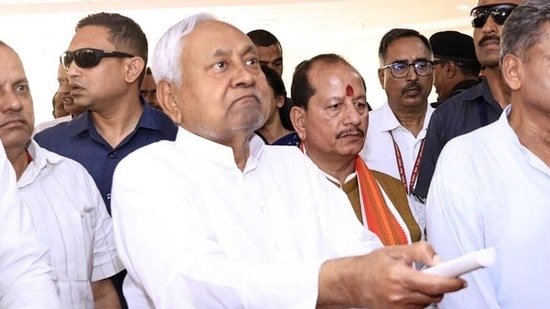
Bihar’s political landscape continues to wobble even after one thing is decided for weeks now: JD(U) supremo Nitish Kumar will no longer be the chief minister. But he continues to be; and there is no clarity yet on when and who will succeed him. Dominant partner BJP is yet to reach a consensus as it gets a chance to have its own CM.


But the steps continue, with the latest being CM Nitish Kumar’s resignation from the state’s Legislative Council, fulfilling a constitutional requirement that follows his election to the Rajya Sabha earlier this month.
But Indian constitutional law allows Nitish Kumar to remain — at least for now — the CM.
On Monday, both Nitish Kumar and BJP national president Nitin Nabin, who was a minister in his cabinet, tendered their resignations as legislators on Monday.
Bihar Legislative Council chairman Avadhesh Narayan Singh, who paid a courtesy visit to the CM earlier in the day, confirmed that he had accepted Kumar’s resignation. “He has been an invaluable leader of the House and devoted himself to Bihar’s cause,” he said.
The resignation was a constitutional necessity. Nitish Kumar was elected to the Rajya Sabha on March 16, and the Prohibition of Simultaneous Membership Rules (1950), framed under Article 101(2) of the Constitution, say a person must resign from their seat in the state legislature within 14 days of their Rajya Sabha election being gazetted. Monday, March 30, was that deadline.
Still CM, thanks to law; and BJP’s uncertainty
The question now obvious is: does resigning from the state legislature mean Nitish Kumar is no longer CM? Constitutionally, the answer is no; not yet.
Article 164(4) of the Constitution allows a person to serve as CM or minister for a period of six months without being a member of the state legislature. This means Nitish Kumar can, in theory, continue to occupy the chair in Patna while simultaneously preparing to take his oath as a Rajya Sabha member on April 10.
So, let’s clear up two technical things: You cannot be a member of two Houses for more than two weeks; but you can remain CM while not being part of any House for six months.
Technicalities taken care of, Nitish Kumar’s switch to the Upper House of Parliament is historic, because he is the first sitting CM to announce his decision to move to the Rajya Sabha. Before him, CMs have moved from the state to the Centre, but only after a gap.
For Nitish, whose health has been a concern, this means he has now been a member of Bihar’s and Centre’s upper and lower Houses, a rare feat. Since first becoming CM in 2005, he has remained a central figure in Bihar politics, navigating multiple alliance shifts while maintaining political relevance.
What happens next?
BJP minister Vijay Kumar Choudhary said Nitish’s resignation as CM would happen “at the appropriate time”.
The BJP has been a dominant force in Bihar’s ruling coalition but has never held the CM’s post, always yielding to Kumar and his Janata Dal (United). That is now expected to change.
The NDA bloc of BJP-JD(U)+ won a landslide victory in the 2025 assembly elections, securing 202 of the 243 seats and defeating the RJD-Congress-led Mahagathbandhan, which won just 35 seats. For the first time, the BJP became the single-largest party in the Bihar Vidhan Sabha, with 89 seats, followed by the JD(U) with 85 seats.
Senior BJP leader Vinod Tawde is already in Patna, meeting with state leaders as the party’s central command moves quickly to shape the transition.
The contenders
Going by the buzz in Bihar’s political circles, deputy CM Samrat Choudhary, Union minister Nityanand Rai, and Bihar minister Dilip Kumar Jaiswal are amongst the top contenders for the CM post.
Political analysts suggest that Samrat Choudhary is the strongest contender. His name is prominent in part because he is a key leader of the Kushwaha community, Bihar’s second-largest backward caste, which could help the BJP strengthen its OBC equation. Choudhary has held the home affairs portfolio in the state and is currently in his second stint as deputy CM, meaning he is second-in-command.
Nityanand Rai is at present the Union Minister of State for Home Affairs. Before joining PM Narendra Modi’s council of ministers, Rai served as the BJP president for Bihar and is a four-time MLA from Hajipur.
Dilip Jaiswal is a three-time MLC, and has also served as Bihar BJP chief.
There is also a dynastic subplot with Nitish Kumar’s son Nishant Kumar, who joined the JD(U) last week, being discussed as a potential deputy CM, with JD(U) leaders reportedly accepting him as Nitish’s political successor.


