



Panaji: Scientists from the National Institute of Oceanography (CSIR-NIO) Goa have been studying the seafloor along the mid-ocean ridges (MORs) to discover how climate change is influencing polar ice volume and decreasing sea-level, which in turn is making the underwater volcanoes more active.“While short-term hydrothermal dynamics are well studied, the long-term response of these systems at slow spreading ridges to glacial interglacial sea-level change remains poorly constrained,” the study states. MORs in oceans are giant underwater mountain ranges, where two tectonic plates are moving away, oozing out hot, melted rock (magma) from deep inside the earth creating volcanism. The magma heats up the surrounding rock and the seawater that seeps in through cracks. This hot water, full of dissolved metals and other chemicals, then shoots back out through vents, creating hydrothermal systems.
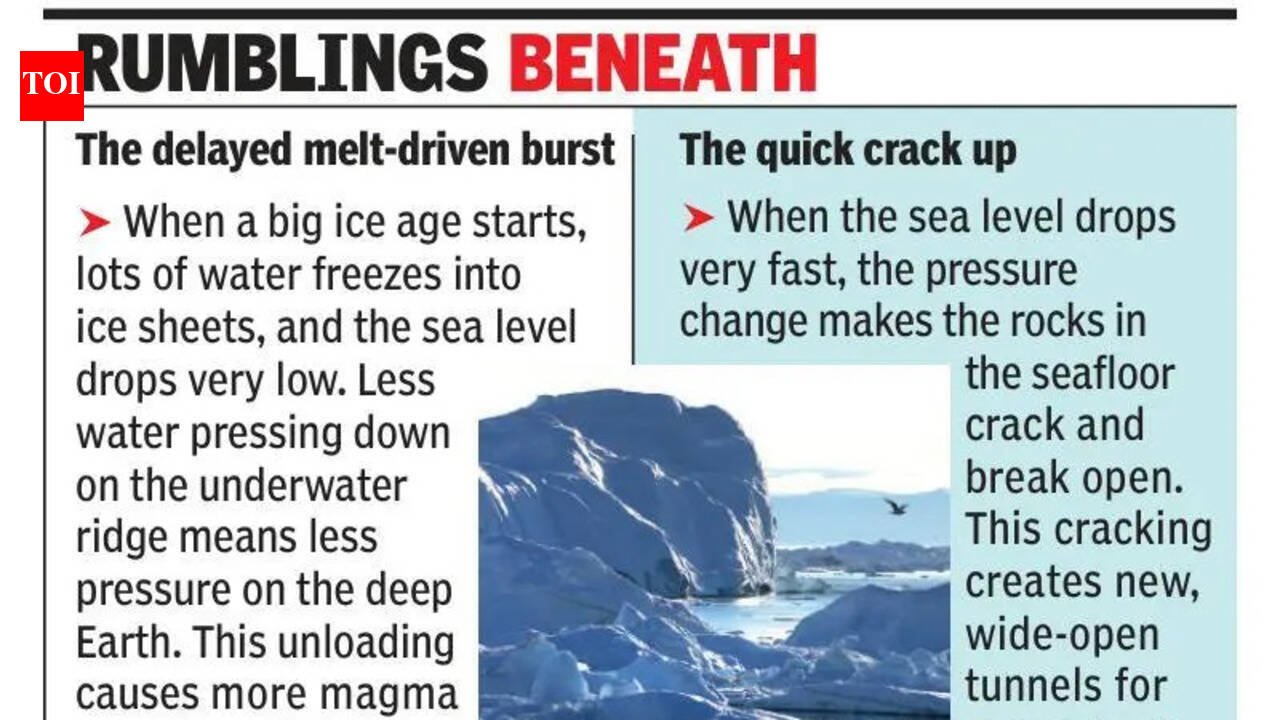
These systems act like pipelines, moving heat and important metals from the earth’s inside out into the ocean.They have looked closely at a section of the underwater mountains called the Carlsberg Ridge in the Indian Ocean. It’s a slow-spreading ridge, meaning the new seafloor is created very slowly and it makes its volcanic activity a little stop-and-go.To figure out how active this ridge was in the past, they collected a tube of mud and rock and found thin coatings of rust-coloured Fe-Mn oxyhydroxides (iron and manganese rust). These coatings are like tiny sponges that soak up chemicals from the seawater and from the hydrothermal vents. The scientists looked at the lead isotopes associated with the rust. Lead isotopes from the Earth’s magma have a different signature than the lead that comes from land dust in the air. When the volcano vents were very active, the rust coatings acquired the magma’s signature.By comparing the chemical signatures in the core to the timing of past ice ages, which caused the sea level to rise and fall, the scientists found a strong connection over the last 49,000 years. Lower sea level during the glacial period 60,000 years ago decreased the hydrostatic pressure, resulting in higher underwater volcanism over the Carlsberg Ridge, supplying more heat and carbon dioxide.They found two main ways that a changing sea level stirs up the underwater volcanoes— the delayed melt-driven burst and the quick crack-up.This study shows that the hydrothermal systems at the Carlsberg Ridge and likely other slow-spreading ridges are very sensitive to changes in global climate, like the coming and going of ice ages.These underwater vents send important trace metals (like cobalt, nickel, and chromium) far out into the deep ocean. By affecting the amount of these metals, the hydrothermal systems might actually play a role in feeding the tiny life forms in the deep sea and even influencing the chemistry of the whole ocean.“Hydro-thermal systems at slow‐spreading ridges functioned as sensitive archives of past climatic forcing and played an active role in modulating deep ocean trace metal flux across glacial‐interglacial cycles,” the study reads.


