



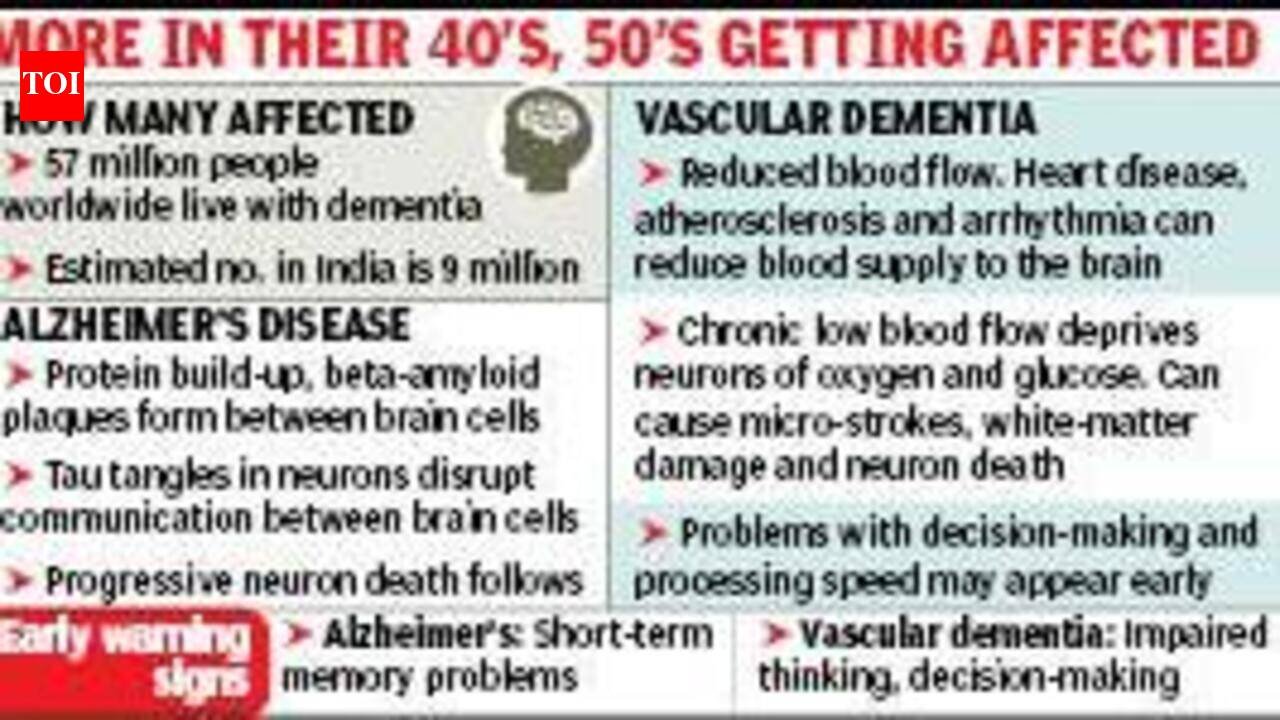
Kolkata: A suddenly acquired forgetfulness or loss of short-term memory may not be a minor sign of ageing, but the first symptom of the onset of Alzheimer’s disease, which could deteriorate fast and have a debilitating impact, warned neurologists on the eve of World Alzheimer’s Day on Monday. Triggered by the deposition of plaque in the neurons, Alzheimer’s could be accelerated when the heart is pumping less blood to the brain due to cardiac ailments, leaving the neuron functioning affected further, which is termed vascular dementia, said neurologists.There could be three reasons why Alzheimer’s is affecting relatively young patients, said Hrishikesh Kumar, head of neurology, Institute of Neurosciences Kolkata. “It is being detected early due to greater consciousness and better access to treatment. Though there are no studies, clinical experience shows that Indians tend to get it at an early age. Finally, environmental interaction like stress, less sleep, or pollution could be the trigger. We are seeing more people in their forties and fifties being diagnosed with dementia triggered by various reasons, including Alzheimer’s,” added Kumar.While the patient age group could be getting younger, it can’t be concluded that the disease is striking earlier than before, said Charnock Hospital head of neurology Rohit Mishra. “While dementia is often the first symptom of Alzheimer’s, it does not necessarily mean that the patient has the disease. There could be other reasons for dementia. Alzheimer’s is one of them and once detected, it can be controlled or checked, though not cured,” said Mishra.Arindam Ghosh, consultant, clinical lead neurology – Narayana RN Tagore Hospital said, “Family members should look for symptoms of short term memory loss, such as, misplacing objects, forgetting what they had for breakfast, asking the same questions repeatedly, or forgetting the information they have learnt recently. They may even lose their way when out of their home. There may be changes in their ability to communicate. It is very important to diagnose dementia early because in some cases, the decline can be controlled,” added Ghosh.Alzheimer’s typically affects people after the age of 65, said Debdatta Majumdar, senior consultant (interventional cardiology), Narayana RN Tagore Hospital. “Younger age onset has been reported in 5%-10% of patients, in their 40s and 50s. They almost always have a genetic predisposition. Certain genes, such as APP, PSEN 1 and 2 and the APOE4, are either directly causative, or strongly predispose towards developing early onset AD,” said Majumdar. There is also a strong heart-brain connection and hypertension, diabetes, cholesterol and other cardiovascular risk factors can impact brain health and cognitive decline, he added.
