



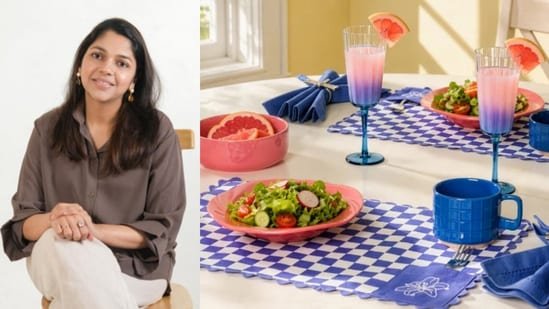
Ten years ago, the dining table was rarely the star of an Indian home. You bought a dinner set once, usually around your wedding, saved the “good crockery” for guests and filled your kitchen with products chosen almost entirely for utility. Home décor conversations revolved around sofas, wall colours and statement lighting. Plates, serving bowls and casseroles barely entered the conversation.
Today, the dining table has quietly become a reflection of personal style. Tablescapes have found a place on Instagram, weekend hosting has become more intentional, and people think far more carefully about what they serve food in than they did a decade ago. It is part of a much larger shift in how Indians view their homes. Every room is expected to feel personal, right down to the kitchen. Some brands created products for this change. Others simply noticed it before everyone else. Nestasia belongs firmly in the second camp.
Co-founded by Aditi M Agrawal in 2019, the Kolkata-based home and lifestyle brand did not invent ceramics, serveware or kitchen storage. Instead, it identified a gap that had existed in plain sight. “There was a gap in the market,” Agrawal told me during our conversation. “You had utility products at one end and luxury brands at the other. Nobody was serving customers looking for great design at an accessible price.”
That observation came long before tablescapes became a buzzword.
Looking beyond utility
Agrawal’s path to entrepreneurship was shaped by years spent living in Singapore and Hong Kong. Frequent travel across Southeast Asia introduced her to local markets filled with thoughtfully designed home products that were practical, affordable and beautiful at the same time. After moving homes several times, she realised that these were the objects she cared about the most. They made everyday routines feel just a little more enjoyable.
Back in India, she noticed a very different retail landscape. Consumers could either buy inexpensive products built almost entirely around function or spend significantly more on premium labels. There was very little in between. That “missing middle”, as she describes it, became the foundation of Nestasia.
Looking back, the timing could not have been better. Around the same period, Indian homes were beginning to change. Open kitchens became more common, people started hosting more often, social media encouraged beautifully styled spaces and millennials, armed with Pinterest boards and saved Instagram posts, began paying attention to details that previous generations rarely considered. The dining table was no longer just a place to eat. It had become another part of the home that reflected personality.
When design became the differentiator
Many startups compete on technology. Others focus on pricing. Nestasia built its identity around design, applying it to products that had rarely been treated as lifestyle purchases.
Take the humble casserole dish. For years, it existed purely as a practical container that moved food from the kitchen to the dining table before disappearing again. Nestasia redesigned it with floral detailing and laser-etched finishes, so it looked just as comfortable sitting on a beautifully laid table as it did inside a kitchen cabinet.
That approach extends across much of the brand’s catalogue. Storage jars, serving bowls, bottles and organisers are designed with the same philosophy. They are expected to perform well, but they are also expected to look good while doing it.
“Design is non-negotiable for us,” says Agrawal. “Your home is an extension of your personality, just like the clothes you wear.”
It is a simple statement, but it reflects a much larger change in Indian consumer behaviour. Fashion and beauty have already gone through premiumisation. Home products are now following a similar path, with consumers increasingly willing to spend on items that make everyday living feel more considered.
The store strategy that confirmed a bigger trend
One of the most interesting parts of my conversation with Agrawal had little to do with products.
Like many modern consumer brands, Nestasia began as an online business before expanding into physical retail. Conventional wisdom suggested that brick-and-mortar stores would mainly serve existing online customers looking for a more immersive shopping experience.
The numbers told a different story.
According to Agrawal, close to 90% of customers visiting Nestasia stores had never shopped with the brand online. That single insight reinforced something many retailers are beginning to recognise. India’s retail market is not moving towards an online-only future. Instead, consumers are comfortably moving between digital platforms and physical stores, depending on what they are buying.
For home products, the in-store experience still matters. People want to feel the texture of ceramics, compare finishes, see colours under natural lighting and imagine how products might look inside their own homes. Clicking “add to cart” is easy. Choosing the right serving bowl is often more emotional than that.
The next chapter sits inside the kitchen
After establishing itself in dining and décor, Nestasia is now turning its attention to kitchenware, a category Agrawal describes as several times larger than dining and one that offers far greater opportunities for repeat purchases.
The company has already expanded into cookware, storage and kitchen organisation, applying the same design-first thinking to products that have traditionally been treated as purely functional. Its triply stainless steel pressure cooker is one example. Beyond the technical benefits of keeping aluminium away from food, the product was also designed to look visually appealing, bringing colour into a category that has changed very little over the years.
The idea is not to make cooking fashionable for the sake of it. It is to remove the assumption that practical products have to be plain.
That philosophy mirrors what is happening across Indian homes today. Consumers no longer separate function from aesthetics quite as rigidly as they once did.
What comes next for the Indian dining table
As design preferences continue to evolve, Agrawal believes consumers are moving towards products with richer textures, reactive glazes and distinctive shapes rather than relying only on printed patterns. At the same time, nostalgia continues to hold strong appeal for millennials, while younger consumers are introducing cleaner colour palettes and quieter styling into their homes.
The result is a far more individual approach to decorating than India has traditionally seen. Matching dinner sets are giving way to collected pieces, layered tables and homes that feel less like showrooms and more like personal stories.
That may explain why Nestasia has resonated with so many consumers. It arrived at a time when Indians were ready to think differently about everyday objects.
Sometimes, building a successful business is not about creating an entirely new category. It is about noticing that people have quietly changed the way they live and responding before everyone else does. Nestasia recognised that shift early, proving that good design does not always begin with grand ideas. Sometimes, it starts with something as ordinary as a serving bowl placed at the centre of a dining table.
Similar articles for you
Cushion covers to brighten up your rooms this summer; My top 8 picks
Office chairs with lumbar support: Understanding why this is important for your back
Switched my armchair to an ergonomic office chair: Changed how I work from home
The author of this article holds a Master’s Degree in Interior Design and has spent over a decade in research, teaching, and designing homes from scratch.
Disclaimer: At Hindustan Times, we help you stay up-to-date with the latest trends and products. Hindustan Times has an affiliate partnership, so we may get a part of the revenue when you make a purchase. We shall not be liable for any claim under applicable laws, including but not limited to the Consumer Protection Act, 2019, concerning the products. The products listed in this article are in no particular order of priority.


