






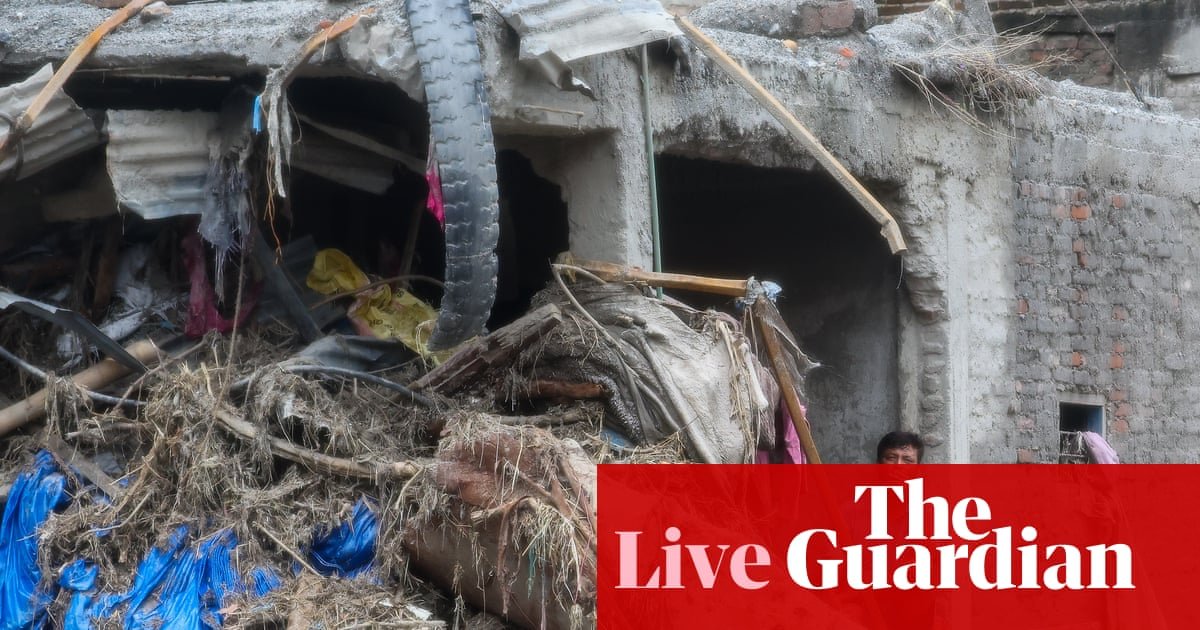
Nepal government calls for specialised assistance from neighbouring countries to aid rescue efforts
The Nepalese government has requested “specific and specialised assistance” from neighbouring countries to aid search and rescue efforts.
This includes assistance with opening tunnels where people are trapped, technologies that can help locate people alive in affected areas, rapid forensic and DNA analysis, and mortuary facilities for the proper storage of bodies, Nepal’s ministry of foreign affairs said in a statement.
It added: “An 11-member specialised technical reconnaissance team for tunnel rescue from India has been mobilised and a tunnel rescue team from China is expected to arrive very soon.”
Key events
Closing summary
We’re wrapping up the Nepal-Tibet flash flood for the time being. Here are the latest developments:
-
Nearly 3,000 people are missing. Nepal’s disaster agency on Saturday said 2,426 people were missing on its side of the border, while China’s Xinhua news agency reports the total number of missing in Tibet is now 554. This includes at least 777 foreigners and 933 workers on hydropower projects on the river where the torrent smashed down.
-
The death toll in Nepal has now risen to 675, the country’s disaster authority has said. China’s Xinhua news agency earlier today reported seven people confirmed dead in Tibet– where information is under the strict control of Chinese authorities – that brings the death toll for the disaster to 682.
-
More than 3,700 people have been rescued in Nepal so far but at least 93,000 people are estimated to have been affected by the disaster, according to the Red Cross.
-
Nepal rescuers send air pipe into tunnel with trapped workers. Nepali army rescuers sent air pipes into tunnels, in the hopes of reaching missing hydropower workers, AFP reported. Rescue efforts are focused on the Trishuli 3A and 3B sites.
-
Nepal’s government has appealed for foreign support to aid rescue efforts. This includes financial aid and freezers to preserve bodies. Nepal’s foreign minister, Shisir Khanal, says reconstruction efforts could run into “billions of dollars”, AFP reports. He added: “We will do loss and damage research and then we plan, but I am reaching out to our international community for support.”
Nepali Americans express frustration with US response to floods in Nepal
Lok Darjee and Catherine Guerrero Knight
Amid the devastating catastrophe in Nepal, Nepali Americans are expressing growing frustration with the US government’s response to the crisis in Nepal.
Tsomo Dasel, 40, is the owner of Himalayan Yak, New York’s first Nepali restaurant. Back home in Nepal, her husband’s family is safe – but it’s not just her loved ones that she’s worried about. Dasel said the priority in the aftermath should be to exhaust all available resources to find the missing. Each passing moment is crucial to the search, which she fears won’t match the enormity of the disaster.
She voiced her distaste with the Trump administration’s humanitarian response, after the state department pledged an initial $500,000 in emergency aid for Nepal – an amount she called an “insult” to address a catastrophe with a death toll that’s in the hundreds, and still rising.
“It’s a joke – if you don’t want to do anything, then don’t do it,” Dasel said.
For Nepali and Tibetan communities thousands of miles away in New York and across the US, the catastrophe is has sharpened the focus on an urgent injustice: who is being forced to bear the consequences of a warming planet, and why should communities that contributed so little to the climate crisis bear some of its greatest costs?
The disaster has also arrived at a particularly fraught political moment, as the US has retreated from international climate commitments while dramatically reducing foreign aid and humanitarian assistance, leaving vulnerable countries with fewer resources to prepare for and recover from disasters.
Dasel said that she is ready to help out in any way she can, in a time when “The world needs to pay attention.”
“We don’t know how we can help them … so we’re sitting down together, like, OK, what are the resources? … Maybe their emergency needs … anything that, you know, they may not have, and we can provide them.”
When the time comes, she’ll be ready: “Whatever the team needs.”
We have satellite images showing the extent of destruction before and after the floods in Nepal.
Rescuers successfully gain access to hydropower site, and proceed with next steps – BBC
Biraj Bhakta Shrestha, the Nepalese energy minister, says a hole has successfully been drilled into a tunnel used to carry cables, BBC reports.
Initial inspection has revealed there is no debris inside, he says, but no communication has been established with anyone inside.
He shared that air is being pumped in; if the weather allows, the rescue team will work through the night to make a hole large enough to fit a person.
There is a risk that the rescue operations may be affected by and even suspended due to rain.
We have images of relatives gathered outside of Tribhuvan University Teaching Hospital in Maharajgunj, Kathmandu, in search of any information regarding their loved ones who are unaccounted for in the aftermath of the devastating floods in Nepal.
We have new images of volunteers preparing relief supplies for Nepal flood victims coming in.
Here’s a recap of what we know so far:
-
Nearly 3,000 people are missing. Nepal’s disaster agency on Saturday said 2,426 people were missing on its side of the border, while China’s Xinhua news agency reports the total number of missing in Tibet is now 554. This includes at least 777 foreigners and 933 workers on hydropower projects on the river where the torrent smashed down.
-
The death toll in Nepal has now risen to 675, the country’s disaster authority has said. China’s Xinhua news agency earlier today reported seven people confirmed dead in Tibet– where information is under the strict control of Chinese authorities – that brings the death toll for the disaster to 682.
-
More than 3,700 people have been rescued in Nepal so far but at least 93,000 people are estimated to have been affected by the disaster, according to the Red Cross.
-
The risk of a lake formed after the glacier collapse bursting near the China-Nepal border has decreased. Satellite images suggest water in the lake – straddling the China-Nepal border at the confluence of two rivers – has been slowly flowing through, decreasing the reservoir gradually, state broadcaster CCTV reported, citing the water resources ministry.
-
People warned against drone use in flood-hit areas, BBC reports. Nepal’s disaster response agency has warned people against flying drones in flood-hit areas, saying unauthorised drones operating in affected areas are “posing serious safety risks” to rescue helicopters and interfering with search operations.
-
Nepal rescuers send air pipe into tunnel with trapped workers. Nepali army rescuers sent air pipes into tunnels, in the hopes of reaching missing hydropower workers, AFP reported. Rescue efforts are focused on the Trishuli 3A and 3B sites.
-
Nepal’s government has appealed for foreign support to aid rescue efforts. This includes financial aid and freezers to preserve bodies. Nepal’s foreign minister, Shisir Khanal, says reconstruction efforts could run into “billions of dollars”, AFP reports. He added: “We will do loss and damage research and then we plan, but I am reaching out to our international community for support.”
Authorities seek freezers to preserve bodies amid rescue missions – BBC
The Nepali foreign minister, Shisir Khanal, has asked for foreign support to help provide freezers to preserve the bodies of flood victims, as they work to identify and reunite them with their loved ones, BBC reports.
Khanal said as rescue missions continue, authorities are facing the challenge of “very limited” space to preserve bodies.
“There is a risk of fast decomposition because these bodies have been in water for a long time,” he said.
He says he is seeking active support from foreign governments to find ways to help preserve the bodies.
The death toll has surpassed 600 with more than 3,000 people still missing.
Aussie found safe as rescuers search for missing
An Australian woman unaccounted for in the Nepal flooding disaster has been safely located by Australian consular officials.
Cara Severino made contact with Australian officials on Saturday and is safe, Foreign Minister Penny Wong confirmed in a post shared to social media.
“I spoke directly with her a short time ago and am very pleased to know she is safe,” Wong posted.
“This is a rare piece of positive news amid a disaster that has brought immense loss and uncertainty,” she added.
Wong concluded her post reiterating Australia’s commitment to work closely with local authorities to locate and assist those affected.
People warned against drone use in flood-hit areas – BBC
Nepal’s disaster response agency has warned people against flying drones in flood-hit areas, BBC reports.
The agency says unauthorised drones have been operating in affected areas, “posing serious safety risks” to rescue helicopters and interfering with search operations.
Anyone flying drones without permission will face legal action, the National Disaster Risk Reduction and Management Authority (NDRRMA) says.
Daughter traces mother and aunt’s last known location in Nepal through TikTok video
Sammy Gecsoyler
The daughter of a woman missing in Nepal has shared how she traced her mother’s location through a TikTok video posted hours before the devastating flash flood hit.
Tulshi Patel’s mother, Hemangini Jitendra Patel, and her aunt, Hema Sunil Amin, set off on a pilgrimage in which they had planned to travel into Tibet but the pair have not been contactable since the flash floods hit.
Patel, a pharmacist from Milton Keynes, England, said in an interview with LBC’s Matt Frei that she had last spoken to her mother and aunt on Monday, had received a photo of them on Tuesday, and their last known location had come from a GPS signal from the tour group at a place called Friendship Bridge at the Nepal-China border.
“We did our own deep-dive research and we found a TikTok video that verified and showed my mum and auntie and three other people from the tour at the border waiting to cross, I guess, that the local Nepali tour guide had made,” Patel said.
Patel said she had messaged the two women “in the hopes that maybe we’ll see a tick to say they’ve seen it or read it” and had attempted to contact the tour guide: “We’ve messaged the tour guide in case he has a signal because he’ll have a local Sim as well.
“Every day we’re calling via WhatsApp … We’ve not given up, but, from our end, all we can do is research, but we just need kind of eyes and ears there from our side to basically get them out. Get all of them out and safe.”
Nepal rescuers send air pipe into tunnel with trapped workers
Nepali army rescuers sent air pipes into tunnels, in the hopes of reaching missing hydropower workers, AFP reported.
Nepal’s government says more than 100 workers may still be alive and trapped inside tunnels at hydropower projects, with rescue efforts focused on the Trishuli 3A and 3B sites.
Those trapped are among 933 hydropower workers missing since a wall of mud and debris swept down on Wednesday morning, according to the National Disaster Risk Reduction and Management Authority.
“We have already started sending air through the small opening, and we will now begin excavation work and send the rescue team inside,” Sudan Gurung, the Nepali home minister, said in a statement obtained by AFP.
The Ministry of Energy reported that “partial success has been achieved in the drilling operation”, adding that “efforts have begun to try to send a camera and oxygen into the tunnel”.
Rescuers continue to work to clear “the mud accumulated inside the tunnel”, it added.
We have photos coming in from Nepal of survivors of the deadly flood salvaging their belongings.
Survivors of the deadly flood in Nepal reflect on their experiences after a glacier collapse on Wednesday unleashed a huge torrent of rock, ice, mud and debris through Himalayan mountain river systems.


