



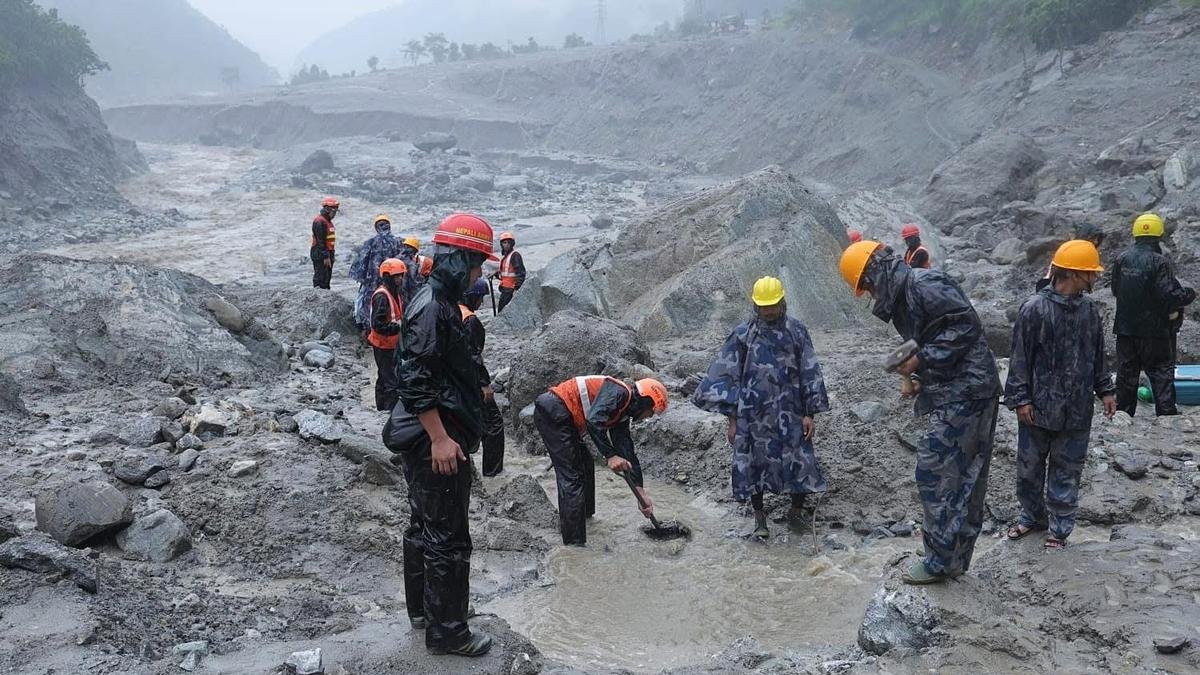
The death toll from Nepal’s devastating flash floods rose to 669 on Saturday (August 29, 2026), as authorities said rescue operations continued, albeit with difficulty, given the remoteness of the region.
Follow: Nepal flash flood updates on August 29, 2026
The country’s National Disaster Risk Reduction and Management Authority (NDRRMA) said at least 2,426 people remained missing, while 4,451 had been rescued.
According to the Nepal Tourism Board (NTB), 187 tourists have been rescued, including 114 from India. Other rescued tourists are from China (27), South Korea (20), Germany (four), Malta (four) and Italy (three).
Rescue operations continued for a fourth day since the disaster struck Rasuwa, a district bordering Tibet in China, causing cascading destruction in villages downstream as authorities forecast more rain, raising fears of further flooding. The flooding has been described as the worst and most unprecedented disaster since the 2015 earthquakes, which killed nearly 9,000 people.
Over 15,000 rescue workers
In a social media post, Prime Minister Balendra Shah said: “More than 15,000 security personnel have been deployed for search-and-rescue operations.”
Police and rescuers use a drone to assess the ground situation after flash floods in Devighat in Nepal’s Nuwakot district on August 29, 2026.
| Photo Credit:
AP
Foreign Minister Shishir Khanal said the Nepal government has mobilised all available resources and efforts for search, rescue, relief and recovery operations, with particular attention to people who remain missing, including Nepali and foreign nationals.
“Our immediate priority remains clear: to save lives, locate missing persons, rescue them, provide urgent relief to survivors and ensure that affected Nepalis as well as foreigners receive appropriate assistance and support,” Mr. Khanal said at a press briefing in Kathmandu.
Did not reject foreign support: Minister
He reiterated that the scale of devastation was enormous and that support and assistance would be required not only during the rescue and relief phase, but also during reconstruction. He dismissed reports that Nepal had rejected international assistance and support.
Mr. Khanal had said on Friday (August 28, 2026) that the government had requested specific and specialised assistance “from our friendly neighbours to strengthen search-and-rescue efforts, particularly in the tunnels.” “An 11-member specialised technical reconnaissance team for tunnel rescue from India has been mobilised, and a tunnel rescue team from China is expected to arrive very soon,” he had said.
China dispatched five tunnel experts on Saturday (August 29, 2026), who landed directly in the disaster-affected area. The Chinese Embassy in Kathmandu said they immediately joined Nepal’s tunnel rescue efforts.
Rescuers have been facing the daunting challenge of rescuing people — believed to number in the hundreds — trapped in hydropower tunnels.
According to the NDRRMA, more than 900 people associated with 11 hydropower projects, including those under construction, remain unaccounted for.
Authorities have been continuously monitoring river systems and downstream flood risks, with agencies placed on high alert.
Bodies wash ashore
Meanwhile, authorities struggled to manage the bodies washed up in Chitwan district, downstream from the flood-affected Bhotekoshi-Trishuli river system.
According to district authorities in Chitwan, as many as 229 unidentified bodies were being kept at holding centres and health institutions.
The officials said it decided to bury the unidentified remains after collecting DNA samples, as identification has become increasingly difficult and the decomposing bodies pose a health risk.
Published – August 29, 2026 11:20 am IST


