



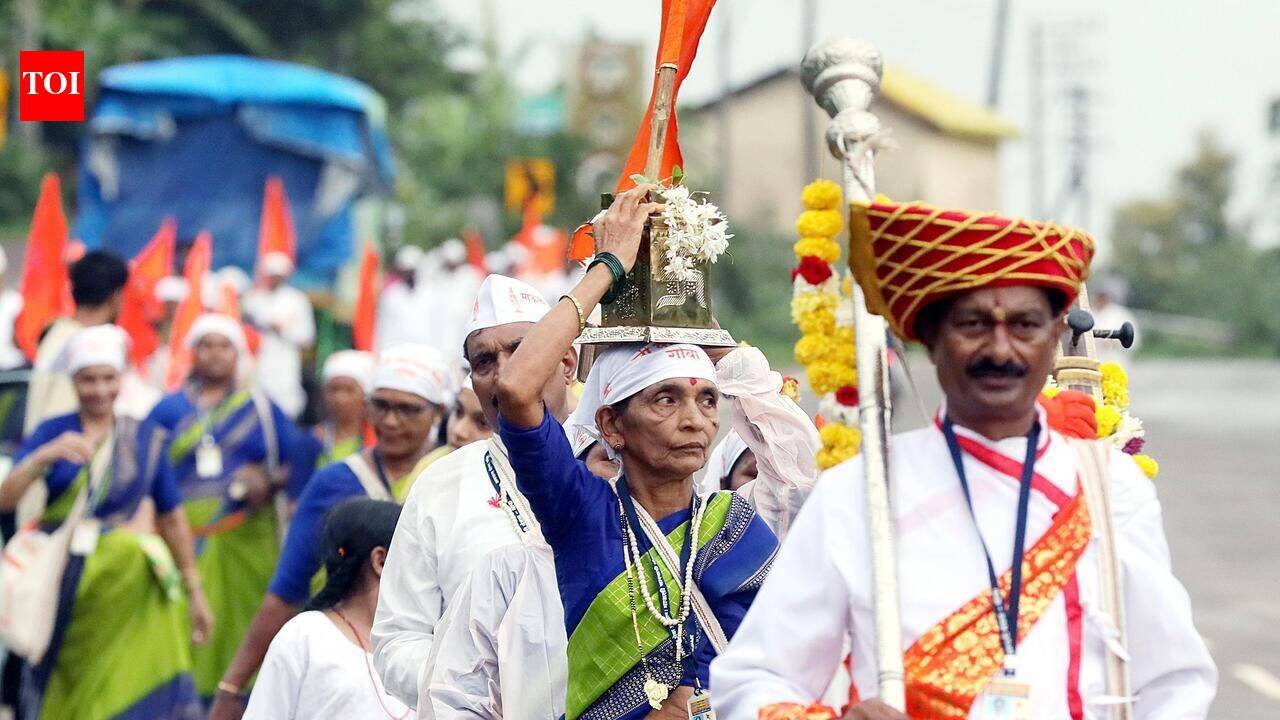
Bicholim: No fancy shoes or trekking gear, a group of 125 pilgrims, each wearing an ordinary pair of slippers, set out from Vathadev-Bicholim on Thursday. They have to cover almost 350km over the next 14 days. The warkaris of Aparant Sewa Prathisthan Mauli Warkari Mandal, Mulgao, must make it to Shri Vitthal-Rukmini temple in Pandharpur, Maharashtra, by Ashadi Ekadashi.The women and men chant “Vitthal Vitthal Vitthala, Hari Om Vitthala” in unison as they begin the arduous journey. They have their devotion for comfort.They are not the only ones. Close to 5,000 devotees of Lord Vitthal and his consort Rakhumai from across Goa undertake the annual wari in 40-odd ‘dindis’, or organised groups of warkari.Almost no one can point out when the tradition took root in Goa, but most agree it was Uday Bua Phadke whose Mulgao group reignited the community spirit of the warkari movement.“We started in 2008 with 53 male devotees. Today, we are three times the number. But we cap the group at 125 because we have to ensure the comfort of the devotees,” says Phadke, founding president of the group.“There is lots to be taken care of, their safety from traffic while walking on roads, there is a team only cooking meals, two cars accompany us for medical emergencies with first-aid kits. Two men are allotted duties to load and unload devotees’ luggage at each night stop. We provide them two pairs of clothes for the pilgrimage and two full meals and three rounds of snacks and tea, all at a nominal Rs 3,000 for the entire journey.”Phadke believes Lord Vitthal himself aids their journey through largely anonymous donations of meals and overnight stays.At least 30km has to be covered each day by devotees, many of them elderly. Many families choose to undertake the wari together.“While most walk purely out of devotion, many testify that their long desired wishes have been fulfilled after they began the wari,” said president of the Mulgao group, Digambar Naik.Krishnabai Parab Gaonkar, 62, says she undertook her first wari with the group 11 years ago.“Though we are told to prepare for the rigours of the wari, I do not go for any morning walks. I come here once a year and began walking. I see Vitthal-Rakhumai before me and I walk. Only last year, I had a fever and I had to use the car for the first time. I wish to complete 13 and then I will feel fulfilled.”Another senior citizen, Vitha Vasudev Gawas, also agrees that it is the only time she does not worry about her home.“I began doing the wari thinking I want to undertake this pilgrimage once in my lifetime. But it has been a decade now and the moment this time of the year draws near, I become restless and cannot wait to begin the wari. I make sure I do not sit in the car. If you go by car, it has no meaning undertaking the wari,” says Vittha.Just like the pilgrims across Maharashtra, culminating at the Shri Vitthal-Rukmini temple in Pandharpur, the singing of abhang carries them through.An image of Vitthal-Rakhumai, worshipped by them each day during the wari, follows them in a separate vehicle, as the devotees thread carrying one veena, a tulsi vrundavan, and kalash, as is the norm with dindi.“We are mere instruments in the Lord’s hands, he sees us through. It is not easy managing everything. But he gets everything sorted out,” says Phadke.


