



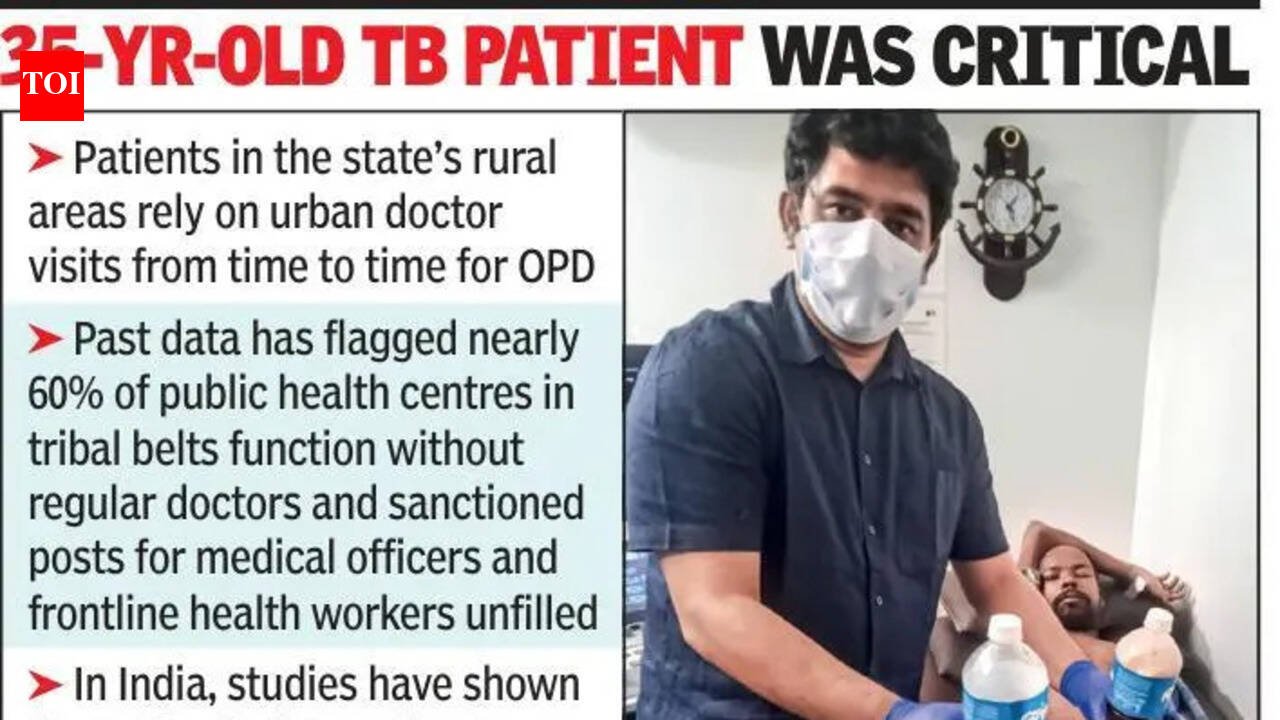
Mumbai: Forced to improvise in a rural setting with no cardiac cath lab anywhere within 70 km, a Navi Mumbai doctor saved a man from the brink of death using a kidney dialysis catheter to drain fluid suffocating his heart. The 35-year-old TB patient from a tribal community arrived at his Sunday OPD in Roha critical.Manohar Pawar and his family reached Dr Anup Mahajani’s OPD at Jadhav Nursing Home from Nandgaon, 25 km away. “I was about to leave when a group arrived with a man lying in the back of a van,” Dr Mahajani recalled. A 2D echo showed cardiac tamponade, which is severe fluid build-up in the pericardial sac, putting deadly pressure on the heart.“The family was informed the procedure required further travel, but they insisted on immediate treatment due to lack of funds and the realisation that time was running out,” said Dr Mahajani, who is attached to Medicover Hospital in Navi Mumbai. Manohar’s wife, Vinita, said residents in her hamlet usually have no choice but to travel long distances to J J Hospital or MGM in Kamothe for advanced care.The standard procedure, pericardiocentesis, involves inserting a needle and guidewire into the pericardium to drain fluid. However, specialised equipment, which is common in cath labs, was unavailable at local pharmacies.“We called around, but no one had the cardiac kit. It clicked that a dialysis catheter functions similarly. The pharmacist had one in stock by luck, so we decided to move forward,” Dr Mahajani said.This was risky. While a cardiac catheter is thin and flexible, a dialysis catheter is thicker and stiffer. Furthermore, Dr Mahajani lacked fluoroscopy, which provides continuous X-ray imaging during such procedures. Working in a sonography room with adapted infection control, Dr Mahajani performed the procedure “blind”, relying solely on a 2D echo in one hand to guide the needle with the other. “Once the needle was inside, I had to confirm placement via echo while simultaneously operating,” he said. As the fluid drained, the pressure eased. Manohar’s blood pressure stabilised at 100/70 mm Hg, his breathing improved, and he regained consciousness. There was more fluid to drain, but to avoid further risk, just 1.5 litres was drained. He was moved to JJ Hospital to drain the rest. “He is getting better,” his family confirmed. Dr Ajay Mahajan, head, cardiac department, KEM Hospital, said, “It is a very easy procedure, but can be a challenge in resource-scarce setups. Anything can go wrong when it comes to the heart if using a dialysis catheter. The doctor had no choice but to save a life.”


