



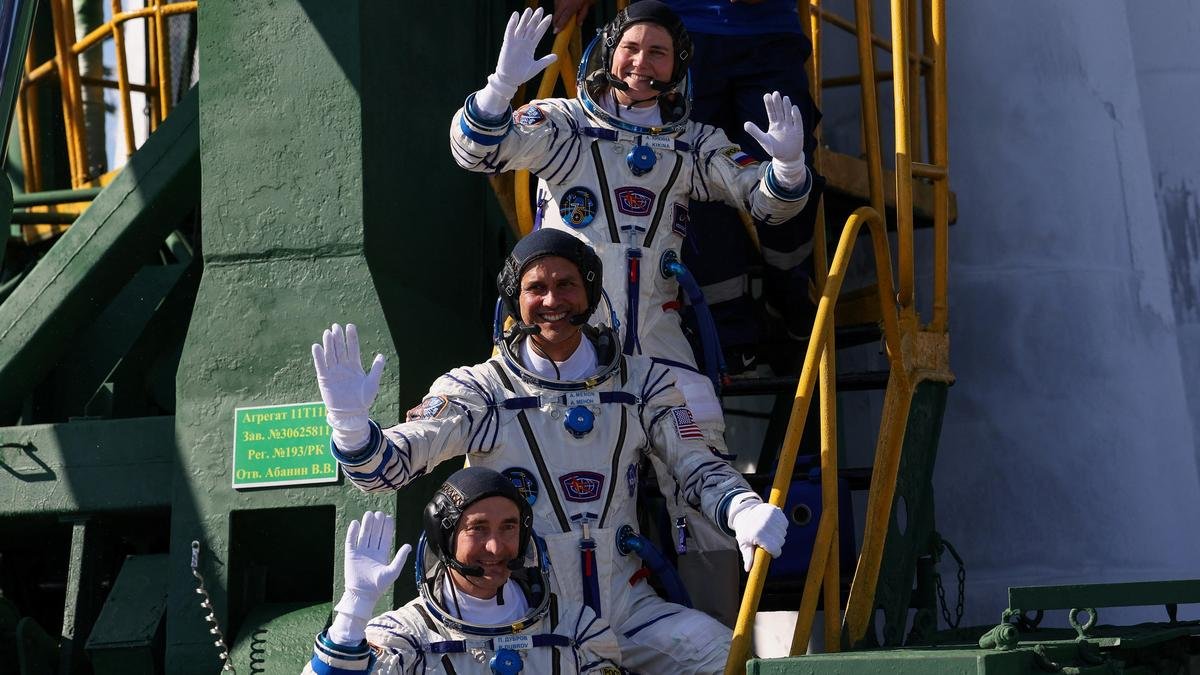
NASA astronaut Anil Menon and two Russian cosmonauts reached the International Space Station with hugs and handshakes in the early hours of Wednesday (July 15, 2026) onboard Soyuz MS-29 spacecraft after a little over three-hour journey.
The Roscosmos spacecraft carrying Mr. Menon and Russian cosmonauts Pyotr Dubrov and Anna Kikina lifted off from Baikonur at 8:17 pm IST on Tuesday (July 14, 2026) just as the orbital laboratory flew over the cosmodrome.
After an eight-minute climb to the preliminary orbit, the Soyuz MS-29 spacecraft began a nearly three-hour chase to the International Space Station to dock at the Prichal module at 11:52 p.m. (IST).
The astronaut then began a series of checks in the spacecraft and the space station before opening the hatch at about 2:00 a.m. (IST).
This marks Mr. Menon’s first spaceflight and the second flight for the Russian cosmonauts, according to NASA.
Incidentally, the live video feed from the space station was cut off at the time the hatch of the spacecraft was about to open due to loss of signal from the tracking and data relay satellites. The link was established 12 minutes later as the satellites were in range again to relay signals.
Mr. Menon’s family members, including astronaut wife Anna Wilhelm and NASA Administrator Jared Isaacman, were at the Baikonur cosmodrome for the spaceflight.
The trio joined NASA astronauts Jessica Meir, Jack Hathaway, and Chris Williams, European Space Agency astronaut Sophie Adenot, and Roscosmos cosmonauts Sergey Kud-Sverchkov, Sergei Mikaev, and Andrey Fedyaev.
Mr. Menon, Mr. Dubrov and Ms. Kikina’s mission will last about eight months, and they are scheduled to return to Earth in April 2027.
Mr. Menon will “conduct scientific research and technology demonstrations aimed at advancing human space exploration and benefiting life on Earth”, according to NASA.
Yelena Remizova, head of Russia’s agency for international humanitarian cooperation Rossotrudnichestvo, earlier told state-run TASS news agency that the rocket will carry drawings made by Indian schoolchildren.
“These are the works of the winners of the ‘First Forever’ competition, dedicated to the 65th anniversary of the flight of the first Earth astronaut, Yury Gagarin, and cooperation between Russia and India in the field of space exploration,” she said.
Born in Minneapolis to Ukrainian and Indian immigrants, Menon is an emergency medicine physician and a U.S. Space Force colonel.
During his stint with the U.S. Air Force, he served on the front lines in Afghanistan during Operation Enduring Freedom and also worked for the Himalayan Rescue Association, caring for climbers on Mount Everest.
Mr. Menon’s father, K.P. Shankaran Menon, hails from Ottapalam in Kerala’s Palakkad district. His mother, Elizabeth, is an immigrant from Ukraine to America.
Mr. Menon, 49, has also spent a year in India as a Rotary Ambassadorial Scholar to study and support Polio vaccination initiatives.
He began his career at NASA as a flight surgeon in 2014 and worked with astronauts living and working on the International Space Station.
Mr. Menon joined SpaceX in 2018, where he started the company’s medical programme, helped prepare for its first human space flights and worked closely in the development of Starship, the super heavy rocket and spacecraft for undertaking missions to the moon, Mars and beyond.
He was selected as a NASA astronaut in December 2021 and joined the two-year training programme the following month.
Mr. Menon’s wife Ms. Wilhelm, travelled to space in September 2024 as part of Polaris Dawn, a private crewed spaceflight operated by SpaceX. The spaceflight lasted for nearly five days.
He will also help test technologies for producing intravenous fluids using the station’s potable water system. Such capabilities could become critical during deep-space missions where medical supplies are limited.
Mr. Menon will continue research to refine in-space production of semiconductor crystals to enable the large-scale manufacturing of components needed for high-performance computers, artificial intelligence, and improved medical devices.
He will also perform ultrasound investigations using augmented reality and artificial intelligence methods that could eliminate the need for medical support from Earth on future space missions.
Published – July 15, 2026 11:41 am IST


