



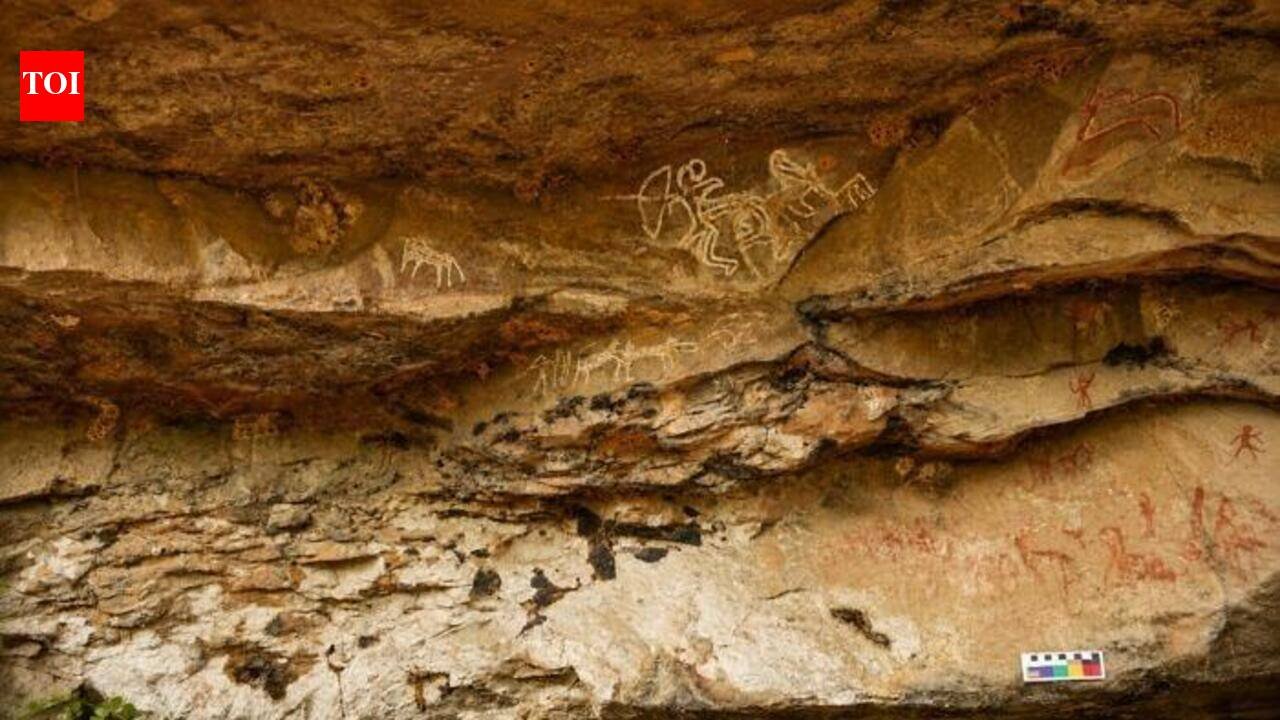
Nagpur: A recent archaeological field survey conducted by two students of Nagpur University has led to the discovery of significant rock art shelters in the Satpura hill range along the tributaries of the Shakkar River, a major tributary of Narmada River, in the Chhindwara and Narsinghpur districts of Madhya Pradesh.The newly documented rock shelters, believed to be around 8,000 years old, are approximately 235km from Nagpur. The students, Sagar B Dodke and Tanmoy Howlader, were guided by professor Prabash Sahu, head of the department of ancient Indian history, culture and archaeology (AIHCA), Nagpur University.The discovery was made during Dodke’s MA dissertation research and Howlader’s PhD fieldwork. As per the researchers, the team began exploring the area after identifying a hill with an ancient Shiva temple, which indicated the possibility of archaeological remains in the vicinity. Further exploration led to the discovery of rock shelter art painted on sandstone surfaces along with prehistoric stone tools, suggesting the site was occupied by prehistoric communities.The researchers identified and documented three groups of rock shelters located within the Satpura hill range. Two of the shelters are situated between the tribal villages of Siyar Kheda and Jamunpani, while the third group is located near the forested region of Gadagad village. All three rock shelter groups occur within an area of approximately 8 to 9 km inside dense forest and appear to be culturally and artistically interconnected through their architectural setting and stylistic characteristics.The shelters remain largely inaccessible due to their forest location. As per local residents, they are generally visited only during January and February, when seasonal religious rituals are performed. Over time, some of these rock shelters have been converted into local shrines, and portions of the prehistoric paintings have unfortunately been covered with limewash, posing a threat to their preservation.Preliminary archaeological observations suggest that the rock paintings belong to the Mesolithic (middle stone age), Chalcolithic (stone-copper age) and historical periods, based on their artistic style and their association with stone tool assemblages found in the surrounding area.Professor Sahu said the paintings likely span the period between the Mesolithic and Chalcolithic ages, reflecting different phases of prehistoric occupation. He explained that rock shelters remained inhabited across several prehistoric periods, with artistic styles evolving over time. During the Upper Palaeolithic period, artists generally drew simple stick-like and abstract figures, while the Mesolithic period witnessed more detailed “X-ray style” depictions. In the Chalcolithic phase, artists began filling in the bodies of human and animal figures.The paintings are executed in red, ochre, black and white pigments and portray a wide range of subjects, including scenes of hunting, warfare, festivals and daily life. The artwork also depicts numerous weapons such as arrows, swords, spears and axes, reflecting the technological and cultural practices of prehistoric communities. Rich representations of fauna, including deer, stag, wild boar, sheep and cattle, further illustrate the close relationship between early human societies and their natural environment.“Prehistoric rock art serves as a visual record of the societies that created it. Themes depicting hunting scenes, religious beliefs, daily life and human activities provide valuable insights into the social and cultural life of prehistoric communities, enabling archaeologists to reconstruct the lifestyle of those generations,” Sahu said.He added that Central India is known for three major forms of prehistoric rock art — pictographs (paintings), petroglyphs (engravings) and cupules (small cup-shaped depressions carved into rock). While sites such as the Gavilgarh Hills predominantly contain pictographs and petroglyphs, finding all three forms together at a single location is uncommon, making the newly documented site particularly significant.Sahu said prehistoric artists prepared durable pigments from minerals and plant-based materials, mixing them with natural binders such as honey or egg. Since sandstone is highly porous, the colours seeped into the rock surface, while the dense forest canopy protected the shelters from direct weathering, allowing the artwork to survive for thousands of years.The researchers said while direct scraping of the paintings for dating is not feasible due to the risk of damaging the artwork, detached flakes from the rock surface can be subjected to carbon-14 (C-14) analysis to help establish the age of the paintings.The department is exploring the possibility of collaborating with the Archaeological Survey of India (ASI) for scientific documentation and conservation of this site.


