



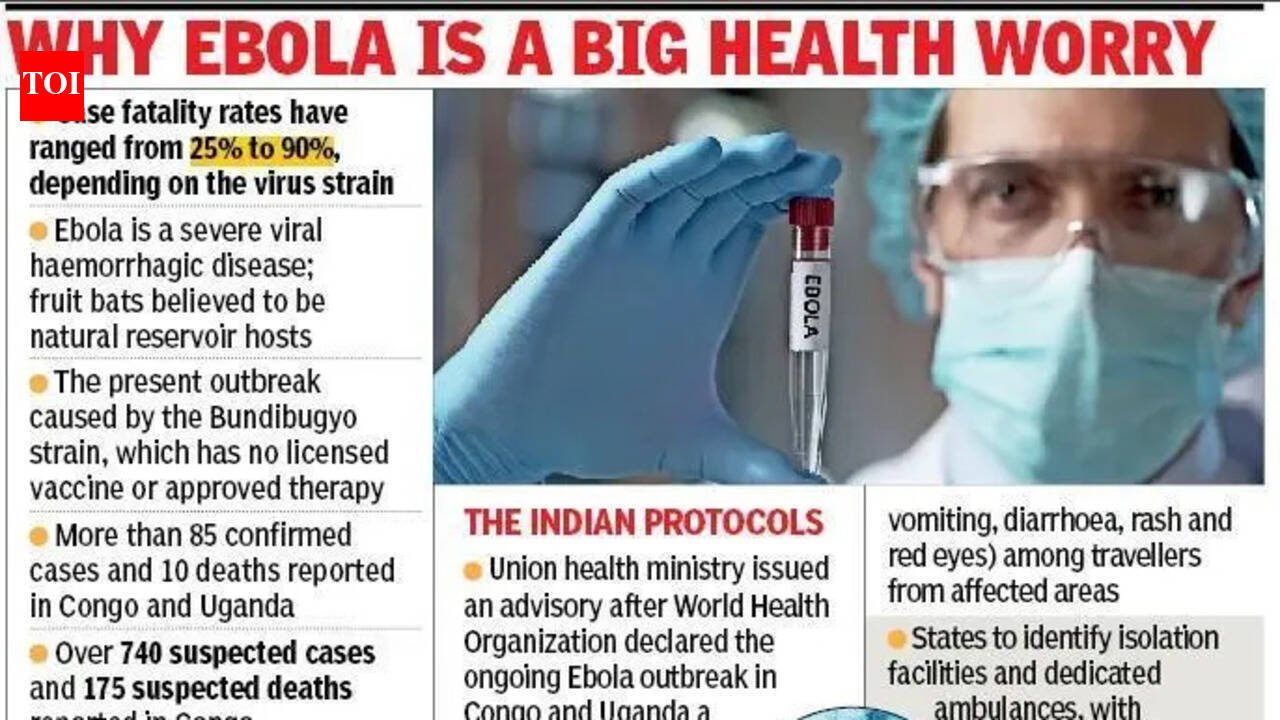
Mumbai: Ebola surveillance has begun in Maharashtra, including Mumbai, where the BMC has designated Kasturba Hospital near Saat Rasta as the isolation facility for suspected cases of the viral haemorrhagic fever.“We are following the Union govt’s guidelines on surveillance and isolation. Kasturba Hospital is our infectious diseases hub and has functioned as an isolation centre during previous outbreaks,” said a senior civic public health official.The Centre’s advisory followed the World Health Organization’s declaration of the Ebola outbreak in the Democratic Republic of Congo and Uganda as a “public health emergency of international concern” on May 17. States have been asked to intensify surveillance for symptoms such as fever, weakness, muscle pain, headache, sore throat, vomiting, diarrhoea, stomach pain, rash and red eyes, especially among travellers from affected African regions.Earlier this week, the Directorate General of Civil Aviation, too, had issued a protocol directing airlines to ensure passengers arriving from Ebola hotspots, including Congo and Uganda, submit self-declaration forms before entering India. Thermal screening of passengers entering Mumbai airport, introduced during the Covid-19 pandemic, continues through infrared sensors that detect elevated body temperature without disrupting passenger movement.Airport surveillance has already led to a 47-year-old Nagpur resident, who recently returned from Uganda, being placed under mandatory 21-day home quarantine. Officials at Dr Babasaheb Ambedkar International Airport alerted civic health authorities about the traveller’s recent visit to Uganda. Health officials said he is asymptomatic and stable, but isolation was enforced as a precaution under the Union health ministry’s Ebola surveillance protocol.On Wednesday, BMC MARD issued an advisory to resident doctors across Mumbai’s civic hospitals stressing preparedness, awareness and infection-control practices while clarifying there is currently no Ebola outbreak or community transmission in India.Infectious diseases specialist Dr Ishwar Gilada said Ebola does not spread through casual airborne exposure like influenza or Covid-19. “Individuals become infectious only after symptoms begin, not during the incubation period, which ranges from two to 21 days,” he said.Ebola spreads through direct contact with infected blood or bodily fluids, contaminated surfaces, medical equipment and unsafe caregiving exposure. The disease has a fatality rate ranging from 25% to 90%. The current outbreak-causing Bundibugyo strain has no approved vaccine or targeted treatment.“India has never experienced an indigenous Ebola case. The only previous Ebola-related incident involved a recovered traveller arriving from Liberia in 2014, with no onward transmission reported,” said Dr Gilada.


