



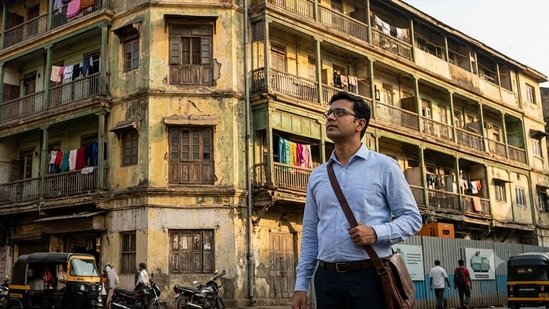
Would you buy a compact apartment today if it meant owning a much larger home a few years later? As redevelopment gathers pace in cities such as Mumbai and Pune, an increasing number of homebuyers are betting on ageing housing societies instead of brand-new projects. The attraction is compelling: buy an older flat at a lower price, receive a larger apartment after redevelopment, and potentially unlock significant value without paying current market prices for a bigger home.

Shirish Tandel (name changed) has a budget of ₹1 crore, but finding a spacious 2 BHK in his preferred locality in Pune has proved difficult. A 750 sq ft apartment there costs around ₹1.40 crore, well beyond his budget.
During his search, Tandel came across an alternative: a 500 sq ft 1 BHK with a 200 sq ft balcony, priced at ₹92 lakh, in a housing society slated for redevelopment next year. The society has already signed a development agreement (DA) with the developer.
Under the redevelopment plan, the existing flat would be upgraded to a 745 sq ft 2 BHK. Tandel also intends to purchase an additional 200 sq ft from the developer at the prevailing rate of ₹10,000–11,000 per sq ft, allowing him to eventually own a nearly 1,000 sq ft 3 BHK.
His other option is a ready-to-move-in 590 sq ft 2 BHK priced at ₹95 lakh. However, he believes the apartment would be too small for his family of four in the long run. Rather than stretching his finances to buy a ₹1.40 crore home today, Tandel is considering the redevelopment property, which could give him a significantly larger apartment for a total investment of about ₹1.2 crore.
The trade-off is time. He is unlikely to receive possession of the redeveloped 3 BHK for another three to five years. During the redevelopment period, once residents vacate the building, the developer will pay monthly rent to homeowners. Tandel plans to use this rental compensation to cover the rent of temporary accommodation until his new home is ready.
Also Read: What is driving the growing interest of large corporates in Mumbai’s cluster redevelopment projects?
Should homebuyers purchase an apartment in an old building?
Property consultants say redevelopment projects can make financial sense, particularly in land-constrained cities such as Mumbai and Pune, where buying a larger apartment in an established locality may otherwise be unaffordable.
However, experts suggest that prospective buyers should thoroughly verify the redevelopment agreement, approvals, the developer’s financial strength and track record, timelines for completion, corpus and rental compensation, and whether the society has obtained the required consent from members.
Developers say opportunity is lucrative, but homebuyers must remain cautious
But the strategy is not without risks. Redevelopment projects are often delayed by approvals, funding constraints, legal disputes and disagreements within housing societies. While some buyers emerge with substantially larger homes and handsome capital appreciation, others can find themselves waiting years beyond the promised completion date. Before buying into a redevelopment project, it is essential to understand the legal, financial and practical considerations that could determine whether the investment pays off.
According to real estate developers, while purchasing an old apartment in a building slated for redevelopment is a lucrative opportunity, homebuyers must remain cautious and do their homework.
“Buying an apartment in the redevelopment-going building is a good investment in the long run, but homebuyers must exercise caution and do their homework before going ahead and not just look at the purchase price,” said Anuj Mehta, Director, Dhuleva Group.
“In some of Mumbai’s mature micro-markets, large-scale redevelopment projects have fetched returns of 20-40% during the project life cycle owing to better infrastructure, facilities, and building features. But the returns depend on certain parameters that need to be checked. Homebuyers must evaluate the builder’s financial strength and experience, the status of approvals from authorities, the project completion timelines, and the redevelopment agreement to finalise their decision,” Mehta said.
According to Ram Raheja, Managing Director, S Raheja Realty, homebuyers should carefully assess two key risks before purchasing an apartment in a building slated for redevelopment.
“First, evaluate the redevelopment timeline, as such projects depend on regulatory approvals and adequate funding. A developer with limited financial strength is more likely to face delays. Buyers should assess the developer’s execution track record rather than relying on projects in the pipeline. Second, scrutinise the society’s paperwork, including the title, members’ consent and the development agreement. Internal disputes within the society are often the biggest hidden risk and the most difficult to resolve,” Raheja said.
Mumbai redevelopment: Numbers tell the story
Mumbai’s redevelopment market continued to gather pace in 2025, with the number of redevelopment agreements rising 16% year-on-year, reflecting growing momentum in the transformation of the city’s ageing housing stock. According to Knight Frank India, 229 development agreements (DAs) for the redevelopment of old buildings were signed in 2025, compared with 196 in 2024.
The trend has continued into 2026. Nearly 70 redevelopment agreements, around 30% of the total signed in 2025, were executed in the first 74 days of the year, up to March 15, according to Knight Frank India. Overall, 1,094 redevelopment agreements were signed between January 2020 and March 15, 2026, unlocking approximately 432 acres of land for redevelopment across Mumbai.


