






MUMBAI: Mumbai’s seven lakes are almost full. Yet the city’s 10% water cut is set to continue, at least until the end of September. As of September 9, the reservoirs held around 13.95 lakh million litres against their combined capacity of 14.47 lakh million litres — about 96%.For a city that has spent much of the year worrying about dwindling water stocks, that should ordinarily be reassuring. But the BMC is still holding back from restoring normal supply.Its argument is that the amount of water stored today is only one part of the equation; what matters equally is how much of a cushion the city will have when the next dry spell sets in.
The water paradox in Mumbai
Why the BMC is still playing it safe
Additional municipal commissioner Vipin Sharma said the BMC would keep watching the lake levels through September before reviewing the water situation at the end of the month. The immediate concern is rainfall. With forecasts suggesting that Mumbai may not receive significant rain during the rest of September, the administration does not want to assume that the remaining 4% will be filled quickly.Citizens, therefore, have been asked to continue using water carefully. The approach may seem overly cautious when the lakes are already 96% full, but the BMC is clearly looking beyond the current number and trying to ensure that the city enters the drier months with sufficient reserves.The seven reservoirs — Upper Vaitarna, Modak Sagar, Tansa, Middle Vaitarna, Bhatsa, Vihar and Tulsi — are the backbone of Mumbai’s water supply. Their combined capacity is around 14.47 lakh million litres, and the current stock is only a little over half a lakh million litres short of that figure.The numbers are comfortable, but they are not unprecedented. On September 8, the lakes were at around 96.41% of capacity, while the corresponding levels in 2025 and 2024 were higher, at about 97.23% and 97.75%. For the BMC, that difference may be small, but when you are planning water supply for a city of millions, even a relatively modest buffer matters.
How the water situation changed
The water cut started when the picture was very different
The 10% cut was imposed on May 15, when Mumbai’s water position was nowhere near where it is today. The seven lakes then had only about 23.5% of their combined capacity. With the summer months still ahead and uncertainty over the monsoon, the BMC decided that reducing consumption was the safest way to stretch the available stock.The restriction was meant to protect the city from the possibility of running short before the reservoirs were replenished. The irony is that the same restriction is still in place nearly four months later, even though the monsoon has dramatically changed the water balance.But there is another reason why the debate cannot be reduced to one number on a reservoir chart. The BMC supplies around 3,850 million litres of water a day, while the city’s estimated requirement is about 4,300 MLD. That gap of roughly 450 MLD is significant.A full reservoir can give Mumbai breathing space, but it does not automatically solve the problems of distribution, leakage, ageing pipelines or rising demand. The city can have plenty of water stored outside its boundaries and still struggle to deliver an adequate quantity to every household.
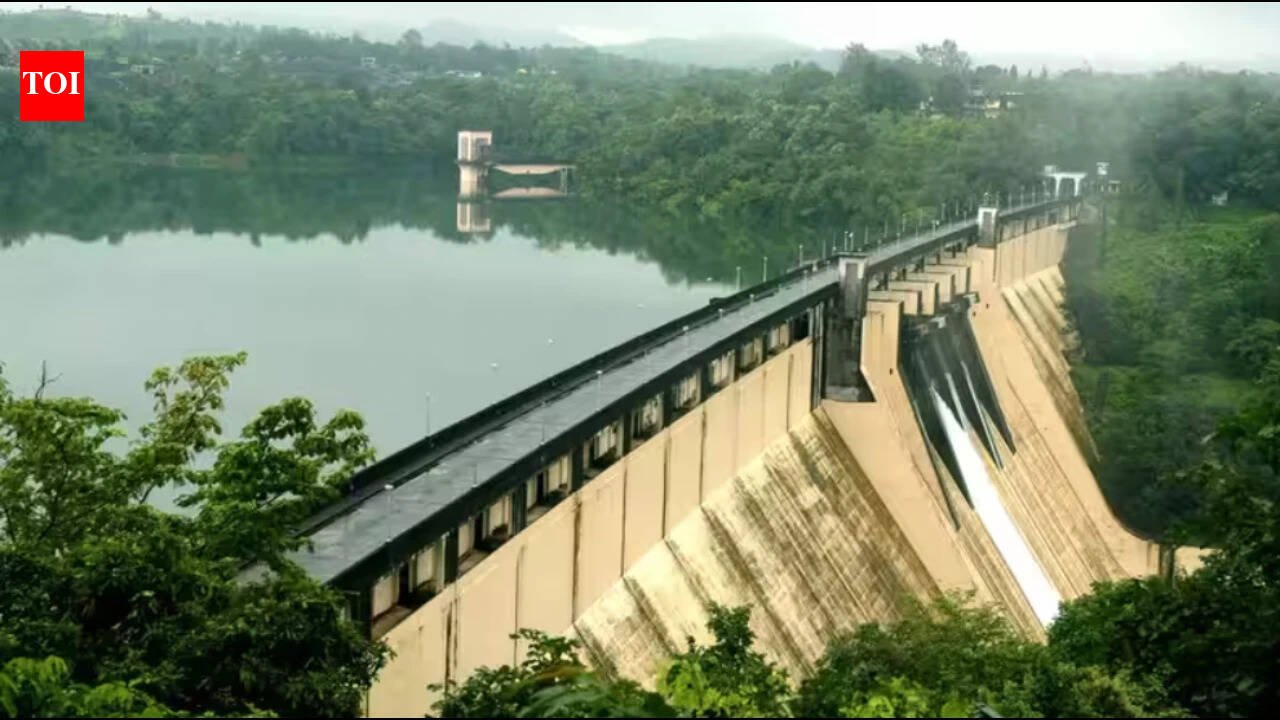
Water discharged from the Middle Vaitarna dam flows into Modak Sagar, one of the seven lakes that supply drinking water to Mumbai
A lake can be full while a tap runs dry
That is perhaps the most important part of Mumbai’s present water story. For residents, water security is not measured in lakh million litres sitting in a reservoir. It is measured by what comes out of the tap, how often it comes out and whether the water is clean. Complaints from parts of the city underline that difference.In Malad, residents have recently raised concerns about low pressure and dirty water, with the issue reaching a BMC ward committee meeting. For such households, a reservoir being 96% full offers little comfort if water is not reaching their homes properly.The BMC’s decision to map Mumbai’s roughly 6,500-km water pipeline network is therefore significant. Sharma said the exercise is under way and will help identify stretches where pipelines need to be replaced. It is an unglamorous part of the water story, but potentially one of the most important. Mumbai’s water system does not end at the lake. Water has to be stored, treated, transported through a vast network and finally delivered to homes. Weakness anywhere along that chain can turn a supply problem into a neighbourhood-level crisis.
The swimming-pool row has added a political twist
The decision to continue the cut has also become a political issue, particularly after the BMC allowed municipal swimming pools to resume water supply from August 16. The announcement, made on August 12, came while households continued to face a 10% reduction. BJP corporator Shivkumar Jha questioned the decision, saying Mumbai was facing a water crisis just ahead of the Ganesh festival. The criticism has gained added resonance with Ganpati and Navratri approaching, when water demand and public scrutiny of civic services traditionally rise.Standing committee chairperson and BJP corporator from Mulund, Prabhakar Shinde, has argued that restoring full supply to households and other essential users should take priority over swimming pools. BJP’s Pravin Darekar has suggested that the residential water cut be withdrawn while restrictions on commercial consumption continue.Congress corporator Ajanta Yadav has offered a different solution — cleaning and desilting wells across the city and using them for non-potable requirements. The suggestions differ, but they point to a common concern: once water stocks improve, should a blanket restriction remain the easiest option, or should the BMC start deciding where water can be saved and where normal supply needs to be restored?
Full reservoir does not guarantee a full tap
Mumbai’s real water problem is not today’s stock
There is a bigger lesson here for Mumbai, and for other Indian cities that depend heavily on the monsoon. Every year, the conversation tends to follow the same cycle: worry about falling reservoir levels in summer, wait anxiously for the monsoon, celebrate rising stocks and then debate when restrictions should be lifted. That approach is understandable, but it does not amount to long-term water security. Mumbai needs to use good monsoon years to fix the weaknesses that become visible during bad ones.The BMC has already been looking at longer-term solutions, including projects such as Gargai, desalination and greater use of treated wastewater. These may take years to deliver, but they matter because the city’s water requirement will not remain static.Population, construction, commercial activity and changing patterns of consumption will continue to put pressure on the system. At the same time, climate variability makes it increasingly difficult for a city to assume that every monsoon will replenish its reservoirs in the same way.For now, Mumbai is not staring at an immediate shortage. With the seven lakes at around 96%, the city has a substantial stock of water. The question is why that stock is not yet enough to give the BMC confidence to restore normal supply. Waiting until the end of September may be a cautious decision, particularly if rainfall is expected to remain limited.But once the review takes place, the civic administration will need to explain clearly what level of storage it considers safe and why.Because ultimately, Mumbai’s water problem is not simply about whether the lakes are full. It is about whether the city can provide a reliable supply without repeatedly moving between panic and restriction.A reservoir at 96% should provide some confidence. A well-maintained pipeline network, reduced leakage, better distribution and additional sources of water would provide much more. For Mumbai, that is the real measure of water security: not just having enough water today, but knowing that there will be enough tomorrow.


