


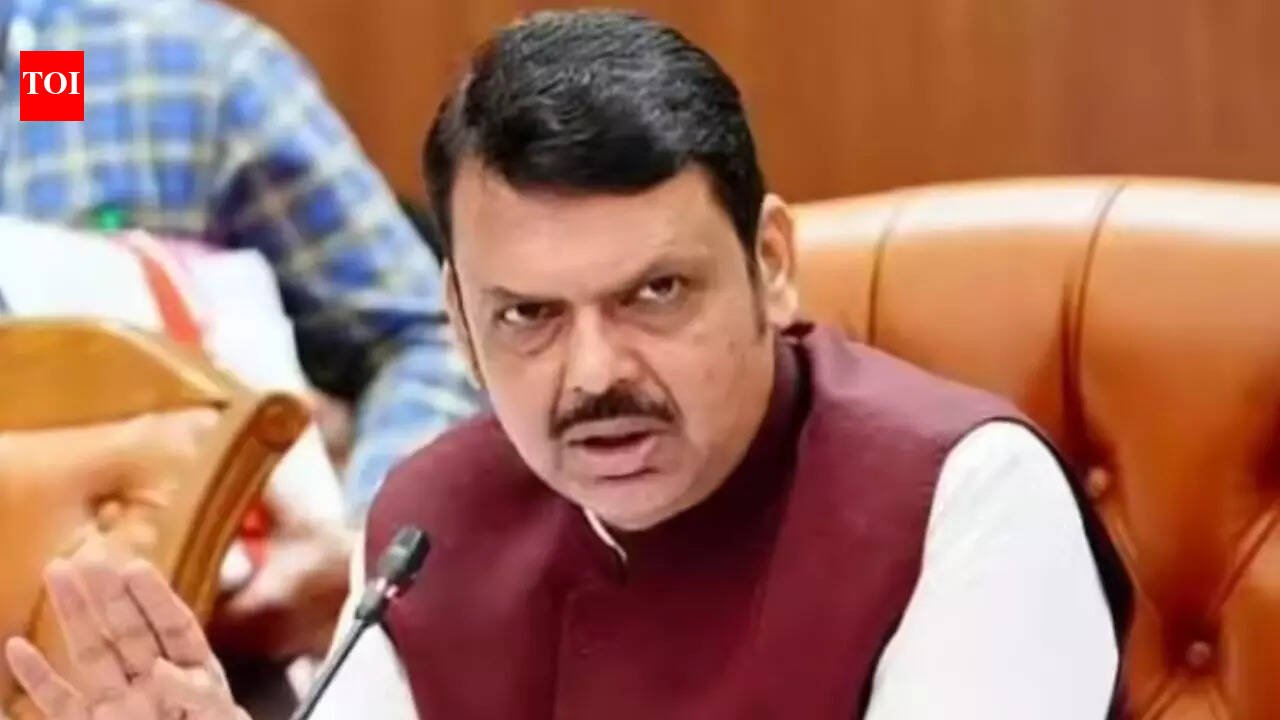
MUMBAI: Maharashtra chief minister Devendra Fadnavis positioned the state as a national leader in climate action, and Mumbai as a “gateway” for climate finance to the countries of the global south at the inauguration of the threeday Mumbai Climate Week at the Jio World Convention Centre.“The scale of climate transition required cannot be financed by public budgets alone. The developing world requires trillions of dollars for this transition,” Fadnavis said. The climate transition refers to efforts to shift from polluting fossil fuels to renewable energy, and to improve adaptation to rising temperatures and erratic rainwall wrought by global warming.
At the event, officials unveiled a climate finance access and mobilisation strategy developed jointly by WRI India and the Maharashtra Institution for Transformation (MITRA).“States that move early will attract capital, talent and innovation. Maharashtra intends to lead this movement,” Fadnavis said, adding “If climate capital must flow at scale, Mumbai is ready to become a medium for that flow.”The Maharashtra government and the Mumbai Metropolitan Region Development Authority (MMRDA) also signed a clutch of MoUs with global and national partners to strengthen climate action. They include urban heat mitigation and nature-based resilience with the United Nations Environment Programme (UNEP); climate implementation accelerators and metropolitan climate finance mobilisation with C40 Cities Climate Leadership Group; and infrastructure planning and low-carbon urban development with the Urban Land Institute India.Calling climate change “today’s greatest governance challenge”, Fadnavis said the transition would require capital, risk-sharing frameworks and blended finance, alongside confidence in execution and support for early-stage technologies. “When Mumbai receives excessive rainfall, it is not simply a statistic; it is trains halted, homes flooded, livelihoods interrupted,” he said.Outlining Maharashtra’s energy roadmap, Fadnavis said the state currently has roughly 48 gigawatts of installed capacity, of which 21% is renewable. “By 2030, we plan to reach 84 gigawatts, of which more than 50% is to be from renewable sources,” he said. “By scaling green hydrogen, electric mobility, biofuels and sustainable infrastructure, states which move early will attract talent, capital and innovation. Maharashtra intends to move early. We are integrating sustainability and resilience in the design stage itself for infrastructure.”Highlighting vulnerabilities, he said, “Our farmers are facing changing rainfall patterns, water stress. Our coastline requires long-term protection. Fisheries and rural communities depend on predictable ecosystems.”Union minister for new and renewable energy Pralhad Joshi said three million connections have been completed in two years under the PM’s Surya Ghar household solar power generation scheme. He added that there has been a 235% increase in solar energy capacity in the last 10 years — from 2.8 gigawatts in 2014 to 141 gigawatts now — with total renewable energy capacity reaching 270 gigawatts.State environment and climate change minister Pankaja Munde said, “Practical, scalable, financeable solutions are crucial for effective climate change action.” She added that climate concerns should be embedded in city planning.Shishir Joshi, CEO of Project Mumbai, which is organising the event, said, “Mumbai will become a climate laboratory for the Global South, creating real public-private partnerships which will lead to scalable solutions.”A commemorative stamp marking Mumbai Climate Week was formally released by Fadnavis at the inauguration. Organisers said the event will focus on climate finance, urban resilience, renewable energy, sustainable mobility and citizen-led initiatives, with an emphasis on implementation and cross-sector partnerships.


