


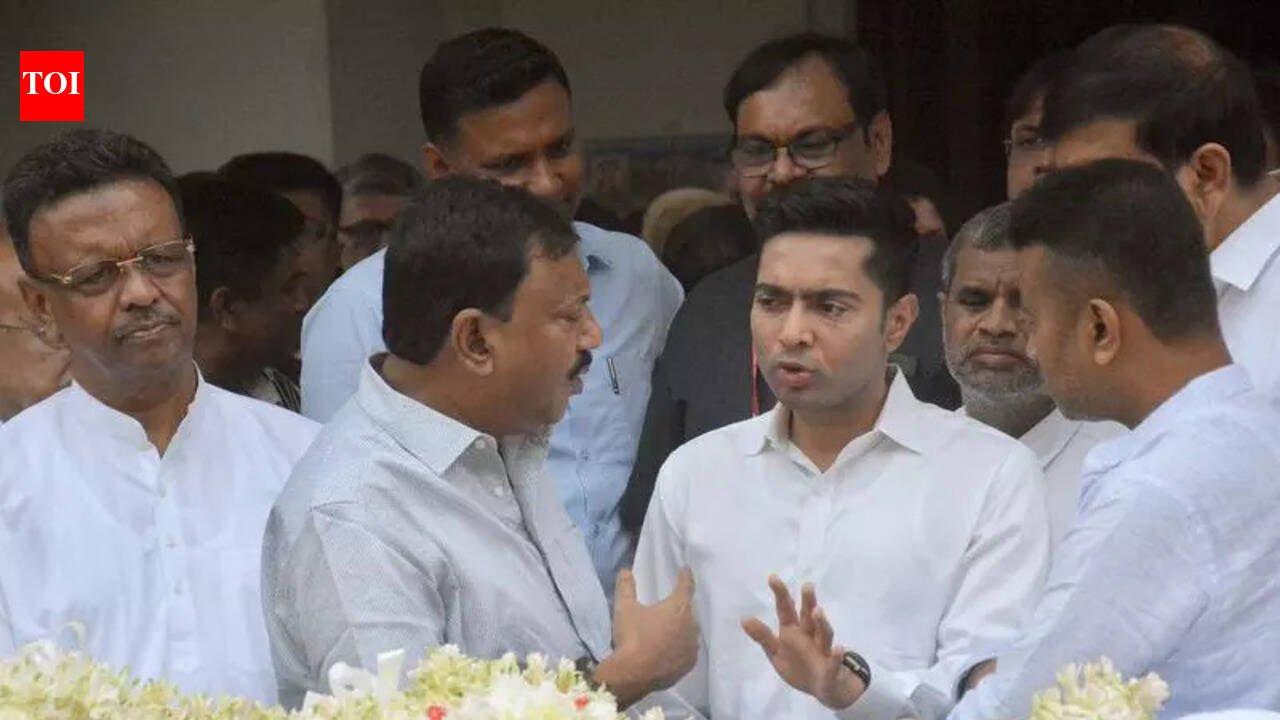
Kanchrapara: From being a co-founder of the Trinamool Congress to helping the BJP notch up its highest Lok Sabha vote tally in Bengal in 2019, former Union minister Mukul Roy was among the few politicians in the state who could claim to have seen both sides of the fence.Roy, 71, breathed his last around 1.30am on Monday following a cardiac arrest at a private hospital off EM Bypass, his son Subhrangshu said. He suffered from multiple ailments and was in and out of hospital for the last two years. Family members said Roy was also diagnosed with dementia and had recently slipped into a coma.PM Narendra Modi posted on X: “Pained by the passing of former Union minister Shri Mukul Roy Ji. He will be remembered for his political experience and efforts to serve society. Condolences to his family and supporters. Om Shanti.”Some of the most poignant images of Roy in recent times were those of his battle with multiple illnesses; even this 600-day struggle, following his admission to hospital on July 3, 2024, bore the hallmark of the grit and resilience that defined his career.Born in Kanchrapara in 1954, Roy began his political journey with the Youth Congress in the 1980s. When Mamata Banerjee broke away from the Congress to form the Trinamool Congress in 1998, Roy was among the first to follow her.“I am deeply shocked and grieved by the news of the demise of veteran politician Mukul Roy. He was my long-time colleague and a comrade-in-arms in many political struggles. His departure has left me heartbroken,” CM Mamata Banerjee said.The CM noted that Roy served as a Union minister and enjoyed acceptability across all levels of the party. Banerjee added that although Roy later chose a different political path before returning, his contribution to Bengal politics and his organisational skills would not be forgotten.TMC national general secretary Abhishek Banerjee — occupying a post Roy held until 2015 — wrote: “The demise of Mukul Roy marks the end of an era in West Bengal’s political history. A veteran leader with vast experience, his contributions helped shape an important phase of the state’s public and political journey.”Abhishek paid his last respects when Roy’s mortal remains were brought to the Bengal assembly and later walked alongside Subhrangshu through the Kanchrapara stretch as Roy was taken home for the final time.Elected to the Rajya Sabha in 2006 and re-elected later, Roy became the Trinamool leader in the Upper House in 2009. In the UPA-II govt, he served first as minister of state for shipping and later as the railway minister in 2012. However, his political karmabhoomi was always Bengal.After Trinamool’s historic victory in 2011 ended the Left’s 34 years in office, Roy engineered mass defections as grassroots opposition workers and leaders gravitated towards the TMC. Under Roy’s watch, defection — previously a shunned word in Bengal politics — became a public spectacle.At the time, he was frequently compared to former CPM state secretary and politburo member Anil Biswas, even earning the moniker ‘Chanakya’. But to many, he represented ideological fluidity and opportunism.Then came the controversies. After the Saradha scam, the Narada sting operation tripped him again. By 2017, relations with his one-time mentor Mamata worsened. Roy eventually quit the party he helped form and joined the BJP.Ahead of the 2019 Lok Sabha elections and the 2021 assembly polls, he emerged as the saffron party’s key organiser in Bengal. The BJP’s tally of 18 out of 42 Lok Sabha seats in 2019 was its highest ever. In 2020, he was appointed national vice president of the BJP.Roy was elected MLA from Krishnanagar North on a BJP ticket in 2021. But within weeks of the assembly results, which saw Mamata secure a resounding third term, Roy returned to the TMC fold, describing it as his “first and last home”. The BJP overlooked him for Suvendu Adhikari for the post of Bengal’s leader of the opposition.By then, however, the once-indomitable strategist was a shadow of his former self and receded from the political battlefield. Roy’s health deteriorated sharply after 2021. He resigned as chairman of the Public Accounts Committee, citing ill health. Though he rejoined the TMC, he never regained the centrality he once commanded as new power centres emerged.The Calcutta High Court later disqualified him under the anti-defection law, a decision subsequently stayed by the Supreme Court. In a twist steeped in irony, the law he long navigated and — critics say — weaponised during his prime, finally turned on him.(Written with PTI inputs)


