



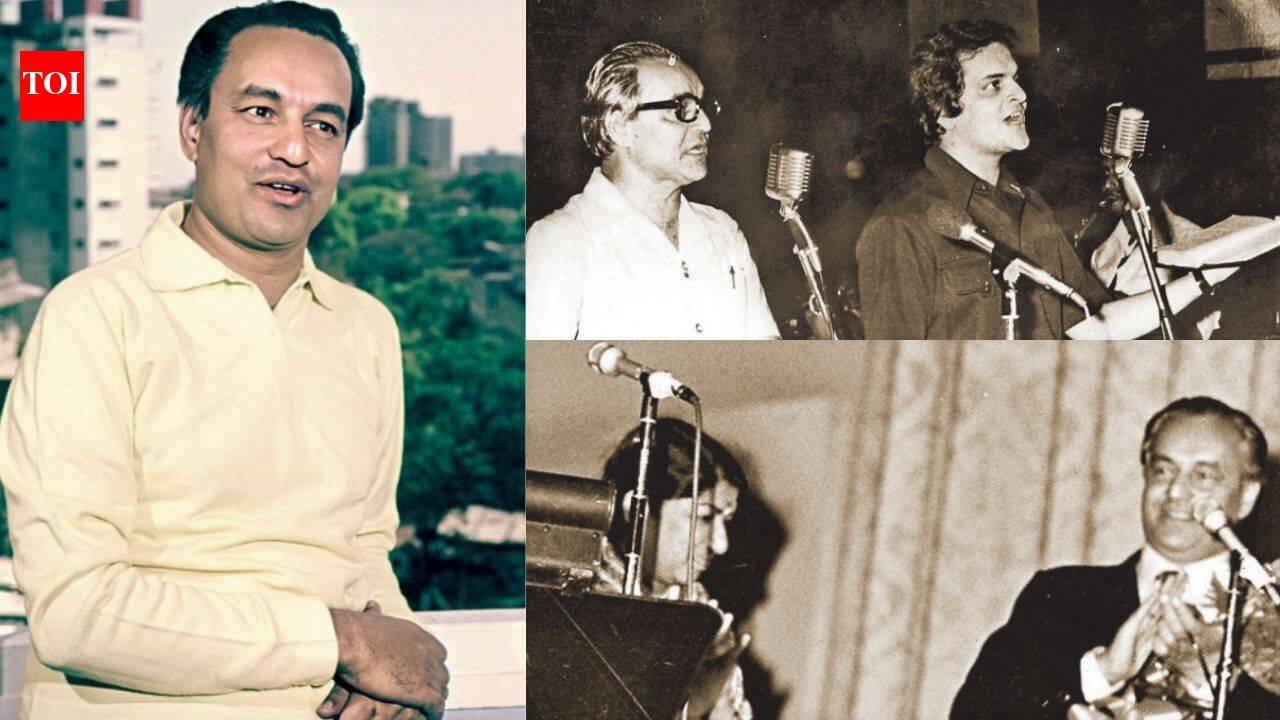
Renowned playback singer Mukesh died on this day in 1976, hours before a Detroit concert. Half a centurylater, his son Nitin recalls the haunting final days of a voice that continues to comfort millionsFor anyone nursing a heartbreak, his voice fell like gentle rain on parched earth. With every note rendered, the heart seemed to heal to its touch.Even now, exactly 50 years after his passing on August 27, 1976, Mukesh, the master of melancholy, continues to comfort millions on aching afternoons and vagabond nights.The Delhi-born singer passed away following a fifth heart attack, shortly before a sold-out musical show with the peerless Lata Mangeshkar in faraway Detroit. The two singers, who shared a close bond, were on a series of shows across cities in the US and Canada.Reporting for TOI on their August 9 show at Washington’s Kennedy Center, journalist M V Kamath wrote that the capacity audience had come from areas “as far away as 800km”. The show, he said, would be “long remembered for its warmth and duration”, adding that Lata and Mukesh sang for “an unprecedented 150 minutes”.
Last days, final moments
Mukesh’s son, Nitin Mukesh, who was with him in his room at Hotel Pontchartrain during the fatal heart attack, remembers that three days earlier, his father had asked Lata in Montreal if Nitin could sing a few songs at the show.“I don’t know why he said that. He had never done that before,” says Nitin, who would go on to become a popular playback singer in his own right.Introduced by Lata to the audience, Nitin sang the chartbuster Kabhi Kabhie Mere Dil Mein. Mukesh played the harmonium. After the show, Nitin received accolades from the audience.But when he asked his father about his performance, Mukesh simply said, “Bahut achha tha (it was very good), but there is room for improvement.”“He didn’t praise me to the skies,” Nitin says. “But my mother told me later that he called her and said, ‘Tumhare bete ne to apne baap ko bhi peeche chhod diya (Your son has left his father far behind)’.”The next day, Nitin again crooned a few songs, this time in Toronto. The father-son duo sang Jaane Kahan Gaye Woh Din from Mera Naam Joker as a duet.Nitin got to sing a lesser-heard stanza:“Is dil ke ashiyaan mein bas unke khayal reh gaye / Tod ke dil woh chal diye, hum phir akele reh gaye.”The words turned out to be strangely prophetic.“It’s been 50 years since I sang those lines, but they still haunt me,” Nitin says.That was to be the last time Mukesh sang on stage.They took the train to Detroit on August 26, a day before the scheduled show. Father and son shared a room at the hotel.On August 27, the fateful day, Nitin stepped out for lunch.“When I returned, I saw him peacefully asleep. I let him be and dozed off,” he says.Nitin remembers being woken up by his father, who teased him:“Aaj mera gala ekdum theek hai, aaj tujhe nahi gaane doonga (My voice feels perfect today, so I won’t let you sing at all).”Mukesh then stepped into the shower.“Suddenly, I had an awful vision. I did something which I had never done before. I knocked on the door and said, ‘Papa’. He was almost irritable. ‘Kya hai? I am getting ready.’”Nitin started feeling more relaxed. But when Mukesh took more time, he called him a second time — only to get a similar response.A couple of minutes later, the door opened and Mukesh emerged, panting. He took a cushion and sat on the chair.“I instantly sensed something was wrong, and started patting his back gently. He said, ‘Don’t touch me, I am feeling uncomfortable.’ He was also sweating.”Nitin called Lata and the hotel reception. The paramedics arrived within minutes, but before them came Lata with her ‘bhabhi’. She applied a tika on Mukesh’s forehead.“Lata didi was scared and aghast,” says Nitin.“My father scolded me, ‘Why did you have to call her, main theek ho jaoonga (I’ll be alright),’ he said.”Before the paramedics put him on a wheelchair and took him down to the ambulance, Mukesh asked for the Ramayan, which he read and recited every day.“In the ambulance, he was calling out to his own mother,” says Nitin.The ambulance reached Detroit General Hospital in about 10 minutes. Nitin was relieved to see an Indian doctor among the medical staff.“I knew that at least one of the doctors would know who he was treating,” he says.Mukesh was wheeled into emergency. The Ramayan was returned.That was the last Nitin saw him alive.Mukesh was only 53.Sadly, two other singing greats — Mohammed Rafi and Kishore Kumar — also died in their 50s.
The importance of no. 9
Nitin says the number nine held a special significance in Mukesh’s life.Nitin Mukesh was born on July 27 — the numerals adding up to nine. When his father travelled to Kenya and Mauritius for shows in 1963, he chose June 27 as the travel date.In 1976, they left for the US-Canada tour on July 27.In Detroit, after Mukesh saw that the hotel room number was 2007, he said:“Sabse achha show hoga (It’ll be the best show).”The Detroit performance would have been the ninth show of the tour.Ironically, Mukesh also passed away on August 27.
The Ramayan album
Mukesh’s seven-album magnum opus, Tulsi Ramayan, remains an evergreen classic.One of the albums, Sundarkand, has 6.6 million plays on YouTube, along with more than 3,500 emotional comments.Old-timers recall how the devotional tracks would play in temples near their homes, becoming a part of their daily lives.Many singers have since recorded the Ramayan, but Mukesh was “the pioneer”, Nitin points out.“So many people come and talk to me about the Ramayan. And, till date, the album fetches royalty,” he says.Mukesh’s rendition of the epic is rich, resonant and filled with a devoutness that comes from deeply feeling the words.The seven albums were recorded over seven to eight years, during which the singer survived four heart attacks.The album’s composer and Mukesh’s friend, Murli Manohar Swaroop, once reassured Nitin after his father’s fourth attack:“Chinta mat kar, Nitin, papa ko kuchh nahi honewala hai. Ramayan baaki hai, bhai (Don’t worry, Nitin, nothing will happen to your dad. The Ramayan is still left).”The recording of the final Ramayan album was completed just a few days before Mukesh and Nitin flew out for the tour.“When he came back home that night, he sobbed like a child and said, ‘My mission is complete’.”
A special duet with Salil Da
Many of Mukesh’s signature tracks were recorded with Shankar-Jaikishan. But several of his unforgettable numbers, including the song for which he received the National Award, Kai Baar Yun Bhi Dekha Hai from Rajnigandha, were composed by Salil Chowdhury.“So many male singers sang for him. But he handpicked the songs that he gave Papa. They sat and sang together, ate and drank together,” says Nitin.Nitin also recalls that Salil da ruffled feathers when he gave the Anand song Kahin Door Jab Din Dhal Jaaye to Mukesh.The original Bengali version, Aamaye Proshno Kore Neel Dhrubotaara, had been sung by Hemant Kumar.“But he insisted that Mukesh would sing the number,” Nitin says.He also remembers the forgotten Kaise Manaoon Piyawa from the 1961 film Chaar Diwari — a song that “perished like an unseen desert flower” when it was first released.“But in America, the audience still asks for that song.”Salil Chowdhury’s tunes for Madhumati and Anand were chartbusters. But Nitin points to two other Salil classics sung by Mukesh — Zindagi Khwab Hai from Jagte Raho and Nain Hamare from Annadata.“They are perennial favourites,” he says.
A great match
Leg-spinner B S Chandrashekhar, who fashioned a bunch of unforgettable Test victories for India in the 1970s, was perhaps Mukesh’s greatest fan.Journalist Raju Bharatan once wrote in the Weekly that the ace spinner possessed more than 100 records of K L Saigal and over 300 albums of Mukesh.Former India captain Sunil Gavaskar has recalled how Chandra would be fired up by a Mukesh song playing on a transistor radio in the stands.When Ajit Wadekar’s team returned after winning India’s first Test series in England in 1971, Chandrashekhar was the toast of the nation. His leg-breaks and googlies had produced a dream spell of 6/38 and destroyed England at The Oval.Mukesh was in hospital at the time, having suffered his second heart attack.Chandra drove straight from the airport to meet his idol.“He was India’s man of the moment. But he came to the hospital to meet Papa. My father was also thrilled and humbled. The doctors took care to ensure that he wasn’t too excited. Both were in tears,” recalls Nitin.“Chandra could hardly speak Hindi. But he knew every Mukesh song.”Over the years, the singer and the cricketer developed a strong mutual admiration society.Every time Chandra was in Bombay, he would visit Mukesh at his residence.“On different occasions, he brought Gavaskar, Vishwanath, and Syed Kirmani home,” Nitin says.In 1973, against Tony Lewis’s visiting team, Chandrashekhar scalped a record 35 wickets at Bombay’s Brabourne Stadium.“Chandra signed and gifted the record-breaking ball and a bat signed by the Indian cricket team to my younger brother, Mohnish,” he recalls.Chandra was in Bangalore when Mukesh passed away.The story goes that the flights were fully booked and Chandra barely managed to get himself onboard.“He was heartbroken, absolutely uncontrollable,” says Nitin.Chandra later named his son Nitin as a mark of respect to the singer.
The voice that never left
Mukesh may have been gone for five decades, but the emotional intimacy of his voice has never really faded.His songs continue to find listeners in moments of loneliness, nostalgia and heartbreak. His Ramayan continues to play in homes and temples. And the memories of the man behind that unmistakable voice continue to live on through those who knew him.The singer is long gone.The songs endure.


