






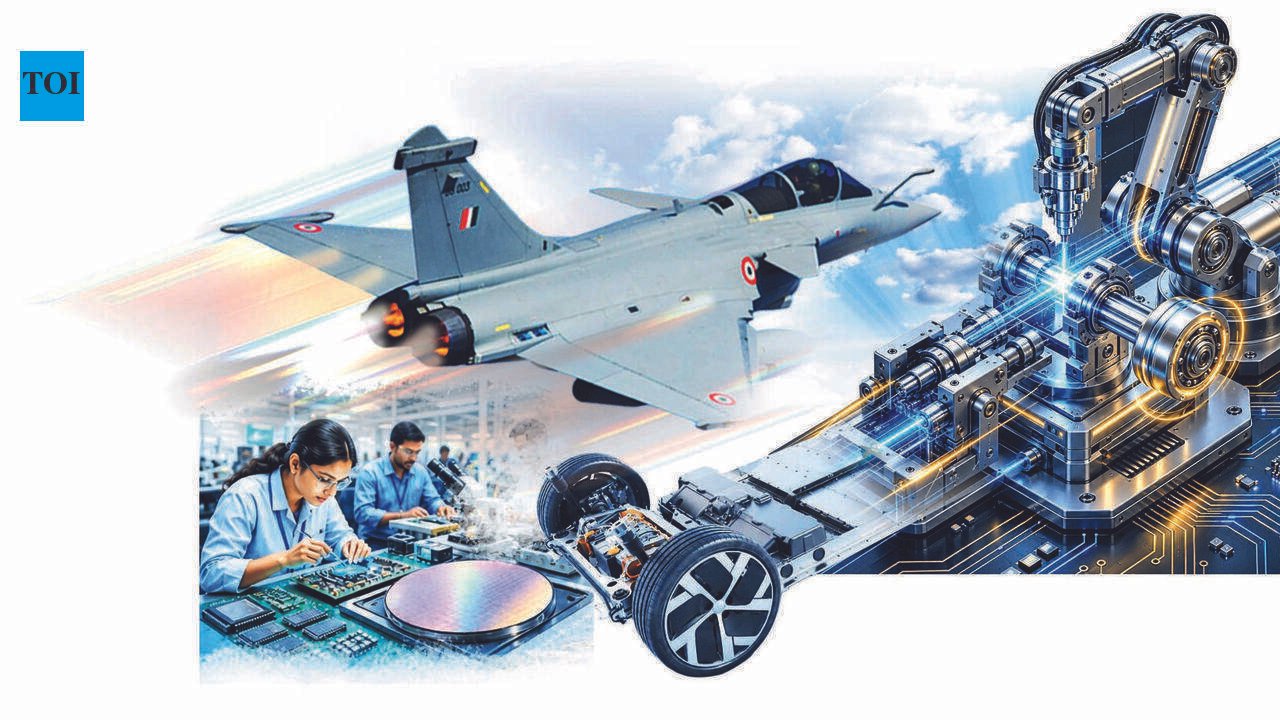
There are now two to three enquiries every day about setting up global capability centres (GCCs) in India, with companies weighing cities like Bengaluru, Hyderabad and Chennai. At the same time, high-end manufacturing and emerging sectors are opening up as global OEMs pursue China+1 strategies, say industry representatives.For Tamil Nadu, the window to stay competitive is narrowing. The challenge isn’t just retaining the state’s industrial edge, but capturing a larger share of new opportunities and moving up the value chain.As the TVK govt drafts a new industrial policy, TOI spoke to industry veterans, industry-body heads and global consultants on what it should achieve, which opportunities TN must pursue, and how to scale them toward a $1.5 trillion economy.“TN does need a new industrial policy, not because the current one has failed, but because the ecosystem it was drawn for no longer exists,” says Nithin Chandra, senior partner, Kearney. The Industrial Policy 2021 broadly delivered on its intent — targeting `10 lakh crore of investment and 20 lakh jobs by 2025, with manufacturing growing at a healthy 9-10% CAGR over five years. The transformation shows in electronics: exports rose from $5.37 billion in FY23 to $14.65 billion in FY25, taking TN’s share past 41% of India’s electronics exports, with Kancheepuram now the country’s second-largest exporting district. TN remains India’s largest garment exporter and produces roughly a third of the country’s non-leather footwear.What’s changed, then, is less the policy’s execution than the competitive landscape around it — with new trade agreements and fresh investment flowing into semiconductors, EVs, aerospace and critical minerals.“Incentive design itself needs to modernise. Gujarat’s ‘choose your incentive’ mechanism, letting investors pick between capital subsidy, interest subsidy or power-tariff relief, is a useful benchmark,” Chandra says.TN’s next policy should aim not just to attract capital but ensure every rupee creates more local value, technology, IP and global market access, says P Ravichandran, chairman, CII Southern Region.The policy should drive synergy across industry, IT, MSME, higher education and skilling departments. “Working in silos greatly dilutes the outsized positive impact these departments can create,” says Ramkumar Ramamoorthy, partner, Catalincs and former CMD, Cognizant India. He recommends an overarching body — similar to the department of military affairs, which unifies India’s army, navy and air force — with power to define ownership and cross-pollinate innovation across academia, industry and government.“Industrial subsidies must align with local skills; otherwise public funds merely subsidise jobs for migrant workers without addressing youth unemployment,” says Prof Vidya Mahambare, from Great Lakes Institute of Management. “Sector-specific subsidies often fail to create significant new jobs — the focus should be on improving broad-based infrastructure,” she says.“New-age sectors should complement existing industries, not shift away from them,” says A Viswanathan, president, Madras Chamber of Commerce & Industry. “Plans for special focus on new-age sectors such as semiconductors, AI, aerospace and space, advanced manufacturing, GCCs and R&D are welcome. Traditional sectors will reinforce this by providing inputs for the emerging sectors as well as consuming the output of new age sectors.”The next phase should focus less on adding assembly lines and more on capability — design labs, precision toolrooms, engineering centres and IP, Ravichandran says.Electronics offers the clearest deepening opportunity: beyond assembly, targets should include PCBs, displays, connectors, semiconductor design, ATMP, industrial electronics and R&D. TN’s auto-component base similarly positions it for battery cells, battery-management systems, power electronics, motors and vehicle R&D.Non-leather footwear shows what targeted strategy achieves: anchor investors such as Hong Fu, Pou Chen, Feng Tay and Evervan Kothari have brought roughly `6,550 crore and 86,000+ jobs across five districts, many held by women. “That’s a template for sector-building: identify a sector seeking China-plus-one, court two or three anchor investors, let the vendor ecosystem follow. The next step is climbing into design, branding and higher-value materials,” Chandra says.Three emerging opportunities stand out. GCCs are most immediate — Chennai’s GCC headcount has roughly doubled since 2019, with room to differentiate through engineering- and manufacturing-linked centres, and to extend the model to Coimbatore, Madurai and Trichy. Defence and aerospace is another: TN’s defence industrial corridor has already drawn over `23,000 crore against a 2032 target of `75,000 crore. Third is advanced capital goods and heavy engineering, including shipbuilding and the blue economy.“We are not moving away from manufacturing,” said state industries minister S Keerthana. “Our approach is to support sectors that generate employment at scale… while creating a differentiated policy framework for newer, higher-value sectors.”The larger bet: TN has the industrial base, talent, supplier networks and export orientation many emerging manufacturing hubs are trying to build. Its task is to climb the value chain before rivals do, Ravichandran says. The next policy should not ask, “How much investment did we attract?” but “What did that investment make Tamil Nadu capable of doing that it couldn’t before?”


