



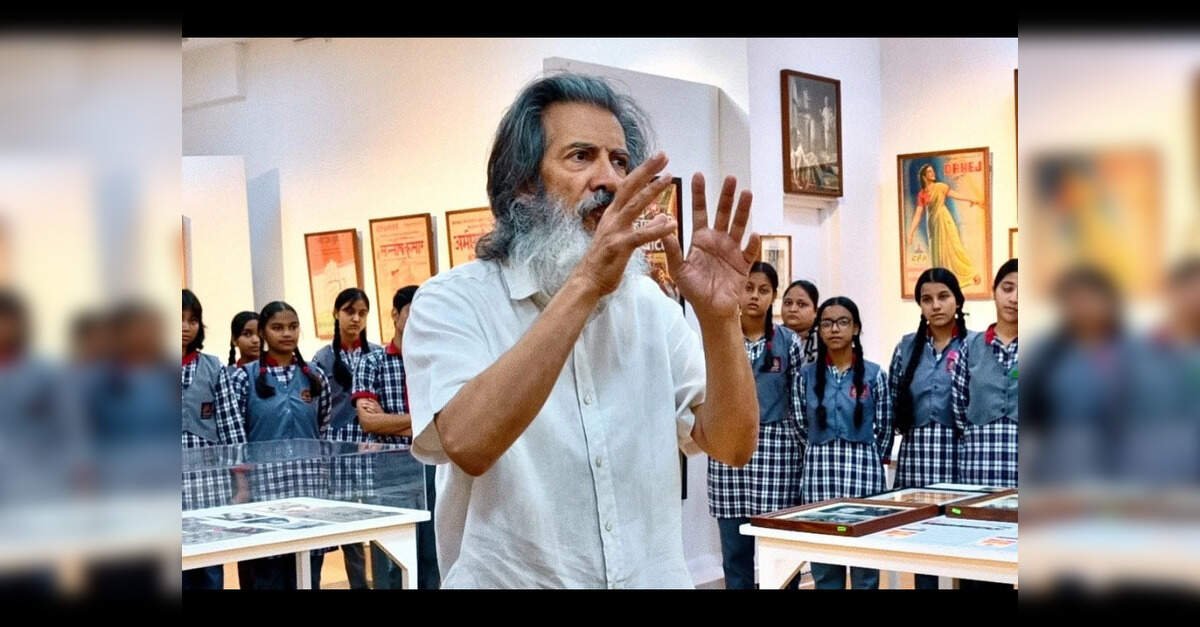
India’s education system has spent generations teaching children to read and absorb knowledge primarily through text. Neville Tuli, however, believes it is time students were also taught to see, hear and question, with greater attention to the context connecting all three.
For Tuli, curator of the exhibition SWARAJ: Re-visualising India’s Political History and founder of The Tuli Research Centre for India Studies (T.R.I.S.), one of the fundamental weaknesses of conventional education is its overwhelming dependence on text and its omission of the visual and the image.
“Education cannot remain overwhelmingly textual. We understand the world through what we read, but also through what we see, what we hear and, most importantly, through the context that connects all three,” says Tuli.
SWARAJ, presented by T.R.I.S. and curated by Tuli, revisits India’s journey towards political self-rule and self-discovery through paintings, photographs, newspapers, books, prints, film publicity art, political propaganda, memorabilia and visual, textual and audio archives.
Rather than treating Independence as a story that culminates on August 15, 1947, the exhibition examines the longer evolution of India’s political consciousness, from reform, resistance and nationalism to Partition, the Constitution, the integration of princely states, wars, the Emergency, communal tensions and people’s movements.
At its heart is a larger question: what does it mean for a civilisation not only to achieve political freedom, but to continually understand and deepen the meaning of self-rule and freedom?
That larger inquiry also explains why Tuli sees SWARAJ as an argument for a different kind of education.
His contention questions something education has long taken for granted: that the textbook is the principal carrier of knowledge, while photographs, films, recordings, posters and objects are merely supporting material.
Tuli turns that hierarchy around.
“The visual should not be treated as decoration. The image is as much the source of knowledge. Sound is knowledge. Material culture is knowledge. Unless we learn to read all of them together, our understanding will remain incomplete,” he says.
SWARAJ demonstrates this through India’s political history. Paintings sit beside photographs; newspapers beside propaganda; books beside film publicity art; iconic political imagery beside seemingly ordinary objects such as Swadeshi matchbox labels and tin covers.
Each can reveal information that a conventional historical paragraph may not.
A political poster can tell us not only what happened, but what people were being persuaded to believe. A photograph records a moment but can also reveal who controlled the gaze. A song can capture an emotion that a chronology cannot. An advertisement or matchbox cover can show how nationalism travelled from political meetings into daily life.
“A photograph is not merely an illustration to a historical event. A speech is not merely an audio supplement. A poster, a song, a newspaper, a film or even a matchbox label can contain knowledge that the textbook has never captured,” says Tuli.
For him, the consequences go beyond how history is taught. They concern how children are taught to think.
When students are primarily rewarded for absorbing a fixed body of text and reproducing it, curiosity can become secondary to recall. Tuli believes education should do precisely the opposite.
“The purpose of education should not be to tell a young mind what to remember. It should create enough curiosity for that mind to look again, listen again, question what it has inherited and then go deeper. Every answer is only relevant to raise a deeper question,” he says.
That philosophy also shapes the wider work of T.R.I.S., whose visual, textual and audio knowledge base brings multiple forms of cultural evidence into conversation rather than allowing them to remain isolated.
Tuli is particularly critical of the confidence with which societies often assume their understanding of history is complete.
“You honestly think you know India? You have no clue,” he says.
The statement is deliberately unsettling, but his larger point is about the limitations of the archival foundations on which academic knowledge has traditionally been constructed, particularly in India.
“The greatest scholars have understood fragments. Any scholarship that has wisdom must be willing to revise itself as new evidence, new images and new context emerges,” he says.
For education, this would require a significant shift in how subjects, particularly history, are taught.
Imagine teaching the freedom movement not simply through dates and chapters, but through Gandhi’s voice, political cartoons, photographs of protests, newspaper front pages, revolutionary pamphlets, cinema, songs, advertisements and objects people actually used, alongside the text.
A student would no longer merely learn that history happened. The student would begin to understand how history looked, sounded, circulated and was experienced.
And that, for Tuli, may be the difference between information and education.
He argues that India needs young minds capable of interrogating the past rather than simply being told about it, while also rediscovering the joy of learning.
“Every answer is only relevant to raise a deeper question,” he says.


