



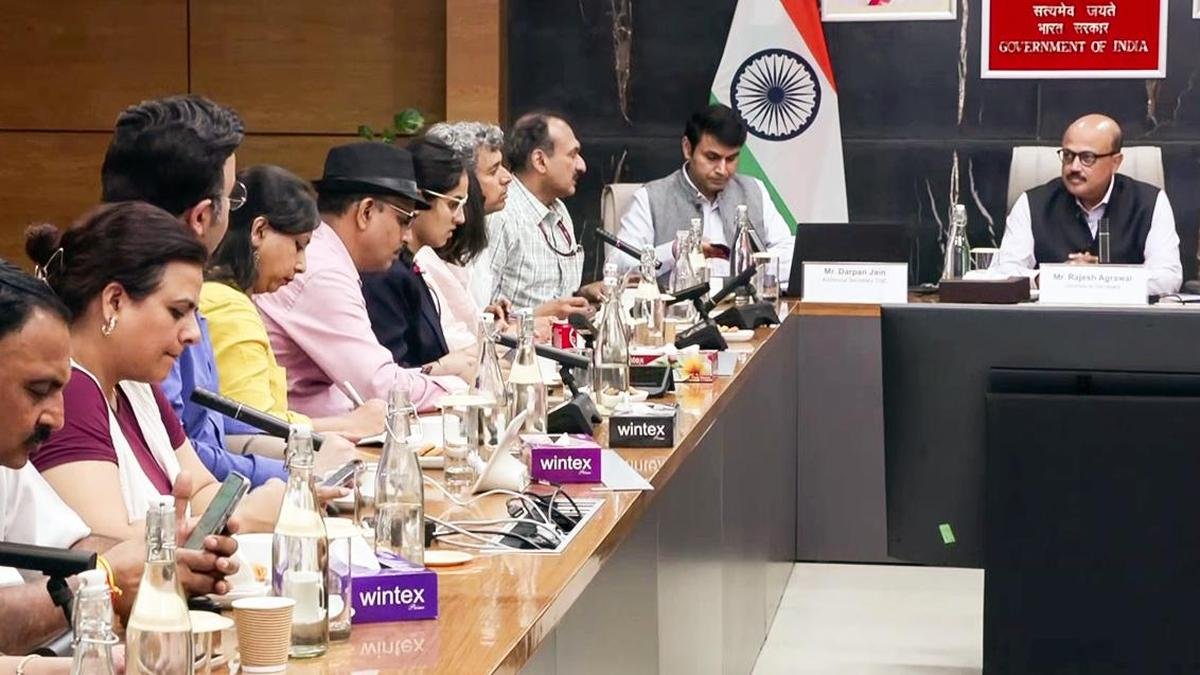
The India-UK Comprehensive Economic and Trade Agreement (CETA) and Double Contribution Convention (DCC) that are set to come into force on July 15 are a “gold standard” and one of the “most ambitious and aspirational free trade agreements” signed by India, Commerce Secretary Rajesh Agrawal said on Tuesday (July 14, 2026).
He added that the deals benefit India’s farmers, fisherfolk, workers and women entrepreneurs. The India-UK CETA and the DCC were signed in July last year.
“This is one of the first free trade agreements (FTAs) of its kind, which establishes a future-oriented economic architecture between two major economies of the world,” Mr. Agrawal said at a press briefing. “This is also one of the most ambitious and aspirational FTAs of India, which we are operationalising as till date.”
Deal dynamics
“It is a gold standard and the first of its kind because of its wide sectoral coverage and deep reduction in both tariff and non tariff barriers,” he added.
Under the deal, the U.K. will immediately eliminate tariffs on 96.8% of its tariff lines, accounting for 97.7% of the trade value. An additional 2% of tariff lines, amounting to 1.8% of trade value, will see reduced tariffs based on quotas. In total, this covers 98.8% of tariff lines and 99.5% of trade value.
India, on the other hand, will immediately eliminate tariffs on 30.3% of the trade value, with 47% more seeing tariffs eliminated in a phased manner. It will also provide reduced quota-based tariffs on 12.1% of the trade value. In total, this would cover 89.5% of tariff lines and 89.4% of trade value.
Wide-ranging impact
Officials in the U.K. have also welcomed the deal, highlighting a multi-sectoral impact.
“For the City of London, the agreement provides a strong platform to unlock even greater collaboration in financial and professional services, insurance, fintech, sustainable finance and infrastructure investment,” Chris Hayward, Policy Chairman, of the City of London Corporation told The Hindu.
“As India continues its remarkable economic growth story, London stands ready to support the mobilisation of global capital and expertise needed to help deliver those goals,” he added.
Mr. Agrawal said that the thirty chapters across which negotiations have taken place under this agreement extend beyond conventional tariff liberalisation to cover digital trade, government procurement, SMEs, innovation, labour, environment, and gender.
He added that the deal addresses non-tariff barriers as well, so that issues like Sanitary and Phytosanitary Measures (SPS) and Technical Barriers to Trade (TBT) “do not become unjustified trade restrictions for our businesses in the future”.
Sensitivities protected, labour benefited
The Secretary further explained that the deal protects India’s sensitive sectors such as dairy, cereals, pulses, vegetables, gold and jewellery, smartphones, and critical polymers.
On the DCC, he said that the agreement was a “gamechanger” for India’s services sector and skilled workforce.
“Indian employees and their employers contribute around 25% of their salary to the UK’s national insurance system,” Mr. Agrawal explained. “Their contribution is like a tax of 25% as employees are unable to draw benefits. These are like sunk costs.”
He said that the DCC will ensure that workers will not need to pay double contributions towards their social security. That is, if they are paying social security in India, then they will not have to pay it in the UK as well for a period of five years.
According to Mr. Agrawal, this will benefit over 75,000 Indian workers and over 900 employers.
Published – July 14, 2026 06:25 pm IST


