






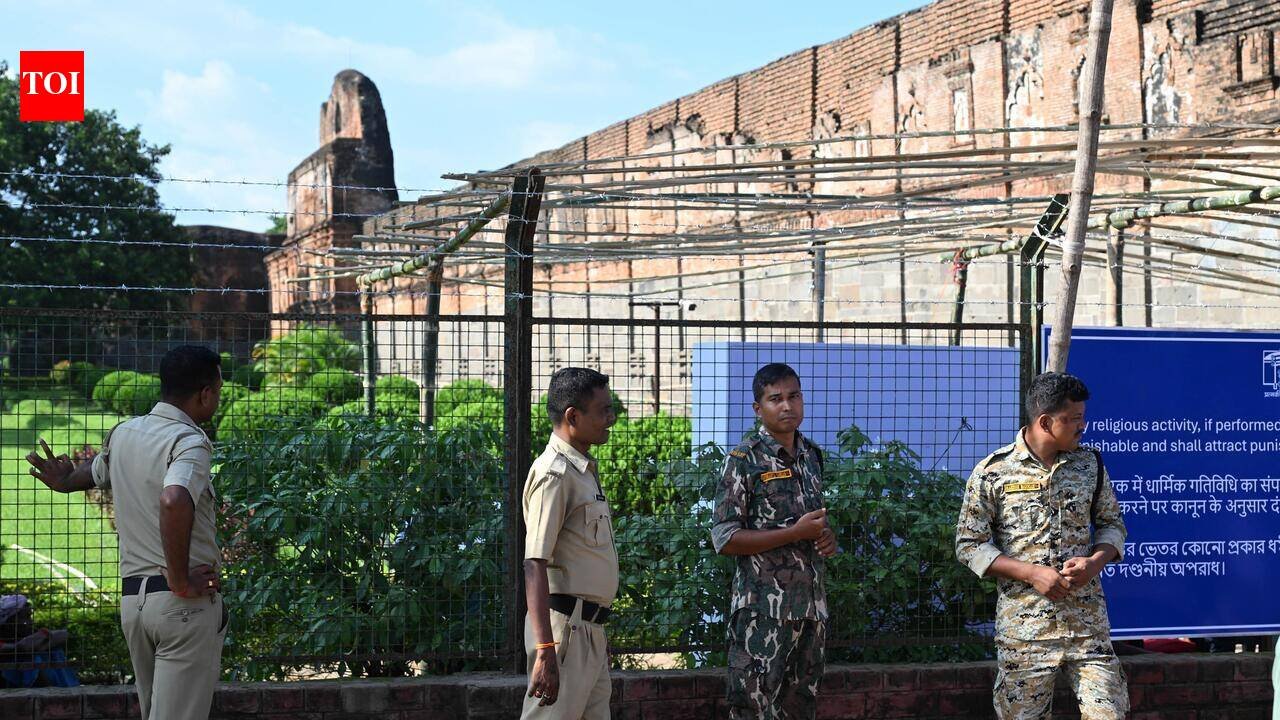
Malda: The mandir-masjid controversy has resurfaced in Malda, this time around the 14th century Adina Mosque, with the Hindu Suraksha Samity vowing to worship Lord Adinath, identified with Shiva, at the site on Monday as part of its campaign to “reclaim” what it says was once the Adinath temple.Preparations are underway, with the outfit saying it will bring a Shiva linga from Tarakeswar. “The holy Shiva linga is being brought from Tarakeswar,” said Brindaban Das, adviser of HSS. However, temple committee chief and district BJP leader Kajal Goswami struck a cautious note. “We have ample evidence that the mosque was built over the temple. Still we are going to perform our ritual beyond the site of it, marked by ASI,” he said.
CJP Jantar Mantar Protest Updates
The claim is not new. In 2024, Hindu activists from Uttar Pradesh had allegedly entered the area to perform religious rites. Goswami said the group did not want confrontation. “We are not to create any law and order crisis, instead we shall approach the Union Ministry of Culture with documents to get the nod of the govt,” he said.The Adina Mosque was built by Sultan Sikandar Shah between 1364 and 1374 AD, possibly as a proclamation of victory over the Delhi rulers. The vast rectangular hypostyle structure, spread over nearly 12.5 bigha, has often been compared with the Great Mosque of Damascus. Its open courtyard and remains of 306 domes point to its original scale. “You know, once 12,000 people used to pay namaaz at a time; the second largest in Asia,” locals claimed.The mihrabs, ornamental inscriptions and elevated royal chamber still survive, though time has altered parts of the flooring and structure. The Archaeological Survey of India inscription at the gate notes: “Architectural members of some earlier structures have been utilized partly in the construction of this mosque.”That line has long fuelled competing claims. For residents of nearby Adina, Eklakhi and Alampur, the monument has never belonged to one community alone. Researcher Susmita Shome said, “Adina has a history much older than the Ilyas dynasty of Bengal. The traces of Buddhist motifs in the mosque bear the testimony of that.” She also said the name Adina is linked to Adinath, another name of Shiva, and that the mouza is recorded as Bhaleswari. “Bhaleswari is another name of Durga,” Shome said.Local histories also cite Raja Ganesh, who ruled briefly in the early 15th century and is said to have turned Adina into a Hindu holy place. Researcher Kamal Basak said, “It is Jalaluddin who was desperate to destroy the Hindu motifs and replace them with Islam ones. Still the remains like Gouripatra (idol of lord Shiva) or tubrins (bow and arrow) are abundant in the campus of Adina.”Adina has also witnessed later conflict, including a Santhal uprising led by Jeetu Santhal in the early 20th century, when rebels captured the mosque before being suppressed by British-backed forces. Bullet marks are still shown by locals on its walls. Today, amid renewed mobilisation, the old mosque stands as both monument and flashpoint.


