






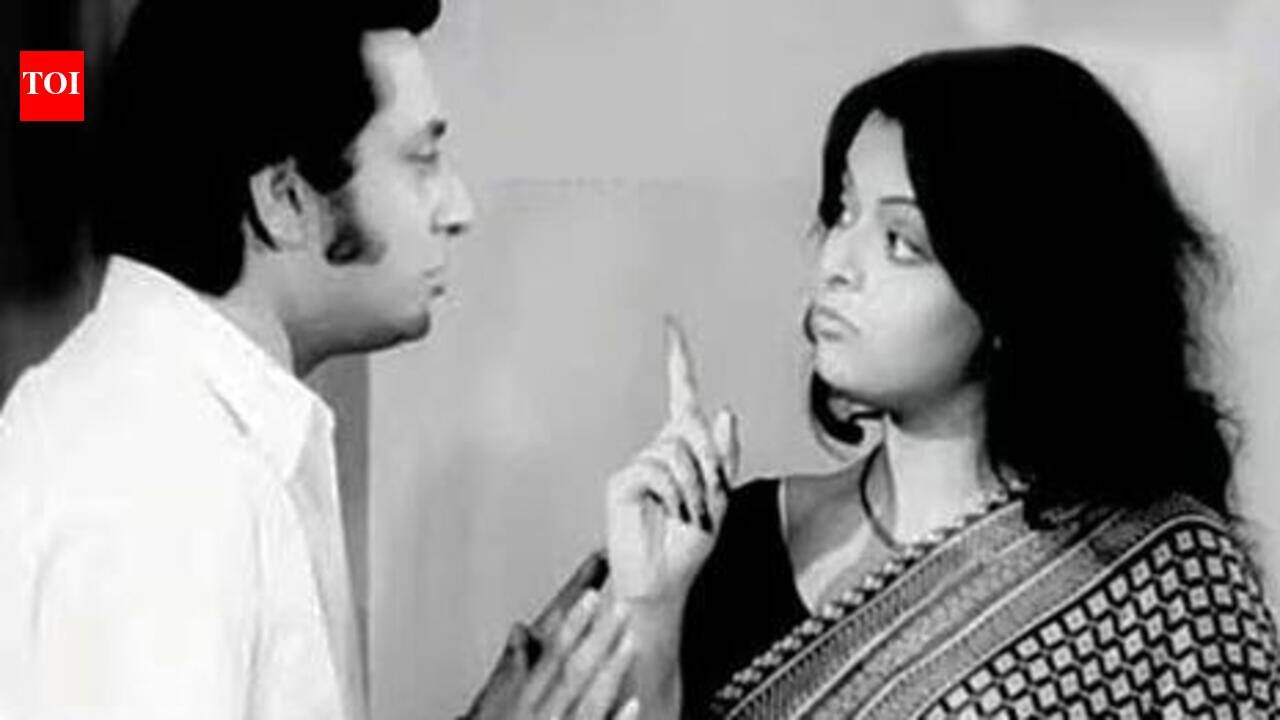
Kolkata: Mithu Mukherjee, the quintessential girl next door of Bengali and Hindi cinema who defined 1970s screen charm, passed away at a Mumbai hospital on Monday morning. She was 71.Expressive, spirited, and effortless, she rose to stardom after debuting in the 1971 Bengali film ‘Shesh Parbo’. Hits like ‘Marjina Abdulla’ (1973), ‘Mouchak’ (1974) and ‘Swayamsiddha’ (1975) established her stardom before she entered Bollywood with ‘Khaan Dost’ (1976) and ‘Safed Jhooth’ (1977), ultimately stepping away in the 1990s.On Goyna Goli in Goranhata, where she grew up alongside five siblings in her ancestral home, local sellers woke late to news of her death. Old-timers who remembered her discovery as a student at St Thomas’ School in Kiddirpore had mostly left. Newer residents love her picturisation of songs like ‘Besh korechhi prem korechhi’ or ‘Hai hai pran jae’ but know little of her films with Raj Kapoor, Dharmendra, Shatrughan Sinha, Yogeeta Bali, Utpal Dutt, and Ashok Kumar. But across Rajballabhpara Street, grief lingered on Monday afternoon. “During shooting breaks, she dropped by to visit her sister and brother-in-law,” recalled resident Kalpana Pal. “We were tenants downstairs and went to see her debut film, ‘Shesh Parbo’. She had such beautiful eyes.”
Mithu Mukherjee stayed in this house in Rajballabhpara
She had a flat in this Southern Avenue building
Her elder brother, Biplab Mukherjee, now living on Central Avenue, received word at dawn. “She went to the US for cancer treatment before the pandemic and got stuck when flights were discontinued. She recovered, but the cancer relapsed three years back. We lost her on Monday morning in Mumbai,” he said.Daughter of an air force officer, Mithu belonged to the Mukherjee family of Pathuriaghata Street before shifting to Goranhata. The family owned a printing press and other businesses. Mamaji, producer of ‘Shesh Parbo’ and a friend of her uncle, had been seeking a new face when he cast her. Her breakout role as Marjina in Dinen Gupta’s 1972 film ‘Marjina Abdulla’ catapulted her to stardom. Sonali Bose Gupta, who co-starred with her in ‘Bandhan’, remembered that the producer was so impressed by her debut that he urged her father to direct the project and cast her following a successful screen test. “Goshto Kumar designed her Marjina costume, and wardrobe arrived from Mumbai for the song ‘Hai hai pran jae’. She was dedicated, happily moody, and quick to learn. She also proactively helped in flood relief. I remember going to her grihapravesh at Ashoka Apartment where Amjad Khan too had come down,” she said.Audiences adored her in Ashutosh Bandyopadhyay’s ‘Nishikanya’ (1973) with Soumitra Chatterjee, Arabinda Mukhopadhyay’s ‘Mouchak’ (1974) alongside Uttam Kumar and Ranjit Mullick, and ‘Swayamsiddha’ (1975) with Mullick too. Director Prabir Roy highlighted the “sensual charm in her presence” that set her apart from the rest. “Her eyes and face spoke volumes. Last year too, I met her when she came during the Pujas to stay at Ashoka apartment,” Roy said.Beside Uttam Kumar, she starred in Yatrik’s ‘Chander Kachhakachhi’, ‘Hotel Snow Fox’, and the blockbuster ‘Mouchak’. Ranjit Mullick, who had hoped to reunite with her at Uttam Kumar’s centenary, reflected mournfully: “The finality of never seeing her again makes me sad. I did three films with her — two were bumper hits. She had no artificial mannerisms. People remember her on-screen effervescence, but they shouldn’t forget how powerful an actor she was. In ‘Swayamsiddha’, she stood her ground against stalwarts like Utpal Dutt, Satya Banerjee, and Chhaya Devi.”Yet, the actor retreated completely from acting after ‘Ashrita’ (1990). Anjali, her sister-in-law, revealed that she was both “choosy” and “moody”. “Getting the right actors to pair with her was not easy. She wouldn’t accept a role if she didn’t like the story or the hero.”The final rupture came when she “grew disillusioned” and “fed up” with the Bengal film industry while producing a project under a banner named after her mother, Bela Mukherjee. “A lead actor had demanded script changes, refusing to romance a character of a domestic help. Mithu, who co-wrote the film’s scenario, refused to compromise Pratibha Basu’s story from which the film was adapted,” he said. Instead, she brought in actor Kanwaljit from Mumbai, hired Chandra Barot of ‘Don’ fame to direct, and secured Hridaynath Mangeshkar for the score. “Although critically acclaimed and commercially successful, its treatment at regional awards where the film was pitted against ‘Beder Meye Jyotsna’ left her deeply hurt,” he said.She walked away, turning her back on cinema for good. On Monday, the curtains finally fell, leaving a quiet, unbroken silence where the applause of millions once echoed.


