



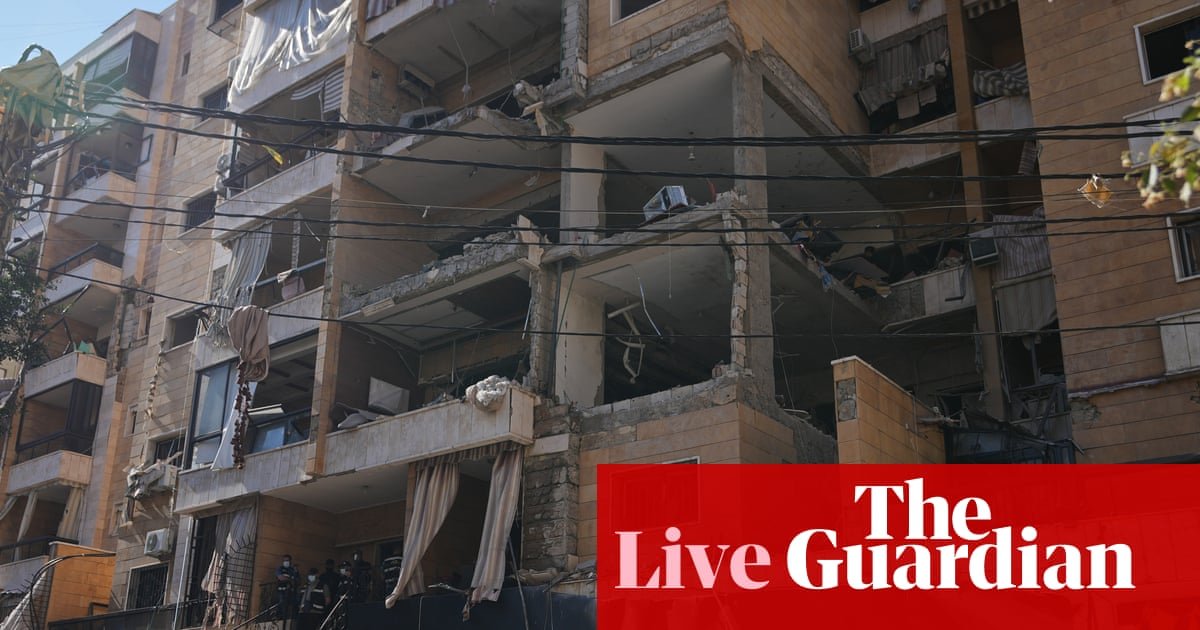
Israel strikes southern suburbs of Beirut despite ceasefire agreement with Lebanon
We are seeing reports of Israeli attacks on Beirut’s southern suburbs, Dahiyeh, with at least three explosions heard so far. The Israeli military claimed about an hour ago in a post on X that it was striking Hezbollah infrastructure in the Lebanese capital, without providing evidence.
In a joint statement, Israeli prime minister Benjamin Netanyahu and the Israeli defence minister Israel Katz said the Israeli military had struck “terrorist” headquarters in Beirut’s southern suburbs in apparent retaliation for Hezbollah firing toward northern Israel earlier. This is in apparent defiance of a US request not to attack Lebanon’s capital.
Lebanon’s state-run National News Agency (NNA), meanwhile, said the Israeli attacks on the southern suburbs, where there is strong support for Hezbollah, the Iranian-backed Lebanese militant group and political party, targeted two apartments in two buildings. There has not been any official confirmation of any casualties or injuries.
Key events
IDF orders residents of Lebanon’s fifth largest city to evacuate ahead of attacks
The Israeli military has ordered residents of the southern Lebanese city of Tyre, nearby “camps” (al-Bass and Zakuk al-Mufdi) and “surrounding neighbourhoods” shown on the map below to immediately evacuate in advance of attacks against the locations.
The IDF’s Arabic-language spokesperson, Avichay Adraee, issued the social media warning, claiming the attacks are being launched due to Hezbollah violating the ceasefire agreement.
Allow content provided by a third party?
This article includes content hosted on platform.x.com. We ask for your permission before anything is loaded, as the provider may be using cookies and other technologies. To view this content, click ‘Allow and continue’.
International law experts say Israel’s warnings are inconsistent and often overly broad and open-ended. Sometimes there is no warning at all before the airstrikes. More than one million people have already been displaced by the renewed Israeli war on Lebanon, triggering a major refugee and humanitarian crisis.
US says it destroyed two drones over strait of Hormuz
In a post on X earlier today, the US Central Command (Centcom) said it destroyed two Iranian drones “that threatened international maritime traffic in the strait of Hormuz”, hours after announcing it struck four other drones and coastal surveillance radar sites.
“American forces remain postured and ready to continue defending against Iranian aggression,” Centcom said in a short statement. It was the latest in a series of back-and-forth attacks that have strained the tenuous April ceasefire between Tehran and Washington and came amid stalled negotiations between the two sides, with neither apparently willing to make any major concessions.
Tehran effectively closed the strait of Hormuz – at least to countries it deemed “hostile” to its interests – soon after the US and Israel launched their war on Iran at the end of February and the US imposed a counter-blockade of ships using Iranian ports on 13 April.
Global energy prices have soared as a result of the effective closure of the strategic waterway, a crucial corridor for oil and natural gas shipments.
Trump says he would not unfreeze Iran’s assets before peace deal is done
Donald Trump had an interview with NBC News’s Meet the Press, which host Kristen Welker said took place on Friday:
In the interview, Trump said he would not unfreeze Iranian assets or lift any sanctions before a peace deal is reached. “Comes after,” he said. “Yeah. If they behave, if they do a good job, we start talking. Yeah.“
Trump also said that he was not demanding that Lebanon be a part of a short-term deal with Tehran.
The US president also reportedly said he wants to keep US troops in the Middle East until “completion” and that the US will seize and destroy Iran’s highly enriched uranium, much of which is believed to be stored extremely deeply underground.
He said the US and Iran are close to making a deal, a point he often repeats despite major sticking points remaining between the two sides: notably Israel’s continuing war on Lebanon, Tehran’s nuclear programme and the status of the strategic Strait of Hormuz. “We’re very close to a deal, or I’m going to blow the hell out of them,” Trump told NBC News.
Israel had already struck the southern suburbs of the Lebanese capital at least twice since the first agreement between Lebanon and Israel went into effect as part of the 17 April ceasefire, under which Washington sought to constrain Israel from striking Beirut in return for a halt in Hezbollah fire towards northern Israel.
Today’s strikes on Beirut are likely to derail US peace talks with Iran as Tehran has made it clear that Israel’s assault on Lebanon must stop for that conflict to end.
Despite being engaged in diplomacy with Lebanon, Israel is striking southern Lebanon and ordering mass evacuation orders on a near daily basis.
Hezbollah, which has not been part of the direct negotiations with Israel, has fired rockets and drones into northern Israel and against Israeli troops in southern Lebanon as it rejects pushes for its disarmament and Israeli occupation of some of southern Lebanon.
The US president, Donald Trump, angrily confronted Netanyahu over Israel’s threats to resume airstrikes on Beirut’s southern suburbs during a heated phone call last Monday, according to a report in Axios. It seems that Trump is, however, somewhat limited in his ability to influence Netanyahu’s military actions despite the US’s far superior military power.
At least 3,526 people have been killed in Israeli attacks on Lebanon since the start of the war on 2 March, according to the country’s health ministry. Israel’s renewed war on Lebanon was triggered in response to Hezbollah firing rockets at northern Israel after the US and Israel killed the former Iranian supreme leader in Tehran on 28 February.
Israel strikes southern suburbs of Beirut despite ceasefire agreement with Lebanon
We are seeing reports of Israeli attacks on Beirut’s southern suburbs, Dahiyeh, with at least three explosions heard so far. The Israeli military claimed about an hour ago in a post on X that it was striking Hezbollah infrastructure in the Lebanese capital, without providing evidence.
In a joint statement, Israeli prime minister Benjamin Netanyahu and the Israeli defence minister Israel Katz said the Israeli military had struck “terrorist” headquarters in Beirut’s southern suburbs in apparent retaliation for Hezbollah firing toward northern Israel earlier. This is in apparent defiance of a US request not to attack Lebanon’s capital.
Lebanon’s state-run National News Agency (NNA), meanwhile, said the Israeli attacks on the southern suburbs, where there is strong support for Hezbollah, the Iranian-backed Lebanese militant group and political party, targeted two apartments in two buildings. There has not been any official confirmation of any casualties or injuries.


